
Update2026.10.24 (토)


[The Warning of "Ghost Skyscrapers" That Even State Media Could No Longer Ignore]
The ultra-tall skyscrapers that once symbolized China’s economic rise now stand half-built and deserted across the nation. These projects—once aggressively pursued by local governments competing for the titles of "world's tallest" or "regional tallest"—have transformed into colossal eyesores, symbolizing the country's real estate crisis and bankrupt local government finances. Crucially, even Chinese state media outlets have begun openly acknowledging them as "urban scars." This shift signals that this is not merely a failure of individual construction projects, but rather a sign that China's growth model itself has hit a structural wall.
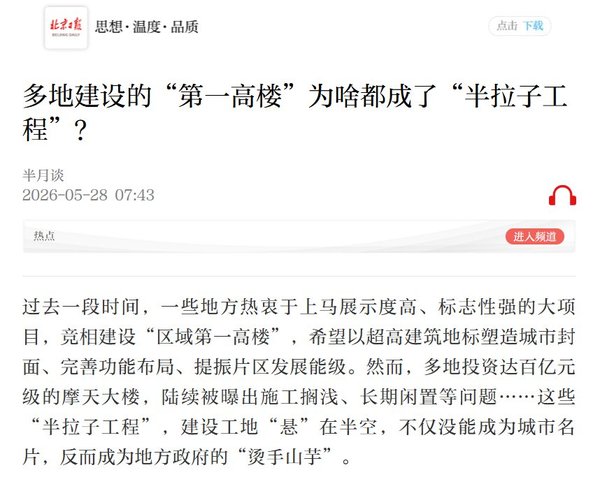
In an unprecedented display of self-criticism, Beijing Daily and Banyuetan—media outlets tightly affiliated with the Chinese Communist Party’s official organ—unleashed scathing reports. They officially deployed terms such as "urban scars (城市疤痕)," "hot potatoes (燙手山芋)," and "half-finished projects (半拉子工程)" on their pages to describe the unfinished skyscrapers scattered across China. As seen in any authoritarian regime, the fact that state-run media has permitted such direct criticism paradoxically proves that the problem has reached a level that can no longer be swept under the rug.
According to statistical data on "unfinished skyscrapers over 450 meters" circulating online, dozens of mega-tall projects across major cities—including Shenzhen, Shanghai, Guangzhou, Chengdu, Nanjing, Wuhan, Tianjin, Shenyang, Dalian, Fuzhou, and Xi'an—are currently suspended, abandoned, or effectively written off. These were buildings that once received full backing from local governments under grand slogans like "China’s Number One Tallest," "Central China’s Number One Tallest," or "The North’s Number One Tallest."
Among them, Tianjin’s Goldin Finance 117 stands as the most iconic symbol of this crisis. Beijing Daily reported, "Goldin Finance 117 in Tianjin, designed to stand 597 meters tall with 117 floors, broke ground in 2008 but saw its construction completely halted in 2015 due to the developer's financial distress." The paper added, "Left abandoned for nearly a decade, it earned the ignominious title of the 'world's tallest abandoned skyscraper.' The 18-year history of this building has come to symbolize both the collapse of the Chinese property market and the retreat of mega-tall developments." Beijing Daily further noted, "Construction has recently resumed through state-led restructuring, aiming for completion by 2027," while pointing out that "around the same time, the 468-meter Greenland Chengdu Tower (绿地蜀峰468) also announced the resumption of its construction, which had been stalled since 2023."
However, resuming construction does not automatically guarantee economic success. The South China Morning Post (SCMP) pointed out, "Analysts note that Tianjin's office market has weakened significantly since 2015. With the 530-meter Tianjin CTF Finance Centre already completed and operational, the economic viability of a second mega-tall tower remains highly uncertain." The report added, "Some analysts bluntly point out that this resumption is a product of political calculation rather than actual market demand."
The Shenzhen Shimao project delivers a shockwave of a different dimension. In 2016, the Shimao Group won the bid for the site at a record-breaking price of 23.9 billion yuan (approximately $3.3 billion USD) and announced plans to invest a total of 50 billion yuan to build a 700-meter structure—billed as "China's Number One Tallest." However, in May 2026, the state-owned enterprise China Resources Land (CR Land) acquired the site for just over 7 billion yuan, completely scrapping the skyscraper blueprint in favor of a residential complex. In just nine years, over 70% of the land value evaporated into thin air.
[The Structural Collapse of the Land Finance Model]
To grasp the deeper core of this phenomenon, one must first understand China’s unique "land finance (土地財政)" framework. This system—where local governments secure fiscal revenue by selling land-use rights to developers—has been the primary fuel powering China’s rapid growth since the 1990s.
The Asia Society Policy Institute highlighted, "Revenues from land-use right sales plummeted by more than 50% over a five-year period, dropping from 8.49 trillion yuan in 2021 to 4.15 trillion yuan in 2025." It further noted, "Local governments are trapped in a double bind: they must cope with dwindling land-sale revenues while simultaneously shouldering fiscal outlays to subsidize low-cost housing and fund the resumption of stalled residential projects."
Local government debt has swelled to unsustainable levels. The China Leadership Monitor reported, "Total local government debt, including other liabilities tied to land financing, reached $18.9 trillion USD by the end of 2025." It added, "The IMF estimates that debt held by Local Government Financing Vehicles (LGFVs) alone reached $8 trillion USD (equivalent to 47% of China's GDP) as of late 2023, with commercial banks holding 75% of that total."
The fallout from China’s real estate crisis has been catastrophic. The Evergrande Group alone accumulated over $300 billion USD in liabilities before being hit with a liquidation order by a Hong Kong court in 2024, leaving behind 1.5 million unfinished housing units and dozens of stalled construction sites across the country.
[Foreign Media Diagnose the 'Marriage of Politics and Construction']
Major Western media outlets analyze this crisis not as a simple market failure, but as a structural distortion of market logic driven by political incentives. Dlubal, a German media outlet specializing in structural engineering, analyzed that "the lack of separation between policy and construction negatively impacts both project timelines and quality." It noted that "bureaucratic delays, flawed decision-making processes, and inefficient resource allocation overlap in a structure where political ideals take precedence over independent construction supervision or quality control." Although that specific analysis targeted North Korea’s construction system, experts evaluate that it applies heavily to China's skyscraper development framework, where political goals routinely override market realities.
Professor Qiao Shitong of Duke University School of Law, in an op-ed published by a CNN affiliate, noted, "The authorities do not want unfinished projects to remain as they are because they become an eyesore to everyone." He implied that "the decision to resume construction prioritizes defusing political burdens over economic viability."
Bloomberg defined China's local government practice of skyscraper development as "a political tool to artificially inflate local GDP figures and land values." It further explained, "Behind this trend lies the central government's meritocratic cadre evaluation system, which judges local bureaucrats based on economic metrics. Since China is an authoritarian state that relies on economic performance for regime legitimacy, hitting growth targets has always been the top priority." In this equation, skyscrapers served as the most visible "proof of performance."
[The Chinese Version of the Ryugyong Hotel: Similarities and Differences]
At this juncture, major foreign media outlets frequently draw comparisons to a shared reference point: the Ryugyong Hotel in Pyongyang, North Korea. The Ryugyong Hotel was a product of Cold War-era systemic rivalry. While South Korea was preparing to host the 1988 Seoul Olympics and transitioning toward capitalist democracy, North Korea planned the 1989 World Festival of Youth and Students and declared it would build the world’s tallest hotel. The building was born entirely as a political response. CNN once described the rusty crane remaining atop the building as "a relic reminding us of the thwarted ambitions of a totalitarian state."
However, the Ryugyong Hotel, which was once listed in the Guinness World Records as the "world's tallest unoccupied building," has finally handed that ignominious title over to China's Goldin Finance 117. The title of the world’s worst abandoned skyscraper has officially migrated from Pyongyang to Tianjin.
The superficial similarities are undeniable: planning driven by a desire to show off the regime, a race for scale detached from actual market demand, reliance on and sudden cutoff of external funding, and systemic inertia that prevents an open admission of failure. These four patterns are distinctly shared across the abandoned skyscraper landscapes of both nations.
Yet, a critical difference remains. In China's case, high-ranking Tianjin municipal officials held direct consultations in January 2026 with executives from CITIC Group, China State Construction Engineering Corporation (CSCEC), and China Cinda Asset Management to salvage the Goldin Finance 117 project. Seventeen corporations have already signed lease agreements, seven of which are state-owned enterprises. This provides evidence that China still retains the capacity to clean up the mess by combining market mechanisms with state resources. In North Korea, such structural reorganization is systemically impossible.
In conclusion, China’s half-built, stalled skyscrapers are more than just physical scars of failed construction. They are towering monuments signaling the end of an era—an era where local governments grew by selling land, developers expanded by piling on debt, and the central government legitimized its regime through GDP growth rates.
In the past, China flaunted its economic confidence through soaring skyscrapers. Today, those exposed steel skeletons no longer symbolize the future. Instead, they stand as massive monuments testifying to the limits of land finance, the perils of local government debt, and the severe aftereffects of a growth model that consistently prioritized politics over economics.
Ultimately, the real test facing China is not how many skyscrapers it can manage to finish. The true trial lies in whether it can discover a new growth model for the post-land-finance era, and whether it can successfully contain the looming deflation and debt crises along the way. Today, the motionless cranes hovering over Chinese cities continue to wait for an answer to that very question.


-중국 푸단대학교 한국연구원 객좌교수
-전 EDUIN News 대표
-전 OUR NEWS 대표
-제17대 대통령직인수위원회 정책기획팀장
-전 대통령실 홍보기획비서관
-사단법인 한국가정상담연구소 이사장
-저서: 북한급변사태와 한반도통일, 2012 다시우파다, 선거마케팅, 한국의 정치광고, 국회의원 선거매뉴얼 등 50여권