
Update2026.10.24 (토)

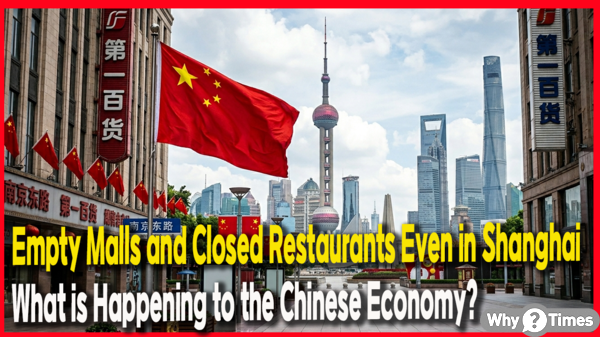
1. China's Domestic Demand Shift Falters: Even Shanghai, the Economic Capital, Could Not Hold Out
HSBC, the world’s largest bank, has slashed its outlook for Chinese consumer spending by nearly half. However, the situation on the ground is far more alarming than the raw numbers suggest. In Shanghai—long considered the beating heart of the Chinese economy—crowds are vanishing and shops are shuttering. As a consumption slump, real estate crisis, and collapsing confidence collide, warnings are mounting that China has moved beyond a simple slowdown and is entering the threshold of a structural crisis.
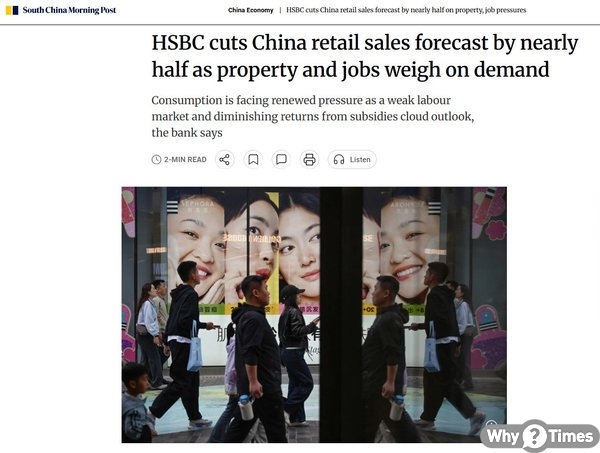
On May 23, Hong Kong’s South China Morning Post (SCMP) delivered a shocking report: "HSBC aggressively lowered its forecast for China’s 2026 retail sales growth from 5.2% to 2.8%." The immediate trigger was April’s retail sales, which grew by a meager 0.2% year-on-year—the lowest in 40 months since the 2022 COVID-19 lockdowns. This figure fell short of the 2% market expectation by less than one-tenth.
HSBC economists Erin Xin and Taylor Wang sharply pointed out:
"The April retail sales figures directly contradict Beijing's recent policy direction of rebalancing growth toward domestic consumption. The Chinese government’s trade-in subsidy program for home appliances and automobiles is losing momentum in both scale and effectiveness."
The HSBC research team diagnosed that demand for major durable goods has slumped due to the "high base effect" of the trade-in program, while the labor market remains "under pressure" and the property sector is "in a downturn." They added that indicators such as the Purchasing Managers' Index (PMI) point to labor market vulnerabilities, and youth unemployment "remains elevated" amid growing anxieties over AI replacing jobs. ING economists reached a similar conclusion, stating, "While industrial production is being driven by overseas demand, other domestic demand indicators remain generally weak."
The April shock is not an isolated incident. CNBC highlighted data from China's National Bureau of Statistics showing that auto sales plummeted 15.3%, marking the seventh consecutive month of decline. Home appliances (-15.1%), building materials (-13.8%), and furniture (-10.4%) all recorded double-digit drops. Urban fixed-asset investment also reversed course, shifting from a 1.7% gain in the first quarter to a 1.6% contraction on a cumulative January-April basis.
On the same day, Bloomberg reported that "growth slowed across all fronts in April, and investment returned to a decline," prompting major investment banks like Nomura and Société Générale to universally call for additional stimulus. On May 20, Bloomberg also reported that government spending in April suffered its sharpest cut in six months, confirming that the worst-case combination—fiscal tightening occurring simultaneously with a consumption crunch—has become reality.
2. Shanghai Crumbles: Second Retail Sales Decline in 40 Years
The "vulnerable consumption" warned of by HSBC is most vividly on display in Shanghai, the economic capital of China. In January, the SCMP reported: "Shanghai’s annual retail sales for 2024 fell 3.1% to 1.79 trillion yuan (approx. USD 246 billion)." The report noted that in the 40-plus years since 1978, Shanghai’s retail sales have declined only twice. The first instance was the result of the extreme shock of the two-month COVID lockdown in 2022; the second occurred without any external shock, driven solely by economic recession.
Recent data for January and February shows a steeper downturn. Chinese financial media outlet Caixin reported: "During this period, which includes the Lunar New Year—traditionally China’s peak shopping season—Shanghai's retail sales shrank by a real 11.1% year-on-year." Concurrently, China's household savings rate surged to 55% in 2024, the highest level recorded since 1952.
The severity of the situation was captured by a local video blogger filming the streets of Shanghai:
"There are really no people left in Shanghai. It used to be that if you came to the pedestrian street on a weekend, you could only see a sea of heads with no room to step. Now, besides security guards and shop owners, you couldn't hit a person even if you threw a stick. It's almost terrifying."
Vision Times, a US-based media outlet specializing in Chinese affairs, analyzed the phenomenon: "Shanghai is traditionally the trendsetter for Chinese consumption. If Shanghai’s figures look like this, we must assume that other cities are experiencing far more severe downturns." Indeed, while national retail sales grew by 3.5% to 4% during the same period, Shanghai moved in the opposite direction. Shanghai's slump is not just dragging down the average; it is a severe outlier.
A more fundamental warning sign than consumption metrics is demographic data. According to data released by the Shanghai Municipal Bureau of Statistics in March 2025, the city's migrant population dropped to 9.83 million at the end of 2024. After peaking at 10.48 million in 2020, it has declined for five consecutive years, falling below the 10-million threshold for the first time in history.
Vision Times noted, "Between 2020 and 2024, approximately 640,000 migrants left Shanghai, with the majority returning to their hometowns in Anhui, Fujian, and Shanxi." The logic is simple: there is no reason for people to stay in a city without jobs. Furthermore, in 2025, Shanghai recorded a natural population decline for the first time, with deaths outnumbering births.
3. Not Just a Shanghai Problem — A 'Domino Meltdown' Across Beijing, Shenzhen, and Guangdong
The "vulnerable labor market and property slump" flagged by HSBC is spreading far beyond Shanghai. In January, Vision Times described Shenzhen as "a city where six alarm bells are ringing simultaneously," revealing that in the second half of 2025 alone, roughly 1,000 restaurants closed in the Pearl River Delta region. Additionally, Shenzhen's fixed-asset investment fell by 10.9%, and real estate development investment plunged by 15.1%.
The SCMP also reported that Guangzhou and Shenzhen—the two largest cities in southern China—recorded growth rates below the national average (5.3%) in the first half of 2025. For Guangdong province as a whole, GDP growth in 2024 lingered at a near-bottom 3.5%, and remained sluggish at 3.9% in 2025.
Beijing is facing a similar plight. Reuters reported that "the monthly restaurant closure rate in Beijing is hovering between 10% and 15%." According to data compiled by Cushman & Wakefield, the average commercial real estate vacancy rate across 15 major national cities reached 11.1% in the second quarter of 2025. Nationwide, approximately 3 million restaurants went out of business over the course of 2024, hitting an all-time high.
Commenting on this trend, the Atlantic Council, a US think tank, diagnosed: "Most of China's current economic woes—including depressed consumption, collapsing confidence, shrinking investment, and falling prices—stem directly or indirectly from the collapse of the property market. Reviving domestic demand is impossible without a real estate recovery."
4. The Subtext of the 'Preventing Return to Poverty' Mandate: Beijing's Implicit Admission of Crisis
Behind HSBC's macroeconomic data lies an even deeper signal of systemic distress. In a commentary published on November 26 last year, China’s Economic Daily explicitly stated that "holding the bottom line against large-scale returns to poverty and new occurrences of poverty is the baseline task for rural revitalization," designating it as a core priority for the 15th Five-Year Plan (2026–2030).
President Xi Jinping also emphasized during his inspection of Yunnan and Guizhou in March last year that "the safety net against poverty must be as solid as an iron fortress, and a large-scale return to poverty must absolutely be prevented." This rhetoric was prominently reprinted by the People's Daily on January 9 and the China Daily on February 25 this year.
Vision Times provided an astute analysis of these statements:
"In the political vocabulary of the Chinese Communist Party, when a policy strongly forbids a specific outcome, it is a clear signal that the outcome is already occurring. Just five years after declaring victory in 2021 by claiming to have lifted 100 million rural residents out of poverty, those very achievements are now at risk of being reversed."
The World Bank estimates that as of 2026, 20% of China's population still lives on less than USD 8.30 a day. The Eurasia Group defined the core of this predicament as a "debt-deflation trap," noting that "too many companies are chasing too little demand, leading to price cuts and wage reductions; workers subsequently cut back on spending, forcing companies to lower prices even further." This underscores why HSBC's downward revision is far more than a routine adjustment of numbers.
5. Why a Way Out Remains Elusive: Structural Issues Heavier than Statistics
In relation to these developments, CNBC pointed out that the crux of the issue is that China is not suffering from a standard economic recession, but is instead trapped in three simultaneous structural snares:
1) The Real Estate Trap
Reporting on the opening of the National People's Congress (NPC) on March 5, CNN noted that Beijing set its lowest economic growth target in decades at 4.5% to 5%. CNN observed that "housing, manufacturing, and infrastructure investment fell simultaneously for the first time in 30 years," adding that the real estate market is in its fifth year of crisis, with protracted declines in investment and sales weighing heavily on consumer confidence and spending. CNBC reported that real estate investment plummeted by 17.2% in 2025, while the Producer Price Index (PPI) extended its deflationary streak to 41 consecutive months.
2) The Political Trap
In its report on the Top 10 Risks for 2026, the Eurasia Group predicted: "With the 21st Party Congress approaching in 2027, Xi Jinping will prioritize political control and technological hegemony over consumption stimulus and structural reform." The report concluded that while Beijing possesses the tools to mitigate the crisis, it will choose not to deploy them, leaving living standards to deteriorate, ripple effects to spread overseas, and the world's second-largest economy stuck in a trap of its own making. The Asia Society Policy Institute (ASPI) similarly forecast that Xi will resist deep reforms that could boost household income or revitalize the private sector, suggesting that the political timeline leading up to the 2027 Party Congress is choking off the window for economic reform.
3) The Confidence Trap
The Atlantic Council assessed: "The Chinese government has suppressed the private sector for five years. As state-owned enterprise (SOE) favoritism and Party intervention stifle the market economy, confidence among consumers and businesses has already hit rock bottom." Citi Research projected that China's growth pattern is calcifying into a K-shaped trajectory—where the new economy and the supply side lead, while the old economy and demand lag behind—predicting that a decisive catalyst to shift this structure is unlikely to emerge within 2026.
[Conclusion: The Reinforcing Vicious Cycle]
These three traps reinforce one another. The real estate collapse drains local government revenues, leading to cuts in public services and civil servant wage reductions, which further freezes consumer sentiment. Political constraints block necessary structural reforms; without reform, confidence cannot return; and without confidence, consumption cannot be revived.
The phrase "Shi Shi Jiu Kong" (十室九空; literally 'nine out of ten rooms are empty,' symbolizing widespread, severe destitution) seen in the underground passageways of Shanghai Hongqiao Railway Station serves as the most visible manifestation of this vicious cycle.
This is precisely why HSBC’s downward revision is not merely a correction of a single data point. If even the nation's economic capital cannot extricate itself from this mire, the fundamental question regarding the Chinese economy must shift: it is no longer a matter of when it will recover, but what kind of structural reform is even possible.

-중국 푸단대학교 한국연구원 객좌교수
-전 EDUIN News 대표
-전 OUR NEWS 대표
-제17대 대통령직인수위원회 정책기획팀장
-전 대통령실 홍보기획비서관
-사단법인 한국가정상담연구소 이사장
-저서: 북한급변사태와 한반도통일, 2012 다시우파다, 선거마케팅, 한국의 정치광고, 국회의원 선거매뉴얼 등 50여권