Update2026.10.24 (토)


[From the Rocket Force Purge to the Collapse of Defense Enterprises: Xi Jinping’s Military Rise Shaken]
China has fiercely trumpeted its military rise backed by massive defense spending, but the internal reality presents a starkly different picture. Nuclear missile fuel tanks were filled with water, and fake numbers piled up in the ledgers of defense enterprises. As key figures—ranging from the mastermind behind the J-20 stealth fighter development to top executives of defense conglomerates—fall from grace one after another, warnings are mounting that structural corruption within the People's Liberation Army (PLA) is undermining military modernization itself. Xi Jinping’s ambition to build a massive military superpower is being put to the test by a fatal internal vulnerability: corruption.
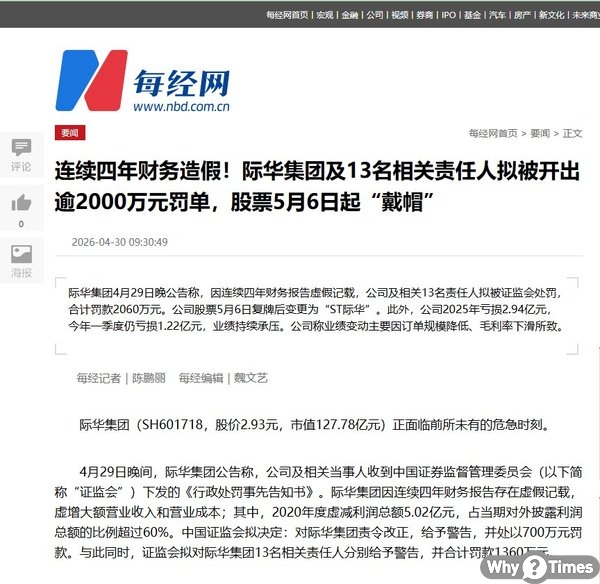
China's National Business Daily drew significant attention by reporting, "The four-year accounting fraud scandal at Jihua Group—often dubbed 'China’s No. 1 Military Procurement Company'—is not an isolated incident." The report highlighted that "from corruption filling Rocket Force missile fuel tanks with water, to the investigation into misconduct by the J-20 stealth fighter’s chief designer, and the death sentence handed down to the head of an aerospace defense giant, structural corruption has been rampant across China's defense industry for decades. Consequently, international assessments are increasingly concluding that the PLA's actual readiness and operational capabilities have been severely compromised."
The National Business Daily further noted, "The severity of the issue does not lie solely in the monetary scale. Jihua Group has been the backbone of the core military supply chain, commanding a 50% market share in providing uniforms and clothing for the Chinese military and the Armed Police. The fact that a company supplying military uniforms, protective gear, and field logistics supplies has spent years fabricating its performance raises fundamental questions about the reliability of data across the entire military procurement system."
['Water in Nuclear Missiles': The Shockwave of the Rocket Force Collapse]
While the Jihua Group scandal represents corruption within the logistics supply system, the PLA Rocket Force (PLARF) corruption scandal that erupted in 2023 struck at the very heart of China’s nuclear deterrent and capabilities. The War Zone reported, "In mid-2023, Chinese authorities announced a replacement of the Rocket Force leadership and launched a corruption probe tied to military equipment procurement." It added, "The backdrop of this purge included US intelligence assessments that some nuclear missile fuel tanks had been filled with water instead of actual fuel."
Bloomberg also reported, "US intelligence gathered that missile silo lids constructed in western China were structurally defective, which could impede successful missile launches." The outlet noted, "This assessment cast a severe shadow over whether Xi Jinping’s nuclear force modernization policies had been internally compromised, further raising profound questions regarding internal confidence in the Rocket Force's capabilities."
The result was an unprecedented personnel upheaval. Since July 2023, approximately 15 high-ranking military and defense officials—including Defense Minister Li Shangfu, the commander and political commissar of the Rocket Force, and numerous general-ranking officers and defense industry leaders—have been purged by Xi Jinping. On December 27 of the same year, the Standing Committee of the National People's Congress (NPC) unseated nine high-ranking officials, including several tied to the Rocket Force, without providing any official explanation.
Notably, many of those purged in 2023 held senior positions overseeing nuclear and conventional land-based missile programs. The Arms Control Association (ACA) analyzed that "this series of purges amplifies doubts surrounding missile reliability and operational readiness."
The Rocket Force scandal was not an isolated event, but a symptom of structural fractures within the highest echelons of the Chinese military command. Since 2022, the Central Military Commission (CMC) has undergone repeated turbulence at its senior leadership level, driven primarily by pervasive corruption within the PLA. General Li Shangfu, who previously headed the Equipment Development Department before being appointed CMC Defense Minister, was removed from office in October 2023 under allegations of corruption related to weapon procurement. Admiral Dong Jun, appointed as the new Defense Minister in December 2023, was unusually excluded from the CMC membership. In November 2024, Admiral Miao Hua, Director of the CMC Political Work Department, was suspended from duty on corruption charges.
The Pentagon's 2025 report clearly outlined this trend with metrics: "Out of the 42 military Central Committee members elected at the October 2022 Party Congress, eight—or 19%—had already been dismissed or placed under investigation. Following the large-scale purges in the Rocket Force and missile industry in 2023, investigations expanded in 2024 into the nuclear industry, shipbuilding, and aviation sectors. The number of state-owned defense enterprise chiefs under official investigation doubled from three in 2023 to six in 2024."
In October 2025, eight high-ranking generals, including He Weidong, former Vice Chairman of the Central Military Commission, were expelled from the Communist Party on corruption charges. He Weidong had held the second-highest military position in China.
[Investigation into J-20 Chief Designer and Head of AVIC: The Aerospace Defense Industry in Crisis]
Moving into 2025 and 2026, the ripples of corruption spread to the heart of China's cutting-edge aerospace weapons programs. The South China Morning Post (SCMP) reported, "In January 2025, Yang Wei, the chief designer of the PLA's J-20 stealth fighter, and Hao Zhaoping, General Manager of the Aviation Industry Corporation of China (AVIC), were placed under investigation, resulting in the removal of their profiles from the AVIC website." The report emphasized that "Yang Wei was a pivotal figure who spearheaded the development of China’s fifth-generation fighter jet."
SCMP continued, "In March 2026, this case reached a dramatic climax with a death sentence. Tan Ruisong, the former Chairman of AVIC—a state-owned defense giant that holds a virtual monopoly over Chinese military aircraft production—was sentenced to death with a two-year reprieve on charges of bribery, embezzlement, insider trading, and leaking state secrets." The core of the charges involved accepting over 613 million yuan (approximately $90 million) in bribes. The court confiscated all his personal assets, determining that Tan had illicitly acquired over 700 million yuan across various roles during his 30-year tenure in the aviation industry.
SCMP further stated, "Tan Ruisong’s successor as AVIC Chairman, Zhou Xinmin, was also dismissed. Simultaneously, nuclear weapons researcher Liu Canli and Luo Qi, Chief Engineer of the China National Nuclear Corporation (CNNC)—the nation's sole supplier of fuel for its nuclear forces—were stripped of their NPC seats. The successive downfalls of top-tier leaders overseeing the aviation, nuclear, and missile sectors are fueling growing concerns that the very continuity of advanced weapons programs is faltering."
[SIPRI Report: While the World Arms Itself, Only China Moves in Reverse]
The fallout of this structural corruption is also evident in the cold data of defense revenue. In December 2025, the Stockholm International Peace Research Institute (SIPRI) released its report on the Top 100 arms-producing and military services companies. According to the report, "Global defense revenues grew by 5.9% to reach a record high of $679 billion, fueled by the wars in Ukraine and Gaza and escalating geopolitical tensions in 2024. However, the Asia-Oceania region was the only territory to register an overall revenue decline, and this reversal was driven entirely by China." SIPRI noted that "the culprit was a 10% drop in the combined revenue of eight Chinese defense firms, among which NORINCO—China's largest producer of land warfare weapons—saw a staggering 31% plunge." During the same period, defense revenues soared by 40% in Japan, 31% in South Korea, and 8% in India.
Nan Tian, Director of the Military Expenditure and Arms Production Programme at SIPRI, evaluated: "Widespread allegations of corruption related to China’s arms procurement led to the deferral or cancellation of major contracts in 2024. This deepens uncertainties regarding the status of China’s military modernization efforts and the timeline for its new capabilities to materialize."
This downturn is particularly anomalous given that it occurred while China's defense budget marked its 30th consecutive year of growth. The paradoxical phenomenon—where budgets expand while actual revenues and weapon contracts of defense enterprises shrink—proves that structural corruption is taking its toll.
[Warnings from IISS and the Pentagon: "Severe Void in Command Structure and Combat Capability"]
The London-based International Institute for Strategic Studies (IISS) and the US Department of Defense are analyzing this issue in direct connection with China's capability to invade Taiwan by 2027. In its 2026 annual Military Balance report, the IISS stated, "China's ongoing military corruption purges are creating a severe void in its command structure and are highly likely to hinder the PLA's rapid modernization." It explicitly noted, "From an organizational standpoint, until these vacancies are filled, the PLA is operating with critical deficiencies in its command structure."
The Pentagon's 2024 China Military Power Report also pointed out that "Xi Jinping’s extensive purges have disrupted key modernization initiatives, including the missile program."
The reason experts view the Jihua Group scandal as a strategic crisis rather than a mere accounting fraud lies in the unique nature of military logistics. In modern warfare, the key to sustaining combat lies just as much in reliable rear-area logistics as it does in troop numbers and weaponry. If a defense contractor supplying uniforms and protective gear has spent years reporting fabricated inventory and production capacities, no one can accurately gauge the actual volume of physical resources available for mobilization in an emergency.
Water in Rocket Force missile tanks, an AVIC chairman’s 30 years of bribes, and Jihua Group’s falsified ledgers may manifest in different military sectors, but they point to a single, shared structural reality. Within a closed military-industrial complex where colossal budgets are executed without independent oversight or accountability, actors have learned that doctoring numbers is safer than producing actual results. Consequently, China faces a paradoxical situation where it pours massive sums into defense, yet those funds fail to translate into actual combat capability.
SIPRI warned that "a convergence of delayed defense contracts, financial pressures, and declining export demand could derail Beijing's military modernization schedule." Analysts project that this could force a revision of previous assessments that set 2027 as the target deadline for China to achieve the capability to coerce or occupy Taiwan.
Jonathan Czin, a former CIA China analyst, told the British daily The Telegraph, "When you look at the scale and scope of it, it’s breathtaking." Some analysts argue that Xi Jinping’s anti-corruption campaign serves a dual purpose: rooting out military procurement malpractice while functioning as a political tool to test loyalty. However, regardless of the underlying political intent, the cascading downfall of top defense talent, sequential delays in arms contracts, and the collapse of trust in the military supply chain inflict damage that cannot be repaired overnight. Ultimately, the issue is not money. Military power built on fabricated numbers does not work on the battlefield. The most dangerous enemy to China's military rise may not be external, but internal.
-중국 푸단대학교 한국연구원 객좌교수
-전 EDUIN News 대표
-전 OUR NEWS 대표
-제17대 대통령직인수위원회 정책기획팀장
-전 대통령실 홍보기획비서관
-사단법인 한국가정상담연구소 이사장
-저서: 북한급변사태와 한반도통일, 2012 다시우파다, 선거마케팅, 한국의 정치광고, 국회의원 선거매뉴얼 등 50여권