
Update2026.10.24 (토)

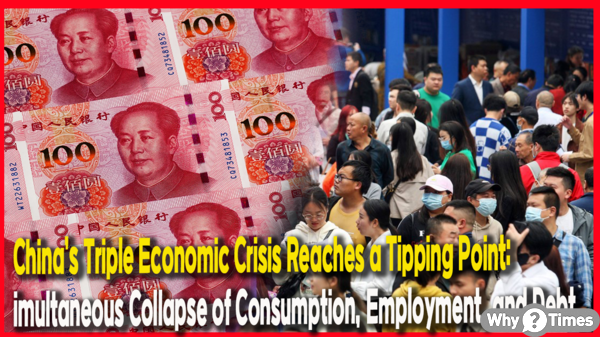
[0.2%—The Reality of a Consumption Collapse Revealed by a Single Digit]
Warnings are mounting that the Chinese economy has entered a structural turning point as three major crises—stagnant consumption, youth unemployment, and a local government debt explosion—converge simultaneously. Consumption indicators are falling short of expectations, the real estate slump is becoming protracted, and experts point out that the youth employment problem is far more severe than official statistics suggest. International organizations are also universally raising alarms over deflationary pressures and slowing growth. The core issue is that the current crisis is not a mere cyclical downturn, but a stark revelation of the limits inherent in China’s growth model itself.
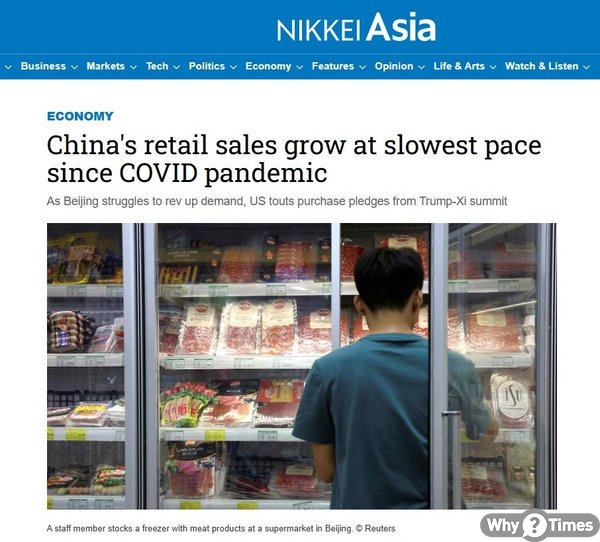
Japan’s Nikkei Asia reported on May 18, “China’s retail sales growth slowed to 0.2% year-on-year in April, missing expectations and suggesting that policymakers have yet to find a solution to revive depressed consumer confidence in the world’s second-largest economy.” It further noted, “Retail sales, considered a key gauge of consumer sentiment, slowed from a 1.7% increase in March and fell short of the 2% growth forecast in a Reuters poll, marking the lowest figure since December 2022 during the COVID-19 pandemic.”
Nikkei Asia continued, “It is not just consumption that has collapsed,” pointing out that “Industrial production in April increased by 4.1% year-on-year, but this was a sharp drop from 5.7% in March and significantly below the market expectation of 5.9%, representing the slowest factory output growth since July 2023.” It also highlighted that “Fixed-asset investment also contracted by 1.6% on a cumulative basis from January to April 2026. The simultaneous underperformance of these three indicators—consumption, production, and investment—cannot be explained by mere seasonal factors.”
Commenting on this, Yuhan Zhang, a senior economist at the Conference Board’s China Center, analyzed: “Retail sales growth from January to April shows that household demand remains weak, with consumers concentrating their spending only on specific discretionary categories. The willingness to purchase big-ticket items linked to housing and income is extremely low.”
[Deflation Trap—Structural Traps Warned by International Organizations]
The collapse of consumption indicators is not a short-term shock but the manifestation of a long-term deflationary structure. In its annual Article IV consultation report on China published in February 2026, the IMF noted, “Private domestic demand remains sluggish, and despite a slight rebound in core inflation, headline inflation has continued to be suppressed, averaging 0% in 2025, while the GDP deflator continued its downward trend.”
The IMF also projected, “China’s GDP growth rate in 2026 is expected to slow to 4.5%, reflecting the long-term impact of tariffs and trade policy uncertainties,” predicting that “deflationary pressures will persist going forward.” More serious is the medium-to-long-term outlook. The IMF estimated, “If a severe shock comparable to the global financial crisis occurs, prolonged deflation could ensue, causing GDP to fall by 5.4% relative to the baseline over five years.” It further warned, “Without fundamental reforms, medium-term growth will gradually decline to around 3.5% by 2030 due to a shrinking labor force, diminishing returns on investment, and slowing productivity.”
The World Bank shares the same concerns. In a recent report, it diagnosed that “the prolonged slump in the real estate sector, depressed consumer sentiment, deflationary pressures stemming from weak domestic demand, and uncertainties arising from shifting global trade policies are serving as key headwinds for the Chinese economy,” urging that “structural reforms to transition toward balanced, high-quality growth are urgent.”
Eurasia Group used a more direct expression, labeling this trend a "deflation trap." It analyzed, “China’s deflationary spiral will deepen in 2026, and Beijing will do nothing to stop it,” adding, “President Xi Jinping will prioritize political control and technological hegemony over consumption stimulus or structural reform ahead of the 21st Party Congress in 2027.” It also warned, “While China’s housing prices have been falling for four and a half years—causing household wealth destruction on par with the 2008 U.S. financial crisis—the pace of decline is actually accelerating.”
[Real Estate Collapse—Five Years of Evaporating Household Wealth]
The epicenter of the Chinese economic crisis is the real estate market. Property sales volume has plummeted by 65% from its 2020 peak, and construction activity has shriveled to its lowest level since before 2000, registering a 19.9% decline compared to 2024. Signs of the market hitting rock bottom are nowhere to be seen.
In this regard, the Asia Society stated, “Revenue from the transfer of state-owned land use rights plummeted by more than half, from 8.49 trillion yuan in 2021 to 4.15 trillion yuan in 2025.” It explained, “Under China’s fiscal system, where revenues are concentrated at the center but spending responsibilities are borne primarily by local governments, this collapse in revenue has directly hit local government finances.” The Asia Society further noted, “Given that housing is the primary store of wealth for Chinese households, the decline in property values is forcing households to aggressively increase savings and cut back on consumption.”
Bloomberg reported, “Vanke, formerly China’s second-largest property developer, recorded a record annual loss of 49.5 billion yuan (approximately $6.8 billion) in 2024,” adding that “this starkly illustrates the severity of China’s real estate woes.” Vanke is currently undergoing formal debt restructuring procedures. Meanwhile, Evergrande has already been delisted from the Hong Kong Stock Exchange.
[The Double Reality of Youth Unemployment—The Gap Between Official Stats and the Ground]
The employment crisis runs even deeper. According to China’s National Bureau of Statistics, the surveyed urban unemployment rate in February 2026 hit a six-month high of 5.3%. However, analysts argue that the actual situation is far worse due to significant data gaps.
The youth unemployment metric itself is a subject of controversy. Authorities expect roughly 12.7 million students to graduate in 2026, an increase from the previous year. Many graduates face a highly competitive labor market where traditional industries fail to meet the demand for jobs. Meanwhile, graduates preparing for postgraduate entry exams or civil service exams are not counted as unemployed, meaning the statistics fail to accurately reflect reality.
Furthermore, China’s more than 300 million migrant workers constitute a core labor force in urban and industrial sectors, yet they remain outside the scope of official unemployment statistics. Without comprehensive data on informal employment, migrant workers, and discouraged job seekers, it is difficult to grasp the full picture.
Attempts have been made to fill this gap. Some analyses suggest that if out-of-school youth who choose to "lie flat" (tangping)—refusing to seek employment—are included, the youth unemployment rate reaches nearly 40%, which is double the officially announced figure.
[The Neologism 'Grand View of Employment'—Wordplay Masking China’s Crisis]
As the severity of the employment crisis escalates, the Beijing authorities have resorted to coining new terminology. The Chinese Communist Party (CCP) authorities have previously sugarcoated the unemployment situation with neologisms such as "slow employment" (manjiuye) and "flexible employment" (linghuojiuye), and have recently introduced the concept of the "Grand View of Employment" (dajiuyeguan). While the action plan distributed by the State Council’s Leading Group for Promoting Employment includes 18 measures, it cannot escape criticism for focusing solely on superficial stabilization and propaganda to signal that jobs are fine through publicly released figures, without offering any structural remedies.
While boosting consumption has been cited as the top priority for policymakers for several years, actually inducing consumers to spend has become an uphill battle. Growth is heavily concentrated in service sectors such as tourism, concerts, and sporting events, while spending on durable goods shows no significant increase.
[A Structure Without an Exit—No Growth Without Reform]
What experts universally point out is that what China is facing today is not a simple downward phase of a business cycle. The IMF warned, “State-led, debt-fueled investment and unnecessary industrial policy support have led to low productivity, the accumulation of financial vulnerabilities, and overcapacity in certain tradable sectors,” adding that “structural challenges such as an aging population will also weigh on the economy over the medium term.”
The Rhodium Group, a U.S. private think tank, went a step further to question China’s actual economic growth rate, pointing out, “An economy that experiences 10 consecutive quarters of deflation while reporting 5% real GDP growth is historically unprecedented.” This implies that a lack of transparency is making the diagnosis of the problem itself difficult.
The economic publication China Briefing analyzed, “The root cause of the consumption slowdown is not a lack of liquidity, but the collapse of consumer confidence itself.” It added, “The binding constraint on household demand is not money, but confidence, and confidence cannot be restored through policy announcements alone.”
Reuters also pointed out, “In the past, China overcame crises by expanding investment and injecting massive liquidity, but today, the old methods are not yielding the same results.” It noted that “the greatest crisis for the Chinese economy is not the growth rate figure itself, but the weakening of confidence in the future,” suggesting that “this is increasingly likely to be the most dangerous warning siren currently facing the China economy.”
The middle class, which holds the key to consumption recovery, is trapped in a vicious cycle: their wealth is locked up in falling housing prices, they avoid spending due to job insecurity, and they are increasing precautionary savings due to gaps in the social safety net. The conclusion reached in unison by international organizations and research institutes—such as the IMF, the World Bank, and the Eurasia Group—is clear: without structural reform, there is no escape from deflation for the Chinese economy. The problem is that such reform runs directly counter to the political control logic of the current regime.
In other words, the CCP has historically engineered GDP figures by mobilizing massive bank loans and debt to build ghost high-speed rail stations in the remote interior regions. Now that the real estate bubble has burst and tax revenues have dried up, the interest on this massive debt bomb is returning as a boomerang in the form of hiked public transit fares for ordinary citizens. The reality of infrastructure growth, once touted as a "national miracle," has been exposed to broad daylight as a massive, unsustainable financial scam.
In a liberal democracy and market economy system, a change of government and drastic structural reforms would have already taken place. However, the Xi Jinping one-man dictatorship, rather than admitting failure, is scraping by by resorting to statistical manipulation, regulatory tightening, and ideological control. The middle class is collapsing, the youth are choosing to "lie flat," and capital is fleeing the mainland. This is the inevitable end-stage scenario that a communist planned economy is bound to face.


-중국 푸단대학교 한국연구원 객좌교수
-전 EDUIN News 대표
-전 OUR NEWS 대표
-제17대 대통령직인수위원회 정책기획팀장
-전 대통령실 홍보기획비서관
-사단법인 한국가정상담연구소 이사장
-저서: 북한급변사태와 한반도통일, 2012 다시우파다, 선거마케팅, 한국의 정치광고, 국회의원 선거매뉴얼 등 50여권