
Update2026.10.24 (토)

[A "Sandcastle" Performance Revealed After Removing the Subsidy Life Support]
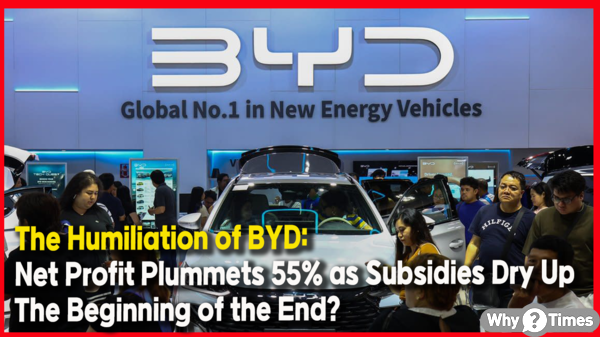
BYD, the electric vehicle giant that grew rapidly on the back of massive Chinese government subsidies, has entered a period of severe management crisis. Hit directly by sluggish domestic demand and the termination of subsidies, its first-quarter net profit was cut in half. This can be described as the most serious complex crisis since BYD's founding, as three crises—the collapse of the domestic market, the disappearance of profitability, and the deterioration of financial health—are converging simultaneously, making the cracks in the "Invincible Myth" a reality.
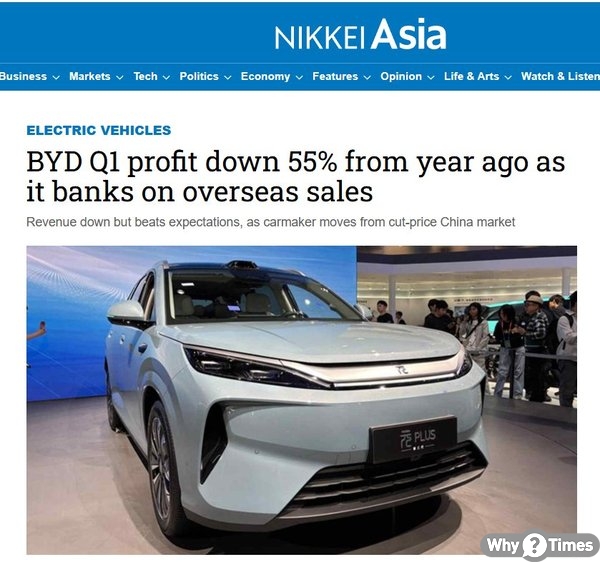
On the 29th, Japan's Nikkei Asia reported, "BYD, the Shenzhen-based EV powerhouse, stated in a filing to the Securities Regulatory Commission on the 28th that its net profit for the first quarter (Jan–Mar) recorded $4.1$ billion yuan ($600$ million USD), a $55.4\%$ decrease compared to the same period last year." The report added, "Since the reduction of government subsidies earlier this year, consumers have taken a wait-and-see approach, sending shockwaves through the entire industry."
In fact, it is truly shocking that the growth of BYD, which had threatened the global market under the full support of the Chinese Communist Party, is now deflating like a bubble. Nikkei Asia pointed out, "Looking at BYD's announced Q1 results, net profit was limited to $4.1$ billion yuan, down more than half ($-55.4\%$), and revenue also decreased by $11.8\%$ to $150.2$ billion yuan." It further noted, "The profit decline for four consecutive quarters suggests that the crisis BYD faces is not a temporary supply-demand imbalance, but an entry into a stage of structural collapse."
Nikkei highlighted, "The primary reason for this rapid fall is the Chinese government's 'withdrawal of subsidies.' BYD, which had survived on tax exemptions and direct grants, lost its price competitiveness and crumbled helplessly as soon as subsidies were halted early this year. Consumers began to turn away from EVs without government support, leading directly to inventory accumulation and decreased utilization rates."
According to data from the China Association of Automobile Manufacturers (CAAM), the drop in New Energy Vehicle (NEV) sales for the first quarter reached $23.8\%$, indicating that the entire industry has entered a 'Death Valley' where they are falling together.
[Driven Out of the Home Market: Market Share Falls Below 10%, Overtaken by Geely]
The epicenter of BYD’s crisis is the Chinese domestic market. According to a report by the Korea Automotive Technology Institute (KATECH), BYD's market share in the Chinese passenger car market plunged to $7.1\%$ (191,000 units) in January and February of this year. BYD's annual share peaked at $15.5\%$ in 2024 after reaching $7.7\%$ in 2022 and $11.5\%$ in 2023, but it began to bend at $14.4\%$ in 2025, and the downward trend has accelerated this year. Furthermore, there is a fact even more shocking than the figures: as of Jan–Feb, Geely Automobile (289,000 units) overtook BYD to become number one in the Chinese domestic market. It is a humiliation for BYD to lose its top spot to a competitor in its home market for the first time in years.
Total NEV sales in China for the first quarter also plummeted by $23.8\%$ year-on-year. Among them, BYD fell the deepest. This is because the Plug-in Hybrid (PHEV) segment, which accounts for $60\%$ of its total sales, was hit directly. As the Chinese government shifted from exempting EV acquisition tax to imposing a $5\%$ tax starting in 2026 and changed the method of paying subsidies for replacing old cars, PHEVs with a pure electric range of less than 100km were completely excluded from the purchase tax subsidy. Li Yanwei, a member of the China Automobile Dealers Association, said, "Short-range models have lost the benefits of the policy." Indeed, BYD's PHEV sales in China plummeted $62\%$ year-on-year to 135,000 units in the first quarter. Data from the China Passenger Car Association (CPCA) shows that BYD's domestic market share was $26\%$ as of March, a loss of 7 percentage points in just one year
[A Bleeding Price War: Forced into a Loss-Making Structure]
The defensive strategy BYD chose to protect its market share was price reduction. However, this led to a vicious cycle that further eroded profitability. According to Chinese auto market data compiled by Bloomberg, BYD's average price cut reached a record high of $10\%$ last March. Competitors like Geely and Chery have also joined the discount offensive, increasing the pressure. Industry insiders predict that "the discounting trend will not stop until next year."
What is more concerning is that even radical discounts are not stimulating sales as effectively as they did in the past. BYD's domestic sales in China have shown a downward trend for seven consecutive months. Even when prices are lowered, consumers are not opening their wallets. The New York Times (NYT) analyzed that "with intensified competition lowering profitability, reduced subsidies, and faster production cycles, it has become an environment where it is difficult for any company to maintain a lead for a long time." Scott Kennedy, a senior advisor at the Center for Strategic and International Studies (CSIS), warned that the Chinese auto industry has entered a 'war situation' and that the number of companies—currently in the hundreds—must be drastically reduced for long-term survival. Even Wang Chuanfu, Chairman of BYD, publicly lamented that "the Chinese auto industry has entered a stage of brutal elimination."
The fundamental cause of this war is structural overcapacity. According to the China Automotive Technology and Research Center, China's annual automobile production capacity reaches $55.5$ million units, but domestic sales are only about $23$ million units. This is about half the factory utilization rate, falling far short of the $70–80\%$ utilization typically required to reach the break-even point. A structure where one loses money the more one sells is weighing down the entire industry, and BYD is no exception.
[World No. 1 BYD, Greatest Crisis… A Warning from the Worst Report Card in 6 Years]
Coupled with worsening profitability, unusual signals are flashing regarding BYD's financial health. BYD's net debt-to-equity ratio, which had remained negative for four consecutive years, has soared to $25\%$. As the burden of debt and the decrease in sales coincided, profitability was severely damaged, and annual profit decreased for the first time since the COVID-19 pandemic.
A deeper problem is the hidden debt structure that does not appear on the surface. Hong Kong-based research firm GMT Research pointed out that BYD's actual net debt reaches $60$ trillion yuan and that it is hiding debt on its financial statements through a supply chain finance method that delays payments to suppliers for more than 275 days on average. BYD operates a unique bill system called 'Dilian,' where maturity dates reach 8 to 9 months, or even a year, meaning suppliers may receive payment a year later in the worst-case scenario. GMT Research is the same institution that warned early about the insolvency of the Chinese real estate giant Evergrande Group in 2021. The fact that BYD earned the dishonorable nickname "The Second Evergrande" reflects the market's anxiety over this financial structure.
[Overseas Exports: A True Savior or a Temporary Fix?]
BYD has pulled out the card of offsetting domestic sluggishness with overseas sales. Export volume in the first quarter reached 321,165 units, up $56\%$ year-on-year, and $46\%$ of total sales were generated abroad. The annual overseas sales target was also raised from $1.3$ million to $1.5$ million units. It is true that high oil prices caused by Middle East conflicts have stimulated global EV demand, creating a favorable environment for BYD.
However, skepticism remains as to whether overseas exports can cover the structural crisis. Bill Russo of Automobility warned, “This transition does not come without costs. Volatility in both market share and profitability will increase, clashing with investor expectations.” Morgan Stanley estimated that "used cars with less than 50km of mileage and within 3 months of release account for about $13\%$ of the total used car market in China, or $19.6$ million units," suggesting that the actual sales performance of Chinese automakers, including BYD, may be exaggerated. Even in overseas markets, structural variables such as Europe's tariff barriers, U.S. import restrictions, and local certification issues remain unresolved.
A report by KATECH analyzed that BYD’s existing market dominance has weakened due to competitors’ improved technology and the release of similar models. It also noted that the change in the Chinese government's 'Trade-in' (Yiguhuanxin) support method from a fixed amount to a fixed rate reduced benefits for relatively low-cost vehicles. The policy landscape of the low-end entry-level EV market, which was the core business foundation of BYD, has changed.
[BYD's Growth Model at the Limits of the Chinese EV Industry Model]
BYD's crisis is seen as a signal that reveals the limits of the entire Chinese EV industry model, beyond the performance slump of a single company. Hundreds of companies that grew rapidly in the greenhouse of government subsidies are being pushed to the edge of a cliff as subsidies are cut. The restructuring of the entire EV industry has already begun. In 2023, there were more closures (16) than start-ups (13) among EV companies in China, and major brands like Jiway (a Baidu-Geely joint venture) and Neta have already shut down.
BYD is still the world's number one EV sales company. Its technological competitiveness in areas like ultra-fast charging, Blade batteries, and autonomous driving platforms remains valid to some extent. However, now that the three crises of domestic collapse, disappearing profit, and financial opacity are manifesting simultaneously, the belief in the "Unbreakable Myth" is now on the test. As the NYT diagnosed, "The era of easy growth has ended due to intensified competition and shortened production cycles," and the road ahead for BYD is a rough one, unlike anything before.
In this situation, the overseas expansion of Chinese companies will become increasingly difficult amidst the global supply chain reorganization led by the United States. It is questionable how long a company that grew through technology theft and unfair competition via subsidies can survive in a market that complies with global standards. Ultimately, BYD's earnings shock is a signal that the 'bubble' of Chinese EVs has begun to burst.
South Korea must also thoroughly prepare for this 'push-out' style offensive of Chinese EVs. We should not be enticed by low-priced volume offensives but rather secure true competitiveness through technological cooperation with allies who share our values. The Chinese EV shock is a crisis for us, but at the same time, it is an opportunity to filter out insolvent Chinese companies from the market.
The EV empire BYD, built under the protection of the Chinese Communist Party, has now reached the threshold of growth. The end is fixed for a company that has grown by watching the Party's mood instead of through transparent management and market competition. BYD's earnings shock in the first quarter is not just a drop in numbers, but a death knell announcing the end of the "Chinese EV Myth."


-중국 푸단대학교 한국연구원 객좌교수
-전 EDUIN News 대표
-전 OUR NEWS 대표
-제17대 대통령직인수위원회 정책기획팀장
-전 대통령실 홍보기획비서관
-사단법인 한국가정상담연구소 이사장
-저서: 북한급변사태와 한반도통일, 2012 다시우파다, 선거마케팅, 한국의 정치광고, 국회의원 선거매뉴얼 등 50여권