
Update2026.10.24 (토)

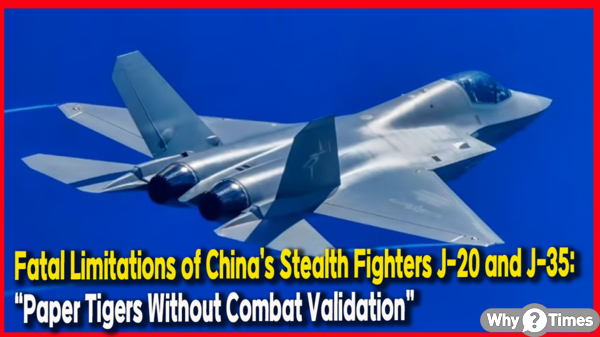
[Appearance achieved through tech theft and imitation, but plagued by engine defects and zero combat data]
Although China has leaped into the ranks of the world's top air powers by simultaneously deploying the 5th-generation stealth fighters J-20 and J-35, both models are facing harsh criticism from Western military experts regarding their actual effectiveness due to a complete lack of combat data to prove their performance in high-intensity engagement scenarios.
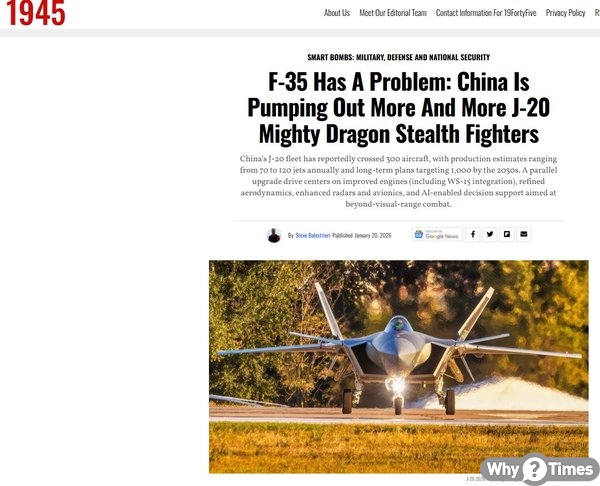
19FortyFive, which provides defense and national security content authored by world-class experts, recently reported, “The Chinese Air Force and Naval Air Force are rapidly expanding the scope of their 5th-generation stealth power, led by the J-20 ‘Mighty Dragon’ and the J-35. Looking only at surface-level figures and specifications, China’s leap is impressive.” The report added, “The number of J-20s held has already exceeded 300 units, and upgrade work including improved engines, next-generation avionics, and AI integration is continuously being carried out.”
19FortyFive continued, “However, military analysts agree that the decisive criterion for a fighter's actual combat capability is 'combat validation,' not specifications or production volume. In this regard, the J-20 and J-35 are facing the final hurdle they have yet to cross.”
[The J-35 Reborn as a Carrier-Based Aircraft, a Core Asset of Naval Aviation]
The development path of the J-35 is distinctly different from the J-20. Its predecessor, the FC-31 'Gyrfalcon,' was a 5th-generation platform for international export developed by Shenyang Aircraft Corporation with its own funds. However, as the Chinese Naval Air Force's demand for a new generation of carrier-based stealth aircraft grew rapidly, the FC-31 platform underwent a complete redesign and evolved into the J-35. Standard carrier-based specifications such as folding wings for carrier operations, reinforced landing gear, launch bars for catapult launches, and arrestor hooks were largely reflected, and both carrier-based and land-based variants were developed side-by-side. Chinese state media officially confirmed that the J-35 was formally deployed to the Chinese Naval Air Force and Air Force in 2025.
However, technical doubts surrounding the J-35 are also significant. In early 2026, Chinese state broadcaster CCTV released a broadcast promoting the third aircraft carrier, Fujian, showing the J-35 taking off and landing, but this video actually backfired. Regarding this, 19FortyFive pointed out, “This is because military experts confirmed that the old WS-21 engine was installed instead of the initially expected new WS-19 engine. With this configuration, it can only perform combat for a mere 7 minutes at a position 900 kilometers away from the carrier.”
19FortyFive also criticized, “Considering that one of the core competitive advantages of a stealth fighter is sufficient cruising range and loitering time, such engine limitations raise fundamental questions about the J-35’s practical utility.”
[The Reality of Stealth Performance, Between External Evaluation and China’s Claims]
External evaluations of stealth performance are mixed. Some studies based on radar simulations and external analysis conclude that both models possess a significant level of low-observable design. The J-20’s canard configuration, which was previously pointed out as a vulnerability by the West, is now evaluated to have effectively lowered radar reflection characteristics through wing-tip treatment and overall aerodynamic integrated design. Some analyses even suggest that the RCS (Radar Cross Section) of the J-35 could be lower than that of the J-20.
In this regard, 19FortyFive stated, “The dominant analysis is that the F-22 and F-35 still maintain superiority over the J-20 in overall stealth performance, data fusion capabilities, and combat experience.” It further noted, “In the case of the J-20, evaluations suggest that while frontal stealth is significant, lateral and rear stealth are relatively weak.” Notably, 19FortyFive pointed out that “the J-20’s inability to store bombs inside the airframe is identified as an additional weakness limiting mission scope, and the training culture where pilots rely excessively on ground control is criticized for hindering tactical autonomy.”
[The Absence of Combat Validation, a Decisive Variable]
19FortyFive particularly emphasized, “Beyond the debate over technical specifications, the weakness most consistently pointed out by military analysts is the complete lack of combat experience. While the J-20 possesses basic capabilities as a stealth fighter and has advanced sensors and modern armament, its limitation is clear in that it remains a fighter on paper because it has never been combat-validated.”
The National Security Journal also stated, “In contrast to the J-35 or J-20, the U.S. F-22 and F-35 have repeatedly performed combat missions on the Middle East front, accumulating actual battlefield data and tactical experience.” It added, “Israel's F-35I Adir variant was successfully utilized to penetrate enemy radar and air defense networks to strike Iranian military facilities and nuclear infrastructure during the 12-Day War, and Russia’s Su-57 is also accumulating combat data through its actual deployment in the Ukraine war.”
19FortyFive also noted, “While hundreds of J-20s are deployed in the PLA Air Force and incursions into Taiwan's Air Defense Identification Zone (ADIZ) reach thousands of times, actual maritime operations or substantial encounters with U.S. fighters are rarely observed. This is interpreted as a persistent weakness suggesting that pilot training and experience for complex, large-scale maritime combat missions are still limited.”
[The Reality and Outlook of U.S.-China Aerial Power]
19FortyFive noted, “It is true that China is proving its capability to design and mass-produce large stealth fighters and develop support systems such as aerial tankers, but the common view among analysts is that this does not immediately mean closing the gap in aerial power to be equal with the United States.” It added, “The dominant analysis is that the F-35 is still superior in solo or neutral environment combat.” However, the National Security Journal explained, “In an engagement taking place over Taiwan, that is, within China’s Anti-Access/Area Denial (A2/AD) zone, warnings that the combination of the improved J-20, new engines, and long-range missiles could change the tide of the battle are difficult to ignore.”
19FortyFive stated, “The U.S. has already started small-scale production of the next-generation F-47 stealth fighter, Japan has ordered 147 F-35s and is pursuing its own 6th-generation fighter program. South Korea is also operating about 40 F-35As while accelerating the development of its own stealth fighter, the KF-21 Boramae.”
It is difficult to deny that China has rapidly narrowed the technical gap in 5th-generation stealth power. However, what determines the final value of a fighter is not the numbers on a specification sheet, but its survival and mission performance capabilities on the actual battlefield. Whether the J-20 and J-35 can cross that final hurdle, or whether a situation where they must cross it will arrive, is a matter directly linked to the direction of the Indo-Pacific security landscape.
[Mere Shows of Force for Domestic and International Propaganda; Objective Power Analysis Required]
In short, the news of the operationalization of China's boasted 5th-generation stealth fighters, the J-20 and J-35, is a side of the PLA's quantitative expansion, but a look inside reveals it is full of typical 'Chinese bubbles.' From a conservative perspective, the true value of a weapons system must be proven by victory on the actual battlefield, not as an exhibit for a dictatorship's military parade. However, China's stealth aircraft have been riddled with the theft and imitation of Western technology since their inception, suggesting that while the external appearance of hardware can be mimicked, the core software and operational know-how that determine victory can never be replicated.
It is natural for the U.S. and other free allies to be wary of China's air power buildup, but there is no need to fall into excessive fear. The U.S. F-22 and F-35 have already proven their ability to neutralize enemy air defense networks and strike core facilities through numerous combat missions. On the other hand, China's J-20 only repeats timid shows of force by violating Taiwan's ADIZ, and its ability to perform substantial encounters with U.S. fighters or complex maritime operations has never been verified.
Particularly, the engine issue is a chronic Achilles' heel of Chinese aviation technology. The old engine mounted on the J-35 extremely limits combat performance time during carrier operations, which is a fatal flaw for a carrier-based aircraft. No matter how much stealth paint is applied to avoid radar, a fighter whose heart—the engine—cannot support it is no different from scrap metal on the battlefield. This clearly shows the limitations of the poor technical skills born of the Communist Party's characteristic performance-oriented culture.
Furthermore, the rigid training culture of Chinese pilots, who rely excessively on ground control, hinders tactical autonomy, which is the core of modern air combat. It is nearly impossible for a military under a totalitarian system, accustomed to a command-and-control style, to respond flexibly in complex battlefield situations. This is a weakness that stands in stark contrast to the organic response system of the ROK-U.S.-Japan combined forces, which share the values of liberal democracy.
Ultimately, China's strengthening of its stealth fighter power has a strong character of political propaganda to threaten neighboring countries and strengthen internal unity. To deter China's ambition to seize hegemony in Northeast Asia using 'paper tigers' with only fancy shells, our military must also maintain an overwhelming technical advantage through the stable operation of the F-35A and the successful development of the KF-21.
The 'fake dignity' shown by China's weapons systems is bound to collapse in the face of true combat. A weapon without combat data is merely a gamble with the pilot's life on the battlefield. We must see through China's technical bluff and fundamentally block the expansion of communism through strong extended deterrence centered on the ROK-U.S. alliance.


-중국 푸단대학교 한국연구원 객좌교수
-전 EDUIN News 대표
-전 OUR NEWS 대표
-제17대 대통령직인수위원회 정책기획팀장
-전 대통령실 홍보기획비서관
-사단법인 한국가정상담연구소 이사장
-저서: 북한급변사태와 한반도통일, 2012 다시우파다, 선거마케팅, 한국의 정치광고, 국회의원 선거매뉴얼 등 50여권