Update2026.06.10 (수)

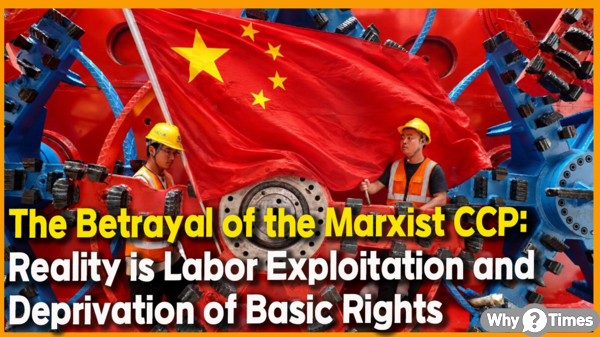
[The Betrayal of the CCP: A People's Republic That Exploits Workers]
Analysis is drawing significant attention through major Swiss media, reporting that workers under the Chinese Communist Party (CCP)—which promotes Marxism as its national governing ideology—are paradoxically suffering from the most severe exploitation in the world. This is identified as the structural root of China’s current overproduction and the collapse of domestic demand. This situation is particularly serious because it essentially betrays the fundamental ideology of the CCP, suggesting that the very reason for the party's existence is being ignored at its roots.

On April 29, the prestigious Swiss newspaper Neue Zürcher Zeitung (NZZ) published a guest column by Professor Yasheng Huang of the MIT Sloan School of Management titled “Areas Where China Has Forgotten Marx” (Wo China Marx vergessen hat).
In this article, Professor Huang stated, “The wages of Chinese industrial workers account for only 4% of the value-added they create.” He added, “This is the second-lowest level among 87 surveyed countries, following Indonesia, as of 2016, when the United Nations last compiled relevant statistics.” Even India, a country significantly poorer than China, had a ratio of 5%, and the United States, known for being less than friendly toward protecting workers' rights, reached 12%.
The core point Professor Huang makes is that this figure is not just a problem of low wages, but the actual source of China's economic hegemony. By suppressing the share that corporations and the state should pay to workers, they have accumulated massive capital to invest in infrastructure such as factories, roads, and production lines. While Western nations criticize loans from Chinese state-owned banks and government subsidies as sources of unfair competition, Huang argues, “In reality, a much more massive subsidy comes from the Chinese workers themselves.” The weak consuming power of the workers acts as a structural subsidy that lowers China’s cost of capital.
[“The Product of Scale and Long Working Hours, Not Efficiency”]
Another striking part of this analysis is the direct rebuttal of China’s ‘productivity myth.’ Citing data from the International Labour Organization (ILO), Professor Huang pointed out that “China’s GDP output per hour is $20, which does not even reach the global average of $23, and is at a similar level to Brazil and Mexico.” During the same period, the hourly GDP in the United States reached $82.
In conclusion, Professor Huang noted, “China’s overwhelming production capacity does not stem from high efficiency, but is the result of a combination of vast economies of scale and world-class long working hours.” He explained that this structure is the reason why production in China’s ‘New Three’ industries, such as electric vehicles, has surged by hundreds of percent compared to the end of 2019, while domestic demand has weakened significantly due to the real estate slump and sluggish income.
Professor Huang analyzed that “this wage suppression structure has allowed China to maintain a strange duality, competing with the West in high-tech fields while simultaneously competing with African nations in low-value-added sectors like apparel.” In short, low wages are being used as an artificial source of all-around competitiveness.
Western nations once overcame the crisis of overproduction that Marx warned about by gradually increasing wages to grow domestic demand, based on the recognition that “workers are also consumers.” However, China has taken the opposite path.
[The BYD Brazil Incident: A Snapshot of Structural Issues]
These issues of low wages and poor treatment are not confined to China but are being replicated in overseas business sites. CNBC reported, “In December last year, Brazilian authorities conducted a raid on the construction site of Chinese EV company BYD’s plant in Camaçari, Bahia, and found that approximately 220 Chinese workers were subjected to conditions equivalent to slave labor.”
The report continued, “Workers were forced to surrender their passports to their employers, most of their wages were remitted directly to China, and they had to pay a deposit of about $900 upfront, which would only be returned after completing a six-month contract.”
CNBC further stated, “The main violations identified by the investigation team were forced labor, degrading living conditions, and extremely long working hours of at least 10 hours a day without unauthorized holidays.” One injured worker testified that he could not rest for a single day for 25 consecutive days and required prior permission even to go out. Based on this, Brazilian prosecutors filed a lawsuit for damages worth approximately $45 million against BYD and two subcontractors.
While BYD denied direct responsibility citing the employment structure through subcontractors, the labor authorities’ investigation revealed that the site workers were effectively under BYD’s direct command. Furthermore, evidence was captured that BYD itself deceived Brazilian immigration authorities to facilitate the entry of foreign workers without proper registration. As the situation escalated, the Brazilian Ministry of Labor officially placed BYD on the list of companies violating slave labor laws, which resulted in BYD being barred from obtaining certain types of bank loans within Brazil.
[“China Must Learn the Lesson of Ford”]
At the end of his column, Professor Huang suggested] a solution through a historical analogy. He emphasized, “In the early 20th century, the American automobile king Henry Ford voluntarily raised wages so that his factory workers could afford the cars they assembled,” and added, “The Chinese authorities also need to make such a decision.” The specific measures he proposes include allowing free wage increases and abolishing wage caps, substantially expanding the social security system, and making the minimum wage realistic.
The Chinese government also set ‘expanding domestic demand’ as its top policy priority at last year’s Two Sessions and explicitly mentioned increasing the income of middle- and low-income groups. However, from Professor Huang’s perspective, “for such policy declarations to lead to substantial wage structure reform, they must be accompanied by a much more fundamental restructuring of the system that shifts the growth engine from exports and investment to consumption.” He viewed that “in a structure where labor wage suppression has functioned as a core means of national competitiveness, dismantling it is by no means an easy choice for Beijing, both politically and economically.”
Professor Huang concluded, “If the Chinese people, who achieved an economic miracle, cannot enjoy its fruits, it is the most fundamental betrayal of the Marxism that the Communist Party professes.”
]Preventing Union Formation and Neglecting Deepening Inequality to Maintain CCP Power]
The reality of the ‘Socialist Modernization’ touted by the CCP is ultimately nothing more than a monstrous form of state capitalism at the expense of workers. It is a profound irony that while they claim to use Marxism as the foundation of their governing ideology, workers are not treated as masters but as consumables to sustain the Party’s power.
Currently, the Chinese labor scene is no different from a ‘human rights blind spot.’ While Western democratic nations check the tyranny of capital through labor laws and free unions, in China, the Party itself acts as the capitalist and pressures the workers. The ‘exploitation of surplus value’ that Marx so detested is taking place in broad daylight under the connivance and leadership of the Communist Party.
A particularly noteworthy point is that the CCP thoroughly suppresses the freedom of association for workers. If it were true Marxism, it should encourage the solidarity of workers, but the Xi Jinping regime regards workers organizing to seek their own rights as a threat of subversion. This is tantamount to admitting that the Communist Party is not a group representing workers, but solely a control mechanism for the Party's permanent grip on power.
Economic inequality is also at a serious level. Although they shout the slogan of ‘Common Prosperity,’ the reality is a structure where the privileged class, in collusion with Party officials, monopolizes wealth. Even though migrant workers (Nongmingong) have been the core engine of urban growth, they are living as ‘second-class citizens,’ excluded from basic social safety nets such as education and healthcare due to the discriminatory Hukou (household registration) system.
This deceptive behavior by China also poses a major external threat. The low-price offensive based on a workforce with low wages and no rights is destroying the fair order of the international market. This goes beyond a simple economic issue; it is a reason why countries upholding liberal democratic values must respond firmly to a product production chain based on China’s inhumane labor environment.
It is a great delusion for Western leftist intellectuals or politicians to view China as an alternative to socialism. China has not evolved into the equal society Marx dreamed of, but into the most malformed type of totalitarian state combining ‘digital dictatorship’ using high technology with ‘capital exploitation.’ If Marx saw today’s China, he would likely have identified it as the first target to be overthrown.
Ultimately, China’s economic growth engine is bound to hit its limit. When the dissatisfaction and alienation of workers reach a tipping point and the supply of cheap labor is cut off due to demographic changes, the Chinese-style growth model will collapse. This is because the Party’s coercive control alone cannot forever suppress human nature’s free will and the desire for a better life.
The CCP must now take off the mask of ‘Marx.’ For a regime that oppresses and exploits workers to use the name of the worker is an insult to the global working class. True reform must begin with giving up the Party’s monopoly on power and returning free voting rights and freedom of association to the workers.
In conclusion, China’s crisis will begin not from external pressure, but from internal contradictions. The day when the target of the ‘Proletarian Revolution’ predicted by Marx becomes none other than the CCP itself may not be far off. The stern lesson of history is that a house of cards built on dictatorship and exploitation never lasts long.

-중국 푸단대학교 한국연구원 객좌교수
-전 EDUIN News 대표
-전 OUR NEWS 대표
-제17대 대통령직인수위원회 정책기획팀장
-전 대통령실 홍보기획비서관
-사단법인 한국가정상담연구소 이사장
-저서: 북한급변사태와 한반도통일, 2012 다시우파다, 선거마케팅, 한국의 정치광고, 국회의원 선거매뉴얼 등 50여권