
Update2026.11.23 (월)

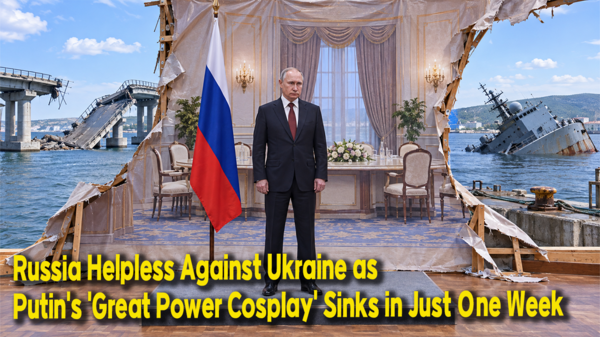
[Russian Warship Capsizes Inside Allied Port]
Russian President Vladimir Putin's plan to use Donald Trump as leverage to project an image of a "Global Big Three" alongside the United States and China—and to use that clout to wrap up the Ukraine war on favorable terms—is crumbling both inside and out. Ahead of the historic first U.S.-China-Russia trilateral summit held in Shenzhen, China, on November 19, Ukraine sent a road span of the Crimean Bridge, a symbol of Putin's authority, plunging into the sea. Three days after the summit, on the 22nd, the Russian Navy missile corvette Merkury capsized after being struck by naval drones while docked at the Benghazi naval base in Libya, Africa. Having already been driven out of the Black Sea, the Russian Navy's demonstration that it is no longer safe even inside an allied port in the Mediterranean comes as a shock. Caught between the pomp of the summit and the reality of the battlefield, Putin's prestige faces an even sterner test.
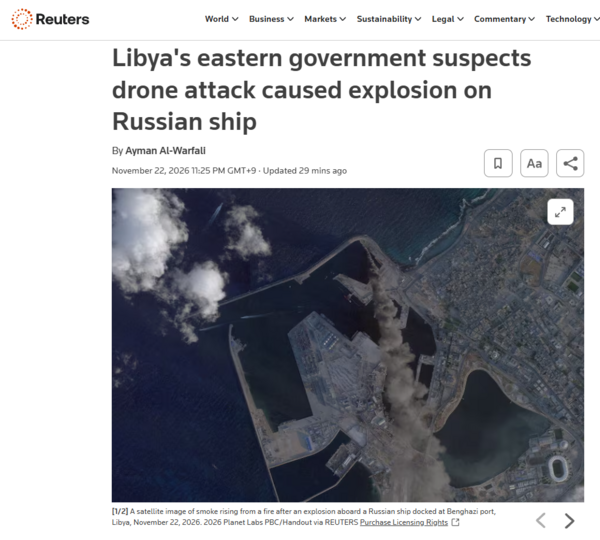
Reuters reported on the 22nd (local time) that "an explosion and fire broke out aboard the Russian Navy corvette Merkury docked at the eastern Libyan port of Benghazi, with eastern Libyan authorities raising the possibility of a drone attack in their preliminary investigation," adding that "analysis of satellite imagery shows the vessel largely capsized and submerged, with only a portion of the bow remaining above water." The party responsible for the attack has not yet been officially confirmed.
The attack began before dawn at the Benghazi naval base. Analysts tentatively identified the vessel as the Project 20380-class corvette Merkury, which was commissioned in 2023. Satellite imagery firm Vantor also stated after analyzing the footage that the ship was the Russian Navy's light warship Merkury. Satellite images released by Vantor captured the Merkury lying capsized beside a pier.
Regarding the incident, the Associated Press (AP) reported that "two military officials affiliated with the Libyan National Army (LNA), relaying initial investigation findings, stated that several Ukrainian naval drones were launched from a Ukrainian military base in western Libya, and while at least four were intercepted, two struck the warship." The Telegraph noted that "the Merkury is estimated to be worth £150 million (approximately 265 billion won)," while also citing a Naval News report stating that "the ship was escorting a convoy for arms exports."
The eastern Libyan government, backed by Commander Khalifa Haftar, stated that "the vessel was docked to take on fuel and supplies under a cooperation agreement between Russia and the eastern government." In a statement, the eastern government said, "We suspect the ship was targeted in a drone attack," adding that it "will conduct a joint investigation with Russia." Hours later, a secondary attack occurred off the coast of Benghazi when a Maltese-flagged cargo ship was struck by a naval drone. Libyan satellite broadcaster Al-Masar reported that "naval and air forces destroyed at least 12 additional naval drones." This indicates a massive swarm of drones converged on the Benghazi area over the course of the day. No group has yet claimed responsibility, and neither Russia nor Ukraine has issued an official comment.
Notably, the incident occurred just three days after the U.S.-China-Russia summit. President Putin had sought to sit alongside U.S. President Donald Trump and Chinese President Xi Jinping to demonstrate that Russia remains a key stakeholder in the global order. He likely aimed to flaunt Russia's presence between the U.S. and China and leverage President Trump's willingness to mediate an end to the war to extract favorable terms in Ukraine. However, before the dust from the summit had even settled, Putin's grand design suffered a major blow with the loss of a warship in Libya following the collapse of the Crimean Bridge.
[Extension of the 'Mediterranean Shadow War']
This attack did not happen out of the blue. On December 19, 2025, a source from the Security Service of Ukraine (SBU) told AFP that Ukraine had "struck the Russian 'shadow fleet' oil tanker Qendil in 'neutral waters' of the Mediterranean." In March of this year, the Russian liquefied natural gas (LNG) carrier Arctic Metagaz was hit by naval drones near Malta. At the time, Russia's Ministry of Transport claimed that "Ukraine carried out the attack from the Libyan coast," labeling it "an act of international terrorism and piracy." France's RFI reported that "Ukraine maintains up to 200 operatives across three bases in Libya, most of whom are drone specialists." The AP also quoted Libyan officials stating that "they have operated primarily out of Misrata Air Base, as well as facilities in Tripoli and Zawiya."
The reason Russia has invested heavily in Libya is clear. When the collapse of Syria's Assad regime in December 2024 shook Russia's strategic Mediterranean foothold in Syria, Moscow leveraged its ties with Haftar to build up Libya as a logistics hub for its Africa Corps (the successor to the Wagner Group). In this context, The Telegraph reported that "the Merkury was originally built for the Black Sea Fleet, but has been unable to enter the Black Sea since the war began and had been operating in northern waters." Pushed out of the Black Sea, the Russian Navy has now been struck again at the very Mediterranean hub it turned to as a fallback.
Both eastern and western governments in Libya voiced strong objections. The eastern government stated, "The Libyan government will not allow Libya's ports, territory, or territorial waters to become a stage for retaliation or an arena for importing international conflicts." The western government in Tripoli likewise declared that it "firmly rejects turning Libya into a stage for international conflict or a battleground for foreign powers to exchange reprisals."
[Just Before the Shenzhen Stage, the Crimean Bridge Falls into the Sea]
The Mediterranean was not the only place where Putin lost face. Beginning on November 16, three days before the trilateral summit, Ukraine launched successive attacks on the Crimean Bridge, which Putin personally opened in 2018 by driving a truck across it. The bridge connects mainland Russia to the occupied Crimean Peninsula. According to reports on the 17th, a roughly 227-meter arch of the road bridge over the Kerch Strait collapsed into the sea along with its connected deck. The arch was a 5,500-ton steel structure installed in October 2017. Footage released afterward showed trains still running on the remaining railway section. However, a follow-up strike hit early on the morning of the 19th, the very day of the summit. Ukraine's Ministry of Defense announced that "Neptune missiles struck the railway section of the Crimean Bridge, hitting near the arch and tracks." The Russian-installed occupation authorities in Crimea halted traffic across the bridge immediately after the attack.
The Crimean Bridge is both a symbol of Russia's illegal annexation of Crimea in 2014 and a vital supply artery to occupied southern Ukraine. Installing the arch in 2017 required hydraulic equipment from the Dutch heavy-lifting firm Mammoet. Under ongoing Western sanctions, bringing such technology back into Russia is virtually impossible. Experts estimate that repairs will take anywhere from several months to several years.
[Putin's 'Ukraine Peace Plan' Derailed]
Against this backdrop, Putin stood on stage in Shenzhen on the 19th with President Xi and President Trump for the first-ever trilateral summit. During the meeting, Putin declared, "Our three nations were the victors of World War II and bear a shared responsibility to maintain international peace and security." Yet the outcome produced by the three leaders fell far short of the picture he had envisioned. The so-called "Peace Declaration" went no further than pledging dialogue on nuclear risk reduction, expanded oil supplies, and United Nations reform. Ukraine was not mentioned in the declaration, and Putin stated only that he had discussed the war during a separate bilateral meeting with Trump. Reuters assessed that "Trump's three-day Asian tour, which he promised would make history and broker peace, yielded few tangible results."
Trump's remarks upon returning home were hardly favorable to Putin either. Speaking at a White House press conference, Trump said, "He [Putin] wants to end the war. It's very tough." He continued, "Frankly, you have two people who don't know how to end it. Two people who hate each other—Zelenskyy and Putin. Both of them are trapped in it." In effect, Trump portrayed Putin not as a great-power statesman steering negotiations, but as a trapped belligerent no different from Zelenskyy.
["An Unsustainable War of Attrition"]
Washington's assessment was even more blunt. U.S. Ambassador to the UN Mike Waltz appeared on The Brian Kilmeade Show and stated that "Russia is recruiting 20,000 to 25,000 new troops every month, but losing 30,000 to 35,000 every month." Waltz called the toll "exponentially worse than what they lost in Afghanistan and approaching World War II levels at roughly 1,000 a day," adding that "it is completely unsustainable." He went on to say, "Neither side can sustain this war of attrition. There is no military path to victory; it has to end through diplomacy."
While Waltz's figures are higher than other estimates if counted strictly as fatalities, the trajectory aligns with Western intelligence assessments. The Center for Strategic and International Studies (CSIS) estimated that "Russia suffered an average of nearly 35,000 casualties per month in 2025 alone." NATO Secretary General Mark Rutte remarked in January of this year that "Russian military deaths are reaching 20,000 to 25,000 every month," calling it "unsustainable." Ukrainian authorities also recently stated that Russia's monthly casualties have surpassed 30,000, exceeding recruitment numbers for the first time since the war began.
[Why Times Insight]
What Putin sought from the Shenzhen summit was far more than a photo opportunity. His goal was to invoke the narrative of "World War II victors" to establish Russia as a co-architect of the global order alongside the U.S. and China, and to use Trump to shape a Ukrainian settlement framework favorable to Moscow. Yet the events of this past week demonstrated the exact opposite. Just before the summit, a span of the Crimean Bridge collapsed; on the day of the summit, the railway section was struck; and three days later, a Russian warship capsized inside an allied port. Ukraine effectively overwrote Putin's diplomatic stage with the timetable of the battlefield.
Even more painful for Moscow is what came out of that summit. The omission of Ukraine from the joint declaration signals that neither Xi Jinping nor Donald Trump is willing to underwrite Russia's position in this war. Driven from the Black Sea, stripped of Syria, and now unsafe even in a Libyan port, Russia's maritime power projection is being peeled away layer by layer—exposing Putin's "great power cosplay" as diplomatic theater unsupported by military reality.


-중국 푸단대학교 한국연구원 객좌교수
-전 EDUIN News 대표
-전 OUR NEWS 대표
-제17대 대통령직인수위원회 정책기획팀장
-전 대통령실 홍보기획비서관
-사단법인 한국가정상담연구소 이사장
-저서: 북한급변사태와 한반도통일, 2012 다시우파다, 선거마케팅, 한국의 정치광고, 국회의원 선거매뉴얼 등 50여권