
Update2026.11.23 (월)

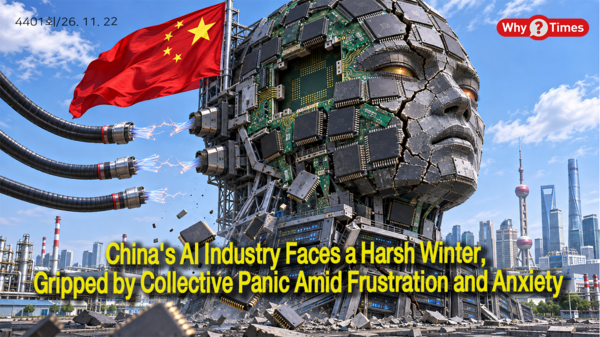
[U.S. 'Remote Compute' Blockade Takes Effect… Southeast Asian Leasing Routes Halted Without a License]
Washington has tightened its grip on the lifeline of China's artificial intelligence (AI) industry. On the 19th, as U.S. President Donald Trump sat across from Chinese President Xi Jinping in Shenzhen, a U.S. Department of Commerce regulation requiring licenses for Chinese firms to remotely access advanced AI chips via overseas data centers officially took effect. The rule had already been unveiled two days prior to the summit. This means that the smiles of summit diplomacy and the technological blockade were scripted together from the outset. Around the same time, Taiwan's TSMC and South Korea's Samsung Electronics halted shipments of chips manufactured on 16-nanometer or more advanced processes for Chinese customers. Having already been blocked from purchasing advanced chips directly, the two lifelines China had relied upon—"overseas leasing" and "overseas foundry manufacturing"—have been constricted simultaneously. Nearly a quarter of the AI computing power used by China can now no longer move without U.S. authorization.
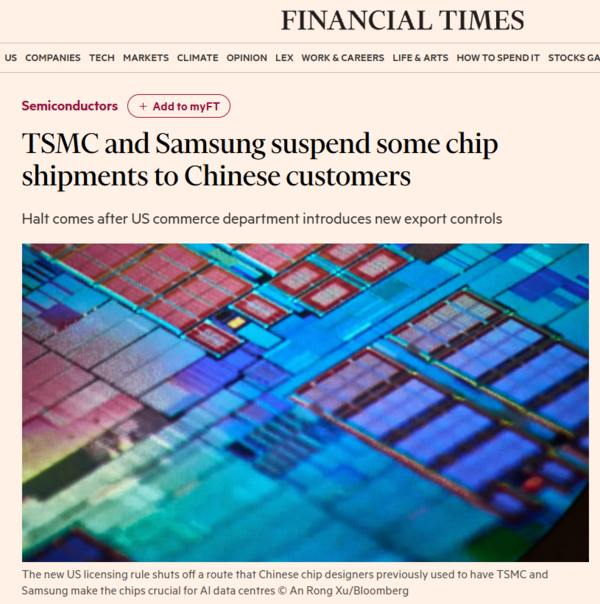
On the 20th, the U.K.'s Financial Times (FT) reported that "U.S. pressure on China is manifesting along two fronts: chip manufacturing and overseas computing power," detailing the far-reaching fallout these American measures will have on China's AI sector.
[First Pressure Point: Even the Foundry Backdoor Is Locked]
The first point of pressure targets semiconductor manufacturing routes. Under revised regulations by the U.S. Department of Commerce's Bureau of Industry and Security (BIS), licenses are now required to supply certain advanced semiconductors made with U.S. technology to Chinese customers. According to the FT, TSMC and Samsung Electronics recently notified Chinese clients that they will withhold shipments of certain processors until BIS licenses are granted, and have initiated the license application process. Reuters reported that "TSMC instructed the suspension of orders for 16-nanometer or sub-16-nanometer processes from Chinese customers lacking U.S. export licenses." The list of affected clients includes major Chinese smartphone makers such as Xiaomi, Oppo, and Vivo, as well as Samsung Electronics' client Kunlunxin—Baidu's AI chip subsidiary—and ByteDance, the parent company of TikTok.
What has been shut down this time is the "backdoor" that Chinese chip designers have used for years. Previously, orders were routed through outsourced semiconductor assembly and test (OSAT) firms; if these firms confirmed that a design was not subject to controls, shipments could proceed without an individual U.S. government license. Under the new rule, any advanced chip designed by a Chinese company not on a U.S. approved list is treated as a controlled AI chip. Consumer chips for smartphones, rather than AI applications, are no exception. However, this does not mean all license applications for consumer chips will be rejected. Industry insiders anticipate that even if licenses are approved, review delays could disrupt production schedules. Because Chinese firms must now obtain U.S. permission every time they modify a design, the production calendar of China's semiconductor design industry has effectively been handed over to Washington.
[Second Pressure Point: "No Matter Where the Chips Are, China Cannot Use Them"]
The second point of pressure is the computing power of overseas data centers. On the 16th, the U.S. announced a rule requiring overseas data centers to obtain a license to provide advanced computing power above a certain threshold to companies headquartered in sanctioned nations such as China. The regulation entered into force upon publication in the Federal Register on the day of the U.S.-China summit. The licensing threshold is set at a Total Processing Performance (TPP) of 12 million, equivalent to roughly 750 Nvidia H100 chips. This measure directly targets the channels through which Chinese companies have used U.S.-made AI chips via overseas cloud providers or data centers.
The ripple effects are already spreading to the financial sector. According to Bloomberg, work on a $480 million (approximately 640 billion won) loan sought by Singaporean cloud firm Aolani Cloud to purchase Nvidia chips for a Malaysian data center—intended to supply computing power to ByteDance—has been frozen. Five financial institutions, including lead arranger Singapore's DBS, reportedly discussed withdrawing from the loan out of concern over violating the new regulations. This illustrates that the impact of the restrictions extends beyond chip export approvals to data center investments and financing.
The scale is substantial. The U.S. think tank Center for a New American Security (CNAS) estimated that by the end of this year, remote access would account for roughly 23% of the AI chip computing power available to China. Nearly a quarter of the computing capacity underpinning China's AI ecosystem is now tied to U.S. licensing. Conversely, U.S. hyperscalers (major cloud service providers) were granted an exemption on the condition of monthly reporting. In the very same Southeast Asian market, a dynamic has been created where American firms remain while Chinese-affiliated operators are pushed out.
[Chinese Big Tech's First Admission: "It Sets Everyone Back"]
The first to publicly acknowledge the shock was China's largest internet company, Tencent. During a third-quarter earnings conference call, Tencent President Martin Lau (Liu Chiping) said of the new regulation, "It sets everyone back in China." He explained that regardless of when a company began leasing computing power overseas, the advanced computing capacity available to all Chinese firms is shrinking. He admitted that next-generation AI model rollouts could be delayed, stating, "In the short term, it will probably take longer to release the next version." It is highly unusual for a Chinese big tech executive to directly acknowledge the impact of U.S. controls during an earnings call.
Even before the rule was issued, Washington had already scuttled a core Tencent contract. According to an FT report, Oracle canceled an approximately $7 billion, five-year agreement to lease up to 100,000 advanced Nvidia chips installed in Southeast Asian data centers to Tencent after the U.S. government raised concerns. It was the largest overseas computing contract in Tencent's history. Tencent's third-quarter capital expenditure surging 225% year-on-year to 65.1 billion yuan can be seen as a desperate measure to offset blocked overseas computing power through domestic investment. Industry groups also testified via Reuters that access to certain China-linked "GPU services" in Southeast Asia has already been suspended.
[Bottlenecks Move Beyond Chips to Computing Power]
Signs of a computing power shortage are already emerging across China's AI industry. According to Chinese business outlet Yicai, users of the DeepSeek app and web service began receiving notices in mid-November stating that long-context conversations, daily usage quotas, and single-input lengths were being restricted due to "insufficient computing power." DeepSeek has not issued an official statement on the matter. According to DeepSeek's official status page, the service also suffered an outage lasting more than four hours on October 15. While this single case cannot define the entire Chinese AI industry, it shows that companies are struggling to ration scarce computing resources amid rising user demand. Washington's latest move works directly to tighten this very bottleneck.
[The Stark Reality Behind 'Tech Self-Reliance'… Huawei Is Less Than 4% of Nvidia]
Beijing's official solution is localization. Martin Lau also noted that the new restrictions will accelerate cooperation with domestic chipmakers. However, the numbers do not back up the slogan. According to U.S. AI research institute Epoch AI, the performance of Huawei's latest flagship chip, the Ascend 950, is roughly half that of Nvidia's H100, which launched in 2022. The total AI computing power Huawei will produce this year amounts to less than 4% of Nvidia's output. The gap in usable High Bandwidth Memory (HBM) capacity reaches 73-fold. Epoch AI projects that Huawei will remain roughly four years behind Nvidia in both chip performance and production volume through 2030.
China cannot buy advanced chips, cannot lease overseas computing power, and cannot close the gap with homegrown chips. Due to structural vulnerabilities—namely its reliance on foreign sources for advanced lithography equipment and HBM—Beijing's push for "localization" currently serves less as a means to narrow the gap and more as a way to endure it.
[This Is Only the Beginning… Congress Demands an Even Tighter Blockade]
An even bigger problem for China is that Washington shows no sign of stopping here. In its 2026 Annual Report, the congressional U.S.-China Economic and Security Review Commission (USCC) recommended requiring audited certifications for companies exporting AI chips to China. The proposal calls for requiring firms to prove that advanced chip manufacturing, HBM, and packaging capacity are not being diverted from U.S. customers, and imposing criminal penalties for false certifications. It envisions managing not just chip sales, but also production capacity and supply chains from a national security perspective.
The report also warned that China's People's Liberation Army (PLA) is actively targeting Nvidia's most advanced chips. In January, the House of Representatives already passed the "Remote Access Security Act," which codifies BIS's legal authority over remote access, by a vote of 369 to 22. Senator Jim Banks praised the new regulation as a "good first step" and urged Congress to make it permanent through legislation. Once executive regulations are cemented into congressional statute, no future summit will be able to easily reverse them.
[Why Times Insight]
First, "handshakes and blockades" are not a contradiction, but a division of labor.
The promulgation of the remote-access rule on the very day of the U.S.-China summit in Shenzhen came as a shock to Beijing. President Xi Jinping was blindsided at the exact moment he was showcasing China's global stature. In fact, the rule had already been unveiled prior to the summit, drafted under the direction of the Treasury Department and the National Security Council (NSC). While the White House handled tariffs and the Ukraine issue as part of a leader-to-leader "deal," national security agencies took AI computing power off the negotiating table entirely. The message handed to President Xi is unmistakable: trade may be up for negotiation, but AI supremacy is not.
Second, the U.S. AI blockade against China has effectively formed a triple-layered structure.
Washington blocked production through equipment controls, blocked purchases through chip export controls, and has now blocked leasing through this latest regulation. On top of that, foundry shipment controls have narrowed overseas contract manufacturing routes. Shifting the standard of control from "who buys" to "who uses" amounts to a declaration that the U.S. will manage the entire flow of computing power, not just individual chips. The workarounds China has spent years building are being erased one by one.
Third, Chinese AI has entered an era of "computing poverty."
Tencent's president admitting a setback on an earnings call signals that even China's big tech giants can no longer claim they can weather the storm. With Huawei's computing output below 4% of Nvidia's, localization is not a catch-up strategy—it is a survival strategy. The task facing China's AI sector is increasingly likely to shift from "catching up" to "preventing the gap from widening further."
Fourth, South Korea is no longer a bystander.
The moment Samsung Electronics halted shipments to ByteDance and Baidu's Kunlunxin, South Korean semiconductors stepped onto the front lines of enforcing the U.S.-China tech war. As Washington's blockade grows tighter, the costs shouldered by companies in allied nations also mount. How South Korea negotiates these costs will be its next critical challenge.

-중국 푸단대학교 한국연구원 객좌교수
-전 EDUIN News 대표
-전 OUR NEWS 대표
-제17대 대통령직인수위원회 정책기획팀장
-전 대통령실 홍보기획비서관
-사단법인 한국가정상담연구소 이사장
-저서: 북한급변사태와 한반도통일, 2012 다시우파다, 선거마케팅, 한국의 정치광고, 국회의원 선거매뉴얼 등 50여권