
Update2026.11.20 (금)

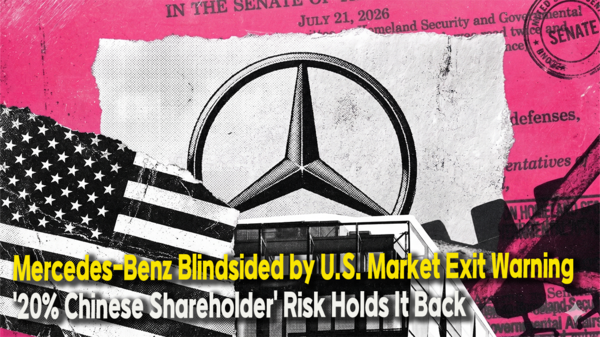
[U.S. House Examines Everything from Shareholder Registry to Tech Cooperation Contracts]
Mercedes-Benz, the symbol of the German automotive industry, is facing a warning sign of being forced out of the U.S. market. On the 17th, Chairman John Moolenaar and Ranking Member Ro Khanna of the U.S. House Select Committee on the Strategic Competition Between the United States and the Chinese Communist Party sent a letter to Mercedes-Benz's top management. The letter demands full disclosure of the automaker's relationships with Chinese shareholders—including state-owned BAIC Group and Geely founder Li Shufu—as well as its Chinese technology partners. The combined stake of the two Chinese shareholders is roughly 20%, already exceeding the 15% cap on Chinese ownership proposed under Congress's "Connected Vehicle Security Act." If the bill is enacted as drafted, Mercedes-Benz will be barred from selling internet-connected vehicles in the United States. With its sales in China plunging by nearly 30%, pressure from Washington has now compounded its woes, exposing the structural vulnerability of a German auto industry that grew reliant on the Chinese market.
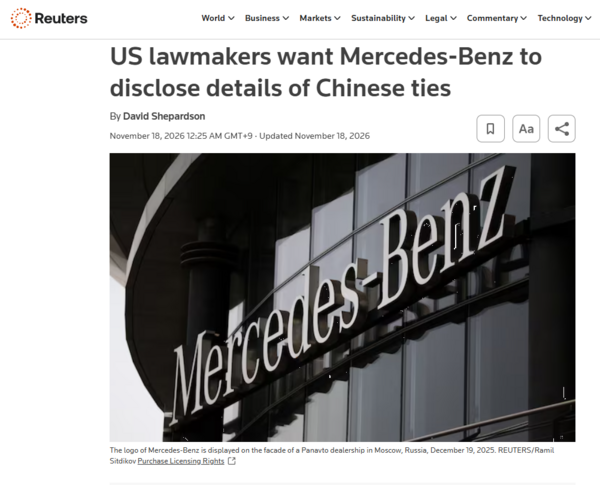
Reuters reported on the 18th (local time) that "the U.S. House Select Committee on China has demanded that Mercedes-Benz submit details on its ties with major Chinese shareholders and technology partnerships with Chinese firms," noting that "the combined stake of BAIC Group and Geely founder Li Shufu disclosed by Mercedes-Benz stands at 19.67%, exceeding the 15% threshold for vehicle manufacturers under a bill passed by a U.S. Senate committee." If this provision remains in the final legislation and applies to Mercedes-Benz, the company's connected-vehicle sales in the United States could be restricted.
The select committee also requested a separate meeting as part of its congressional oversight, specifically calling for North America CEO Jason Hoff to attend in person. Citing a House resolution as the basis for its investigative authority, the two lawmakers emphasized in the letter that "the Select Committee has broad authority to investigate and submit policy recommendations to counter the economic, technological, security, and ideological threats posed by the Chinese Communist Party to the United States and its allies and partners." With bipartisan leadership putting their names side by side on a single letter, the move carries unmistakable cross-party weight.
The first issue the committee seeks to verify is the extent to which Chinese shareholders can influence Mercedes-Benz's strategic decision-making. The second is the scope of technology partnerships forged with Chinese companies such as Hesai, Tencent, and Momenta. The committee is asking what technologies have been shared, whether Chinese entities have access to Mercedes-Benz's proprietary R&D results, what Chinese-made components are used in vehicles manufactured and sold in the United States, and what contacts have taken place with Chinese government officials. The key point to watch in Mercedes-Benz's response is how closely its technology cooperation for the Chinese market is linked to the components, software, and data processing of vehicles sold in the United States.
[The Reality of the '20% Chinese Stake'... State-Owned Enterprise and Geely Founder]
At the heart of the issue lies the company's ownership structure. Mercedes-Benz's largest single shareholder is BAIC Group, which holds a 9.98% stake. Its second-largest shareholder is Geely founder and Chairman Li Shufu, who holds 9.69% through his investment vehicle Tenaciou3 Prospect. Together, their holdings reach 19.67%. BAIC Group is Mercedes-Benz's core joint-venture partner in China, manufacturing models such as the E-Class sedan and EQE SUV, while Geely Holding, led by Li Shufu, is the controlling shareholder of Volvo Cars. The two lawmakers pointed out that because not all shareholders participate in votes, the actual voting power of these stakes at general shareholder meetings is likely higher than their ownership percentages. The committee expressed particular concern that BAIC Group is a state-owned enterprise and that Geely plays a leading role in China's national strategy to dominate the global automotive market.
Mercedes-Benz moved swiftly to contain the fallout. The company stated that it had received the letter and would cooperate with the investigation. Explaining that it operates independently under the direction of its board of directors, it stressed that "our shareholders hold neither board seats nor management authority." It added, "We have long supported measures to protect U.S. national security, and any claim that the company opposes these goals is untrue." Throughout discussions on the bill, Mercedes-Benz has maintained that since neither shareholder owns 10% or more and neither has representation on the board, they do not exercise meaningful influence over management.
[The 15% Ownership Threshold... A Ticking Legislative Clock]
Behind the House investigation is the "Connected Vehicle Security Act (S.4429)" currently pending in the Senate. Co-sponsored by Senators Bernie Moreno (R-Ohio) and Elissa Slotkin (D-Mich.), the bill would completely block connected vehicles, software, hardware, and core components linked to "foreign adversaries"—including China, Russia, Iran, and North Korea—from entering the U.S. market starting in January 2027.
The Senate Commerce Committee unanimously advanced the bill to the full Senate on July 22, while in the House, Chairman Moolenaar introduced a companion bill with Representative Debbie Dingell (D-Mich.). The provision fatal to Mercedes-Benz prohibits companies with more than 15% Chinese ownership from selling vehicles in the United States.
Mercedes-Benz mounted an all-out lobbying campaign in response. According to Bloomberg, the automaker requested that the ownership cap be raised to 25%. Replacing the numerical threshold with a qualitative national security review has also been floated as an alternative, an approach viewed as more favorable to Mercedes-Benz. Senate Commerce Committee Chairman Ted Cruz warned that leaving the 15% provision intact would effectively exclude Mercedes-Benz from the U.S. market. Senator Moreno stated, "Mercedes-Benz will be given an implementation period until 2030 and can also apply for an exemption during that time," adding, "There will never be a ban on the sale of Mercedes-Benz vehicles in the United States." Moreno is a former Mercedes-Benz dealer whose son still operates a Mercedes-Benz dealership.
However, the bill hit a snag in September. After Senator Rand Paul (R-Ky.) objected, arguing that "the legislation could unfairly ensnare Mercedes-Benz," Senate leadership postponed plans to pass the bill by unanimous consent without a roll-call vote and continued negotiations. Reuters reported that day that "Senator Moreno said the final text will ensure Mercedes-Benz is not banned in the United States and expressed hope that Congress would pass it as early as this week."
Time is also running short. Democrats won control of the incoming Congress in the November 3 midterm elections, and reports have even emerged that the future of the Select Committee on China is under review. The Alliance for Automotive Innovation, which represents major automakers in the United States, has also repeatedly urged passage within the year. In effect, the structure of Mercedes-Benz's U.S. business will be decided during the lame-duck session.
[China, Once Its Home Turf, Has Already Turned Its Back]
What puts Mercedes-Benz in an even tighter spot is that the Chinese market itself is collapsing. Mercedes-Benz's sales in China from January to September 2026 fell 29% year-on-year. On October 27, the automaker lowered its full-year adjusted return on sales forecast for its passenger car division from 3–5% to 2–3%, and revised its group operating profit outlook to remain flat from the previous year rather than posting a sharp increase. It became the third German automaker to cut its annual guidance, following BMW and Volkswagen. CEO Ola Källenius admitted, "Market conditions have become even more challenging this year, particularly in China." By contrast, third-quarter sales outside China rose 1%, underscoring that the earnings slump is essentially driven by China.
The irony is unmistakable. While losing market share in China to local rivals such as BYD and Xiaomi, Mercedes-Benz now faces the threat of expulsion from the United States precisely because of its capital ties with China. Volvo, which is 78% owned by Geely, effectively cleared the regulatory hurdle through a separate compliance track, leaving Mercedes-Benz to find a legislative solution on its own. Adding to the burden, buying back and canceling treasury shares would only push the Chinese shareholders' ownership percentage even higher.
[Why Times Insight]
① The price of bringing in Chinese capital.
Mercedes-Benz's "20% Chinese stake" did not materialize overnight. Li Shufu acquired a stake in Daimler (now Mercedes-Benz Group) in a surprise move in 2018, and BAIC Group raised its stake to 9.98% in 2019. The two companies are also intertwined through cross-shareholdings, with Mercedes-Benz holding a 9.55% stake in BAIC's Hong Kong-listed subsidiary. At the time, German executives welcomed the deals as a gateway into China, the world's largest auto market. Choices made when China was the engine of growth have boomeranged as security risks in an era of U.S.-China strategic competition—a bill German corporations are now paying for their reliance on China.
② It will not end with adjusting ownership percentages.
Given that the bill's sponsors have repeatedly stated they have no intention of banning Mercedes-Benz, there is a significant chance the 15% cap will be eased or an exit opened through grace periods and exemptions. Yet the House investigation is targeting more than just numbers. Reliance on Chinese technology and data—including LiDAR from Hesai, autonomous-driving software from Momenta, and partnerships with Tencent—has also been put under the microscope. If the ownership threshold is replaced by a qualitative review, these ties could become the core focus of scrutiny. Nor can it be overlooked that Chairman Moolenaar already stated in a July op-ed in The Wall Street Journal that "Mercedes-Benz must unwind its Chinese ownership."
③ Scenarios.
First, the bill is amended and Mercedes-Benz receives a grace period or exemption. Even then, the company will face the cost of stripping Chinese technology out of vehicles sold in the United States. Second, Chinese shareholders are effectively forced to divest their stakes, which could jeopardize Mercedes-Benz's joint-venture partnership with BAIC Group in China. Third, regulations close to the original draft are finalized, threatening the automaker's connected-vehicle sales in the United States ahead of the 2030 deadline. Under any scenario, Mercedes-Benz can no longer avoid choosing between the United States and China.
④ Implications for South Korea.
In South Korea, Mercedes-Benz has long stood as a "symbol of wealth" at the top of imported car sales. Yet this episode demonstrates that in global supply chains, the nationality of capital and technology has become more decisive than the country of origin. South Korean companies entangled with Chinese capital, components, or software must read this as a warning that they, too, could be judged by the exact same standard in the U.S. market.

-중국 푸단대학교 한국연구원 객좌교수
-전 EDUIN News 대표
-전 OUR NEWS 대표
-제17대 대통령직인수위원회 정책기획팀장
-전 대통령실 홍보기획비서관
-사단법인 한국가정상담연구소 이사장
-저서: 북한급변사태와 한반도통일, 2012 다시우파다, 선거마케팅, 한국의 정치광고, 국회의원 선거매뉴얼 등 50여권