
Update2026.11.19 (목)

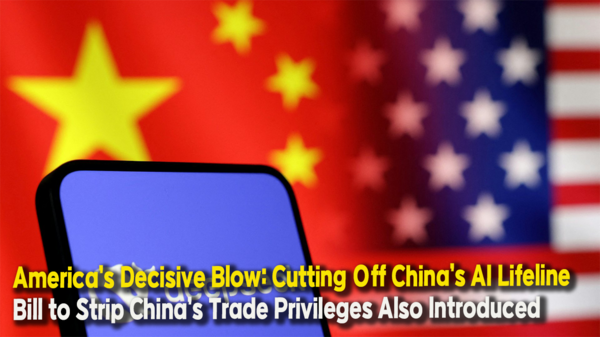
[Halted Despite $2.4 Billion in Sales to China… A Changed Nvidia After Jensen Huang’s Exit]
U.S. pressure on China’s artificial intelligence sector is tightening simultaneously along two axes: semiconductor supply chains and the trade order. Less than a week after Jensen Huang—the strongest advocate for opening the Chinese market—left Nvidia amid allegations of ties to Chinese intelligence, the company abruptly halted shipments to China of its H200 chips, even though they had received U.S. government export approval. The Trump administration has also begun blocking workarounds that allow Chinese firms to remotely access advanced chips through data centers in third countries. Meanwhile, in the U.S. Senate, a bill to revoke China’s Permanent Normal Trade Relations (PNTR) status was introduced just two days before a U.S.-China summit. Spanning chips, cloud computing, and tariffs, this campaign takes direct aim at the structural vulnerability of China’s AI industry, which has relied on American computing power for its growth.
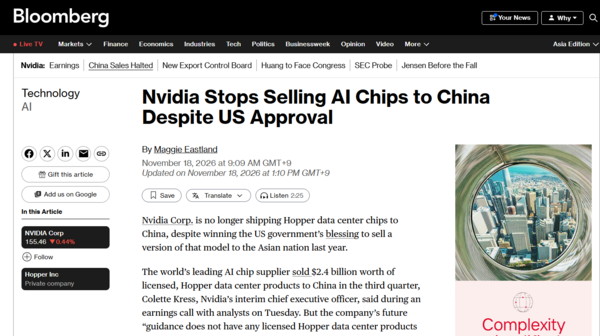
Bloomberg reported on the 18th that "Nvidia has halted shipments of Hopper-based data center products that it had been selling to China with U.S. government permission."
Interim Nvidia Chief Executive Officer Colette Kress stated during an earnings call that day that the company is "no longer shipping licensed Hopper data center products to China." Sales of those products to China totaled $2.4 billion (approximately 3.2 trillion won) in the third fiscal quarter ended October 25. Nvidia also excluded revenue from Chinese data center compute products from its next-quarter financial outlook. Kress did not disclose specific reasons for stopping the shipments. For a company that spent years lobbying Washington to expand business with Chinese customers, the move marks a sharp reversal.
According to Bloomberg, the H200 chip, which the U.S. government cleared for sale to China last year, is two generations behind Nvidia’s latest Rubin family. Nvidia had previously sought permission to sell its cutting-edge Blackwell chips to China as well, but the Trump administration rejected the request. Instead, President Donald Trump approved H200 sales—a decision Bloomberg characterized as the product of personal rapport Huang had built with Trump. Coincidentally, that sales channel closed in tandem with Huang’s departure. As a result of this decision, Chinese companies now face disruptions in new supplies even for products that had already been approved.
The shipment halt was disclosed less than a week after founder Jensen Huang stepped down. Nvidia announced on the 12th that Huang had resigned from his roles as president, CEO, and board member. Prior to his resignation, Huang admitted to an extramarital affair with Alice Huang, a former executive at Singapore-based data center operator Megaspeed. U.S. intelligence agencies suspect she was recruited by China’s Ministry of State Security (MSS), though the allegations have not yet been substantiated and the Chinese government has denied them.
Board Chairman Harvey Jones stated on the 17th that there are no plans to bring Huang back as CEO, and the company also decided to establish a board committee dedicated to national security and export controls. While China operations ground to a halt immediately after the loudest voice for expanding Chinese sales disappeared, the company has not stated a direct causal link between the resignation and the shipment suspension.
[From Chip Exports to 'Remote Access'… Washington Moves to Block Loopholes]
Nvidia’s decision aligns with the broader policy direction in Washington. On the 16th, the Trump administration rolled out measures tightening scrutiny over processor exports to multiple countries. The rules include restricting chip sales to data centers seeking to provide Chinese companies with remote access to advanced AI chips and servers. The Information reported that "the Commerce Department is finalizing a rule requiring licenses for exports of Blackwell-class or higher chips to seven countries, including Malaysia, Singapore, Thailand, and Indonesia."
Current export controls regulate only the physical transfer of chips. Consequently, Chinese firms have effectively bypassed restrictions by renting computing power from overseas data centers. Reports have also surfaced that Tencent, Alibaba, and ByteDance signed contracts with foreign data centers to gain access to Nvidia’s top-tier chips. Once this workaround is closed, Chinese AI firms will have to choose among smuggling, indirect leasing, and domestic chips. However, smuggling routes are narrowing amid stepped-up crackdowns in places like Taiwan, while domestic chips still face clear limitations in both performance and supply volume.
[Hong Kong Stock Market’s ‘AI Twin Engines’ Plunge… Divided Interpretations Over the Cause]
In a recent column, Hsieh Chin-ho, chairman of Taiwan’s Wealth Magazine (財信傳媒), attributed the collapse of leading Chinese AI stocks to U.S. pressure. According to his analysis, Zhipu (智譜) fell 89% over the four months since July, while MiniMax (稀宇科技) dropped 91.4%. Both companies went public in Hong Kong in January this year and were once hailed as symbols of "China’s new AI era." MiniMax’s share price hit a peak of HK$1,330 (about 230,000 won), and Zhipu’s market capitalization once surpassed HK$1 trillion (about 170 trillion won). Hsieh noted that shares of Chinese AI chipmakers—including Cambricon (寒武纪), MetaX (沐曦), Biren (壁仞), and Moore Threads (摩尔线程)—have also been cut roughly in half, arguing that "without the support of advanced American chips, China’s AI is not as formidable as people thought."
Chinese business outlets such as Caixin (財新) and 36Kr place greater weight on other factors. The immediate trigger they cite is the expiration of lock-up periods in July. In MiniMax’s case, roughly 63% of its Hong Kong-listed shares were unlocked all at once. As the scarcity premium formed immediately after listing evaporated, concerns over additional fundraising amid ongoing losses compounded the sell-off. This lends weight to the view that the stock plunge began with a supply-demand shock and valuation reset, which was then layered with fears over a U.S. blockade on computing resources.
[Trade Truce Talks in Shenzhen, Push to End Normal Tariff Treatment for China in Washington]
Following semiconductors, pressure is also mounting on the trade front. According to Reuters, Democratic Senator Tammy Baldwin introduced a bill on the 17th to strip China of its PNTR status. China has held this status since 2002, allowing Chinese goods to enter the United States under an average Most-Favored-Nation (MFN) baseline tariff of 2.5%, the same rate applied to other major trading partners.
Although President Trump imposed additional tariffs of roughly 25% during his first term and up to 20% in his second term, those measures left the PNTR framework intact and relied on separate legal authorities. Baldwin’s legislation dismantles that foundational framework itself. If enacted, PNTR would terminate after one year, subjecting Chinese imports to higher baseline tariff rates under the U.S. Harmonized Tariff Schedule (HTS). The bill also includes provisions directing the Office of the U.S. Trade Representative (USTR), alongside the Commerce Department and the International Trade Commission (ITC), to issue reports on trade and economic challenges posed by China.
In a statement, Senator Baldwin said, "We need to reset our trade relationship with China and be honest about the fact that China has undercut us at every turn." She criticized the U.S. for rolling out the "red carpet" for China for more than two decades while Beijing continued market manipulation and intellectual property theft. She also argued that President Trump’s inconsistent tariff policies have increased burdens on businesses and consumers, stressing the need for a stable trade policy grounded in law.
Debates over revoking PNTR are not new. Representative John Moolenaar (R), chairman of the House Select Committee on the Chinese Communist Party, introduced the "Restoring Trade Fairness Act" with bipartisan support, and the congressionally mandated U.S.-China Economic and Security Review Commission (USCC) also recommended revoking PNTR in November 2024. However, legislative efforts repeatedly stalled due to economic interests. This time, the landscape has changed. With the Democratic Party capturing both the House and Senate in this month’s midterm elections, the bill stands a stronger chance of gaining momentum in the new Congress next year.
The economic costs are substantial. In an August report, the ITC estimated that revoking PNTR would raise the trade-weighted average tariff rate on Chinese imports by 35.2 percentage points. Over the long run, this would push up U.S. consumer prices by 0.7% and reduce economic output by 0.2%.
The timing of the bill’s introduction is equally notable. President Trump and Chinese President Xi Jinping are scheduled to hold their third summit of the year in Shenzhen, China, on the 19th on the sidelines of the Asia-Pacific Economic Cooperation (APEC) Leaders' Meeting to discuss extending the trade truce set to expire next January. While the executive branch seeks to ease tensions through negotiation, Congress is moving to lock in a hardline stance against China through legislation. China has warned of countermeasures against the new U.S. chip curbs, and congressional leaders have given bipartisan backing to incorporating three export-control bills into the National Defense Authorization Act (NDAA).
[Why Times Insight | Even If the Trade Truce Is Extended, China’s AI Supply Crunch Will Remain]
The current turn of events can be distilled into a single scene: Jensen Huang, who most forcefully championed the argument that selling to China benefits the United States, has exited the stage amid allegations of an intelligence operation tied to that very country. Huang had long contended that withholding U.S. chips would only accelerate China’s indigenous development, yet this episode has severely undermined the political persuasiveness of that rationale. China hawks now have justification to treat calls for expanded sales not as corporate lobbying, but as a national security risk.
While supply-demand dynamics and the deflation of a valuation bubble were the primary triggers behind the plunge in Chinese AI stocks, there is a clear reason investors cannot envision a recovery scenario: the judgment that access to computing resources is being structurally cut off. When all three pathways—direct chip exports, smuggling, and remote leasing—narrow simultaneously, sustaining model competitiveness becomes difficult, and the market appears to have begun pricing in that reality.
If the bill to revoke PNTR passes Congress, President Trump will face a difficult political dilemma. Legally, he could exercise his veto power. However, amid strong domestic public sentiment calling for tougher pressure on China, vetoing a hardline China bill without a compelling justification would be politically hazardous.
Similar voices are also emerging from within the Republican Party. Chairman Moolenaar has spearheaded this initiative, and Secretary of State Marco Rubio was an original co-sponsor of that legislation during his time in the Senate. Vice President J.D. Vance also served as the lead sponsor of the "China Trade Relations Act" while in the Senate, which sought to revert China to its pre-PNTR status. Rejecting a policy championed by key figures within his own administration simply because it came in the form of a Democratic bill would make it hard to fend off attacks that he is "soft on China."
That is precisely the political burden this bill places on the White House. Ultimately, regardless of whether it passes, the legislation will act as a shackle narrowing the scope of concessions Trump can offer at the Shenzhen summit. At the same time, it could serve as negotiating leverage to press Beijing with the argument that "greater concessions are needed to persuade Congress." Even if the summit results in an extension of the trade truce, China’s AI procurement crunch is bound to persist unless this dual squeeze across chips and trade is resolved.
-중국 푸단대학교 한국연구원 객좌교수
-전 EDUIN News 대표
-전 OUR NEWS 대표
-제17대 대통령직인수위원회 정책기획팀장
-전 대통령실 홍보기획비서관
-사단법인 한국가정상담연구소 이사장
-저서: 북한급변사태와 한반도통일, 2012 다시우파다, 선거마케팅, 한국의 정치광고, 국회의원 선거매뉴얼 등 50여권