
Update2026.11.18 (수)

[Trump Directly Plays the 'China Meeting' Card on His Departure]
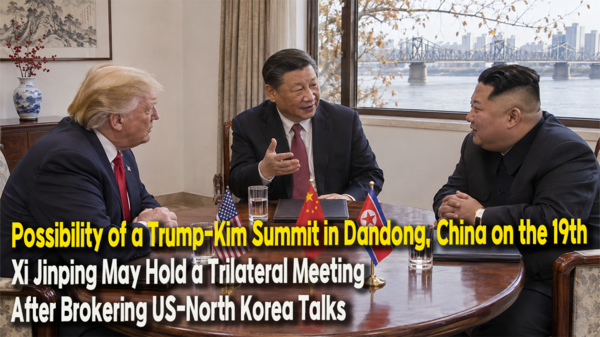
As U.S. President Donald Trump embarked on his Asian tour and directly stated that he "could meet Kim Jong Un in China," the "Dandong meeting" scenario—in which Trump delays his return flight on the 19th by a day to fly from Shenzhen to the North Korea-China border city of Dandong to sit down with Kim—has rapidly gained traction. The architect behind this scenario is Chinese President Xi Jinping. Why Times analyzes that the joint appearance of Wang Huning and Wang Yi during Kim Jong Un's visit to Dandong last month was Beijing's groundwork to wrest the mediation rights for a U.S.-North Korea summit away from Russia. If the summit materializes, Xi Jinping will gain the diplomatic asset of being "the leader who brought Trump and Kim Jong Un together." Conversely, the Lee Jae-myung administration, which had envisioned a Panmunjom summit, faces the predicament of being pushed off the stage despite being a direct party to Korean Peninsula issues.
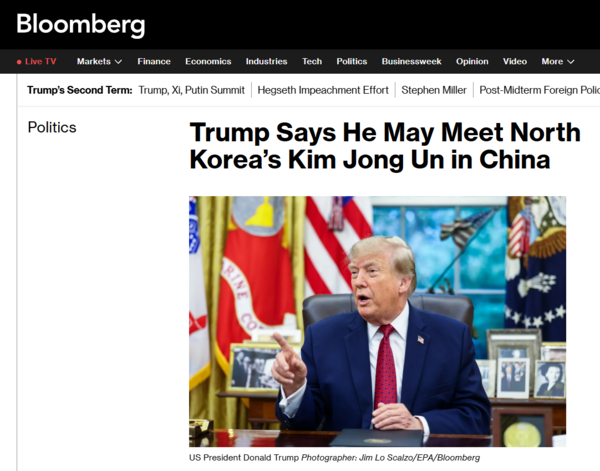
Bloomberg News reported on the 16th (local time) that "as President Donald Trump left the White House for his Asian tour and explained his schedule to reporters, after mentioning plans to meet Xi Jinping and Russian President Vladimir Putin, he added without even being asked that he 'could also meet Kim Jong Un,'" and that "when asked where they would meet, he replied, 'We'll meet in China. That's up to President Xi.'" Although he did not specify a date or location, he effectively handed the key to the summit over to Xi Jinping and publicly requested his cooperation.
However, these remarks diverge from the internal stance of the White House. On the 13th, a U.S. administration official stated that there were "no plans to meet Kim Jong Un during the tour." Yet three days later, Trump personally brought up the idea of a "U.S.-North Korea summit in China," reviving discussions that had seemed to be fading. Since August, Trump has repeatedly expressed his willingness to hold a summit within the year, and in that same month, he ordered the scaling back of South Korea-U.S. joint military exercises to create favorable conditions for negotiations with North Korea. However, Pyongyang has so far only continued to probe the situation without offering a clear response.
His tour schedule is tightly packed. At his first stop in Manila, Philippines, on the 17th, he will discuss economic and security cooperation with ASEAN leaders and sign a trade agreement with Thailand. He will then arrive in Shenzhen on the 18th to attend the APEC summit before returning to Washington on the 19th. In Shenzhen, the first-ever U.S.-China-Russia trilateral summit will take place to address nuclear arms reduction, with the war in Ukraine also expected to be discussed. Chinese Foreign Ministry spokesperson Mao Ning described the trilateral summit as having "groundbreaking significance." Citing a White House official on the 13th, the New York Post reported that "the North Korean issue could also be discussed at this venue."
[The 'Dandong Scenario,' Possible by Delaying His Return by One Day]
It is true that time is physically tight. However, Trump appears likely to adjust his return schedule if a summit can be secured. In June 2019, he proposed a "DMZ meeting" via social media and shook hands with Kim Jong Un at Panmunjom just one day later. If Kim Jong Un feels burdened by long-distance travel and security concerns, having Trump take Air Force One to the North Korea-China border is a realistic alternative. Located over 2,000 km from Shenzhen, Dandong is directly accessible by land from North Korea, and China can handle all security and protocol. This is why an itinerary in which Trump extends his trip by a day to travel to Dandong after concluding the trilateral summit on the 19th is being floated.
[The 'Dandong Signal' First Pointed Out by Why Times]
In an exclusive strategic analysis on October 25 titled "Xi Jinping's Calculations Behind Kim Jong Un's Trip to Dandong... Will U.S.-North Korea Summit Mediation Shift from Russia to China?", Why Times predicted this very trajectory. Kim Jong Un visited Dandong on October 24, and Reuters, citing North Korean state media, reported that "Wang Huning, Chairman of the Chinese People's Political Consultative Conference, conveyed Xi Jinping's greetings and accompanied Kim on visits to the Memorial of the War to Resist U.S. Aggression and Aid Korea and an automobile factory, with Foreign Minister Wang Yi also in attendance." On the North Korean side, Foreign Minister Choe Son Hui and Workers' Party Vice Department Director Kim Yo Jong made appearances. The welcoming banquet hosted by Wang Huning was also arranged under Xi Jinping's instructions. Key figures of China's core leadership and diplomatic chief gathered in one place with North Korea's top diplomats for U.S. affairs just one month before APEC.
This was not the first time Beijing signaled its intention to mediate. Citing multiple sources on September 10, the South China Morning Post (SCMP) reported that "China is willing to broker a meeting between Trump and Kim Jong Un and wants an active role in resuming U.S.-North Korea diplomacy." Notable details include the fact that the meeting took place in Dandong rather than Pyongyang, and that Kim Jong Un personally crossed the border by car. Why Times assessed that this may have been a dress rehearsal in preparation for a U.S.-North Korea summit.
Calculations aimed at keeping Russia in check also underpin this move. The Financial Times (FT) analyzed that "Kim Jong Un's visit demonstrated China's concern over deepening North Korea-Russia ties." Peter Ward, a research fellow at the Sejong Institute, also noted that "as North Korea has secured support channels outside of China through military cooperation with Russia, Beijing has found reason to reinforce its ties." Victor Cha, Korea Chair at the U.S. Center for Strategic and International Studies (CSIS), assessed in August that "China could support U.S.-North Korea summit diplomacy both to curry favor with Trump and to check Russia's influence over North Korea." This supports the interpretation that when Russia-led summit discussions hit a snag over demands to "pre-determine the gifts Kim Jong Un would receive," China stepped into that vacuum.
If Trump and Kim Jong Un meet in Dandong as China intends, there is also a possibility that President Xi Jinping will join them to hold a trilateral meeting. Doing so would highlight Xi Jinping's achievement in brokering the summit. Should such a meeting materialize, the atmosphere at the upcoming U.S.-China summit in Shenzhen will be exceedingly warm.
[Rubio's 'Regime Survival' Remarks... A Shifting Mood in Washington]
Washington's perception of North Korea has also changed. Secretary of State and White House National Security Advisor Marco Rubio, long considered a quintessential North Korea hawk, compared Iran and North Korea at a Washington, D.C., event on the 13th, stating that "Kim Jong Un's top priority is maintaining his regime and surviving." He added, "He (Kim Jong Un) has no intention of invading Japan or China." This marks a sharp shift in tone compared to his 2017 CBS interview, in which he argued that the U.S. "must do almost anything to stop Kim Jong Un's capability to launch a nuclear attack on the U.S. mainland." Notably, he made no separate mention of the military threat North Korea poses to South Korea.
Trump, too, has referred to North Korea as a "nuclear power" since right after taking office, and in August stated that "Kim Jong Un has 57 nuclear weapons." Foreign media outlets are speculating that the goal of U.S. policy toward North Korea may be shifting from complete denuclearization to "management," such as a nuclear freeze or arms reduction. Domestic circumstances are also pushing Trump toward diplomatic achievements. Following the Republican Party's crushing defeat in the midterm elections on the 3rd, compounded by widespread flight disruptions, criticism of the administration has intensified. Adding a U.S.-North Korea summit to the U.S.-China-Russia summit would allow him to stage the symbolic spectacle of "easing tensions with nuclear powers."
[Why Times Insight | Dandong Instead of Panmunjom: Why South Korea Finds Itself in an Awkward Position]
What Xi Jinping is aiming for is not a seat as a summit participant, but the position of "the person who made the meeting possible." If the summit is held in Dandong, Beijing will handle all security, protocol, and itinerary coordination, allowing it to claim credit afterward. The calculation is to convert its influence over North Korea into "the ability to deliver the results the U.S. wants" and use it as leverage in U.S.-China relations. However, it is premature to conclude that the U.S. will make concessions on tariffs or Taiwan in return. What China gains immediately is a measure of political trust, and one must also be wary that brokering the summit could serve as a means to bolster solidarity among communist regimes.
The party placed in the most difficult position is Seoul. Why Times understands that the Lee Jae-myung administration sought to utilize Russian channels to get involved in a U.S.-North Korea summit and had Panmunjom in mind as the venue. Yet if the summit takes place on Chinese soil under Beijing's brokerage, South Korea will not even get near the venue, let alone play the role of mediator. If Trump hands Kim Jong Un the "gift" of regime security without putting forward denuclearization as the ultimate goal, South Korea will be reduced to passively accepting the outcome despite being a direct party to the discussions.
The wild card is Kim Jong Un. Reuters reported on the 23rd of last month that "North Korea's lack of response and conditions for sanctions relief are lowering the likelihood of a U.S.-North Korea summit this year." However, the uncertainty over how long Trump—now facing a Democratic offensive—will remain interested in dialogue also puts pressure on Kim Jong Un. The conditions are ripe, and all that remains is execution. What to watch over the next few days will be whether the White House alters its return schedule, signs of heightened security around Dandong, and Pyongyang's messaging toward the United States.
-중국 푸단대학교 한국연구원 객좌교수
-전 EDUIN News 대표
-전 OUR NEWS 대표
-제17대 대통령직인수위원회 정책기획팀장
-전 대통령실 홍보기획비서관
-사단법인 한국가정상담연구소 이사장
-저서: 북한급변사태와 한반도통일, 2012 다시우파다, 선거마케팅, 한국의 정치광고, 국회의원 선거매뉴얼 등 50여권