
Update2026.11.13 (금)

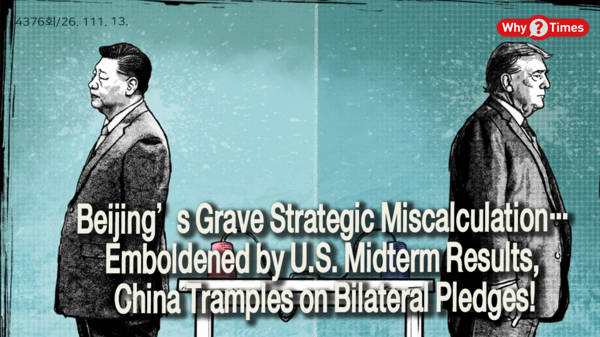
[WSJ: “Seeing a Weakened Trump, Beijing May Face a Far Tougher Negotiator”]
As Republicans lost both chambers of Congress in the midterm elections, weakening President Donald Trump’s grip on domestic governance, assessments are mounting across Washington that Beijing views the outcome as an opening to expand its negotiating leverage against the United States. Yet China has failed to honor the rare earth supply commitments made at the U.S.–China summit in Busan last October. Since that agreement, U.S. imports of Chinese rare earths have plummeted to one-fourth of prior levels, and just weeks ahead of the elections, Beijing even halted refined petroleum product exports. Immediately following the electoral defeat, Trump appointed hardliner Stephen Miller as White House chief of staff, signaling a decisive break from conciliatory policies. Meanwhile, the newly empowered Democratic majority in Congress is poised to become the single biggest obstacle to the relaxation of high-tech export controls that China covets. At the upcoming APEC summit in Shenzhen on November 18–19, the counterpart President Xi Jinping encounters may not be a “lame-duck president,” but rather a leader who suspects China played a role in his political defeat. Beijing’s calculus risks culminating in a severe strategic miscalculation.
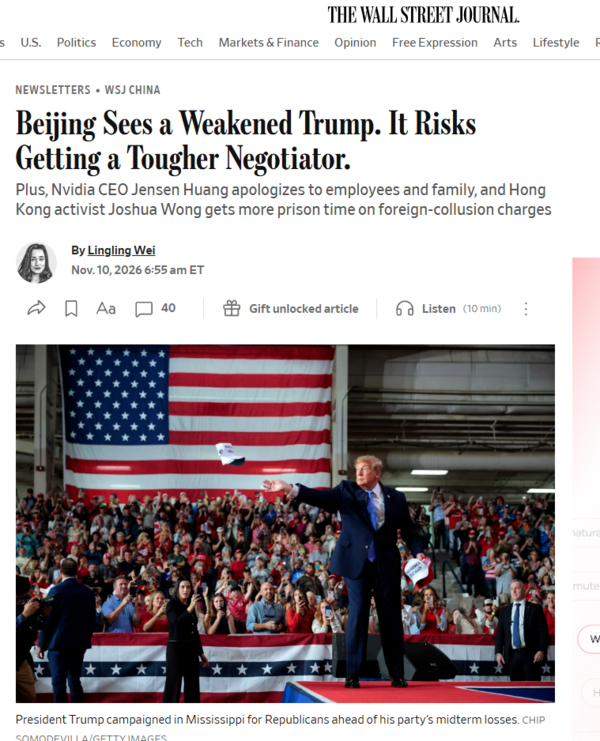
In a November 11 newsletter written by veteran China correspondent Lingling Wei, The Wall Street Journal (WSJ) analyzed that “Beijing’s calculation to exploit Trump’s midterm defeat in negotiations could backfire.” The WSJ recalled November 2014, when President Barack Obama visited Beijing immediately after Democrats suffered midterm losses, and Xi lectured him for hours on Chinese history and governance. Matt Turpin, a visiting fellow at the Hoover Institution who served as director for China on the National Security Council (NSC) during the first Trump administration, noted, “Xi left convinced that Obama’s America would not confront the People’s Republic head-on.” At the time, China’s economy was expanding at over 7%, the West was still nursing the aftereffects of the global financial crisis, and Washington remained committed to free trade with China.
Twelve years later, a U.S. president smarting from midterm losses once again meets Xi Jinping, this time as host of the APEC summit in Shenzhen. Yet the strategic landscape has shifted dramatically. China’s economic health is far weaker than it was a dozen years ago, and Xi faces a critical leadership transition at the 21st Party Congress in 2027—making stability in U.S.–China relations his paramount priority. In an earlier interview with Newsweek, Turpin predicted that “this Party Congress could serve as a ‘referendum’ on Xi Jinping’s rule.”
Even so, Beijing appears unable to resist the temptation to wield the leverage in its hands. Following the May summit in Beijing, China successfully induced the United States to freeze a $14 billion arms sales package to Taiwan—an arrangement President Trump described as a “negotiating chip.” However, unfulfilled promises could upend the calculus ahead of the Shenzhen talks. Turpin remarked, “My hunch is that Trump feels Xi deliberately tripped him up in the midterms.” If Trump truly views matters through that lens, his incentive to make concessions to Xi—including over Taiwan—diminishes sharply.
[One Year After Busan Agreement, Rare Earth Imports Drop to a Quarter of Pre-Restriction Levels]
The core issue is that more than a year after the Busan agreement, Chinese rare earth exports to the United States have actually contracted. According to a report by the Center for Strategic and International Studies (CSIS), the United States imported an average of 76.8 metric tons per month of rare earth compounds and metals from China between June 2024 and March 2025. Between November 2025 and September 2026—following the October 30, 2025 Busan trade truce—that monthly average plunged to 19.3 metric tons, representing a drop of nearly 75%. Despite signing the accord, supply flows have deteriorated below the levels seen prior to April 2025’s sweeping export controls.
The situation is even graver for heavy rare earths. During the eight months preceding China’s export curbs, the United States imported 333 metric tons of yttrium; in the eight months following the restrictions, imports collapsed by 95% to just 17 metric tons. Yttrium is essential for specialized thermal coatings in high-temperature components such as jet engines. In February 2026, two North American aerospace coating firms temporarily halted production due to yttrium shortages, while a third suspended sales of yttrium-oxide products after exhausting inventories. The report concluded that “supply controls are no longer a ‘projected risk’—they are manifesting as actual production stoppages.” The automotive, semiconductor, and defense industries are similarly experiencing raw material shortfalls.
What the report highlighted in particular is that “China’s controls are applied selectively by country.” Over the ten months following the Busan agreement, China’s total global exports of relevant rare earth materials declined by only 2.5%, yet shipments bound for the United States and Japan plummeted by a combined 58%, while exports to other regions surged by nearly 146%. The report analyzed that “Beijing is artificially calibrating which nations obtain critical minerals.” Similarly, Global Trade Alert noted in May that “while China’s global exports of rare earth magnets hit a four-year high following the Busan deal, shipments to the United States hit a four-year low,” characterizing the tactic as “divide and rule.”
Under the Busan agreement, China pledged to postpone for one year the expanded export controls announced on October 9, 2025, and to issue general export licenses for rare earths, gallium, germanium, antimony, and graphite. In return, the United States lowered tariffs on Chinese goods and suspended certain semiconductor export restrictions. However, China’s existing export licensing regime remained intact. Although both sides agreed in September to extend the truce deadline to January 10, 2027, notices issued by China’s Ministry of Commerce still list November 10, 2026 as the expiration date for the suspension of expanded controls. U.S. officials told the Financial Times (FT) in September that “China’s compliance rate on its rare earth commitments stands at only about two-thirds.”
[Washington’s Warning: “Immediate and Complete Implementation”]
Washington’s frustration has also surfaced through formal diplomatic channels. On the 6th, Treasury Secretary Scott Bessent and U.S. Trade Representative (USTR) Jamieson Greer held a video call with Chinese Vice Premier He Lifeng. According to the Treasury Department, Bessent pressed for “complete and immediate implementation of the Busan commitments” and conveyed concerns regarding Beijing’s recent actions. The USTR stated that Greer “emphasized that it is critically important for China to take concrete steps to fully honor its prior commitments, particularly regarding agricultural purchases as well as rare earths and other critical minerals.” Ahead of the January 2027 truce expiration, compliance has emerged as the central flashpoint in bilateral ties.
[A Democratic Congress: The “Biggest Barrier” to Easing Tech Controls on China]
Turpin anticipated that “Democratic congressional leadership will focus its energy on investigating the past two years, exposing corruption, scrutinizing the tech industry, and preparing for the 2028 presidential election.” Unlike the final stretch of the Biden administration—when a Republican House and a Democratic White House forged a bipartisan consensus on China—foreign policy attention this time is more likely to shift toward Israel, Iran, and Russia. In the realm of advanced technology, however, the new Democratic majority in Congress is poised to make life considerably harder for Beijing.
China has long demanded the lifting of U.S. restrictions on advanced semiconductor sales. Yet controversy has recently erupted surrounding Nvidia CEO Jensen Huang. Democratic Senator Chris Coons, who won a fourth term in the midterms, wrote on X: “The more we learn about the unhealthy relationships between the Trump administration, Chinese spies, and AI billionaires, the clearer it becomes that nothing this administration touches is free from corruption,” pledging congressional investigations. With three Republican House committee chairs also summoning Huang for closed-door briefings, the matter has become a bipartisan flashpoint. In such a climate, calls to ease technology controls on China stand virtually no chance of gaining traction.
Xi Jinping may walk into the summit venue confident of holding the upper hand against a weakened Trump. Yet the man sitting across from him will be an American president who privately suspects China bears partial blame for costing his party Congress.
[Why Times Insight]
If Beijing interprets the Republican midterm defeat as a favorable turn and attempts to quietly brush aside the agreements struck between Trump and Xi, it will commit a monumental miscalculation. The camp scrutinizing compliance with U.S.–China accords even more relentlessly than the White House will be the Democratic Party. Democrats on the House Foreign Affairs Committee have already criticized Trump for effectively subjecting Taiwan arms sales to Beijing’s “prior approval,” demanding formal notification of the congressionally authorized $14 billion package.
On China policy, Democrats today are arguably even more hawkish than Trump. Should Xi renege on personal commitments made to Trump, the price will be unified pushback from across Washington. U.S. pressure on China’s semiconductor sector is likely to intensify, and Washington will inevitably hold Beijing accountable for failing to honor its rare earth pledges.
The deeper problem lies in China’s decision-making structure. Rather than assessing international politics dispassionately through an objective lens, Beijing remains trapped inside its own narrative, with aides routinely packaging geopolitical developments to suit what Xi wishes to hear. The “absence of doves toward the United States” and the “profound misunderstanding of America’s power structure” noted by Turpin are direct products of this system. When reports ascending to Zhongnanhai are curated solely to please the supreme leader, miscalculation ceases to be an accident and becomes a structural certainty. Beijing must recognize that a political culture devoid of dissent or self-reflection will only drive China into deeper diplomatic peril with each passing day.
-중국 푸단대학교 한국연구원 객좌교수
-전 EDUIN News 대표
-전 OUR NEWS 대표
-제17대 대통령직인수위원회 정책기획팀장
-전 대통령실 홍보기획비서관
-사단법인 한국가정상담연구소 이사장
-저서: 북한급변사태와 한반도통일, 2012 다시우파다, 선거마케팅, 한국의 정치광고, 국회의원 선거매뉴얼 등 50여권