
Update2026.11.11 (수)

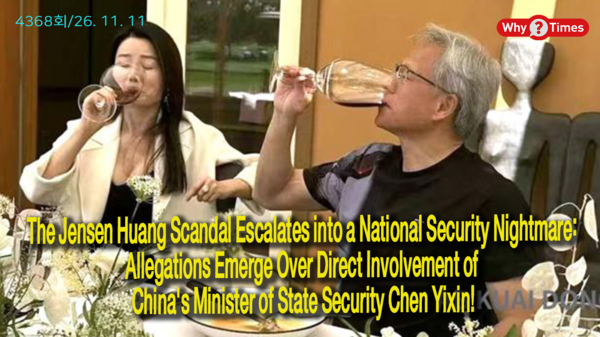
[The 'National Security Nightmare' Highlighted by WSJ… Chen Yixin’s Name Surfaces in Taiwan]
Following NVIDIA CEO Jensen Huang's admission of an extramarital affair, the fallout has escalated into a national security matter unsettling U.S. artificial intelligence (AI) chip export policy toward China. Taiwanese media have raised allegations that Alice Huang (Huang Le), reported to have been close to Jensen Huang, was directly directed by Chen Yixin, China's Minister of State Security. President Donald Trump stated that the Federal Bureau of Investigation (FBI) is looking into the matter, and NVIDIA's board of directors has also initiated an independent investigation. While the U.S. government has not publicly confirmed Chen Yixin's involvement, calls are already growing within the U.S. Congress to strengthen congressional oversight over advanced chip exports and track chips sent overseas.
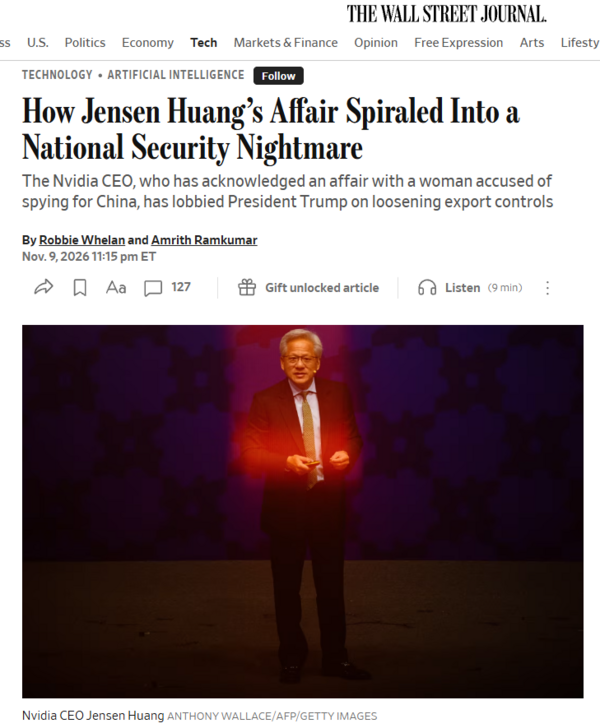
The Wall Street Journal (WSJ) tracked how the relationship between the two intertwined with Washington's chip export policy debate on the 10th in an article titled "How Jensen Huang’s Extramarital Affair Turned into a National Security Nightmare." The WSJ reported that "a classified memo overseen by U.S. Secretary of State Marco Rubio contained a warning that Jensen Huang was personally close to an individual suspected of having ties to Chinese intelligence," adding that "this memo was circulated among senior administration officials ahead of President Trump's visit to China in May."
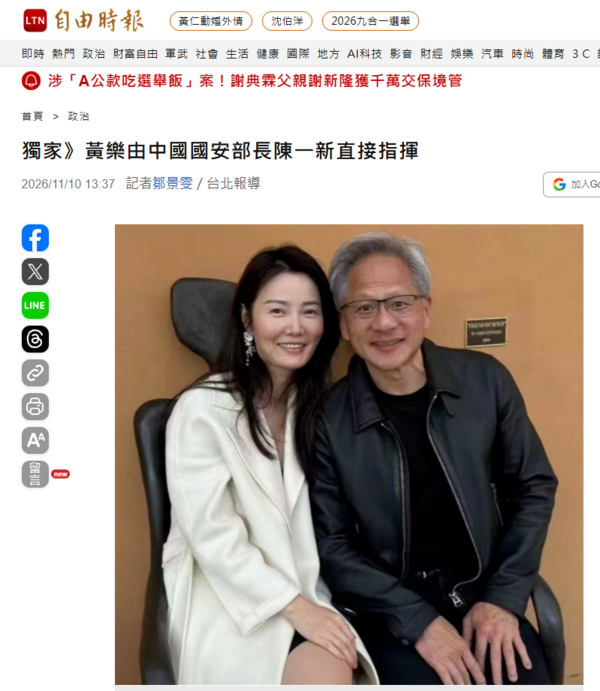
On the same day, Taiwanese media reports shifted the focus of suspicion to who directed Alice Huang. Taiwan’s Liberty Times reported, "The Central Committee of the Chinese Communist Party formed an 'Artificial Intelligence Small Group' to respond to the U.S.-China AI competition, and the Ministry of State Security, which participated in it, established a separate internal 'Chip Unit' (晶片組)," adding that "Alice Huang belonged to this unit and was under the direct command of Minister Chen Yixin."
The Liberty Times identified a two-pronged mission: one was to establish paper companies in third countries to secure advanced chips and servers, and the other was to approach Jensen Huang to influence the easing of Washington's export controls. Allegations also surfaced that personnel assigned similar missions infiltrated various levels within U.S. technology companies.
In a follow-up report, the Liberty Times revisited an article written earlier this year by Chen Yixin in Qiushi, the CCP's theoretical journal. In the article, Chen argued that in the face of external challenges, China must deeply wage struggles against "subversion, hegemony, separatism, espionage, and containment/blockade." The newspaper drew attention to the term "anti-blockade," interpreting it as an indication that directives to break through the U.S. chip blockade were in fact being executed through intelligence operations.
[From a Taipei Bar to H20 Approval: The Trajectory of Influence]
Following the timeline reconstructed by the WSJ, the personal relationship and policy lobbying coincided chronologically. The two first met in March 2024 at an NVIDIA event in California. Three months later, at a bar in Taipei during Computex, Alice Huang reportedly told industry executives, "Jensen is a good friend of mine," adding, "I can call him over," after which CEO Huang actually appeared minutes later and ordered whiskey. Weeks after the two were spotted kissing on the cheek at a dinner in Taipei in May 2025, CEO Huang met with Deputy Secretary of State Christopher Landau alongside his lobbying team to request export clearance for the H20 chip tailored for China. Days later, the administration approved H20 sales on the condition that 15% of China sales be remitted to the U.S. Department of the Treasury.
Around the same time, NVIDIA General Counsel Tim Teter contacted Jeffrey Kessler, head of the Commerce Department’s Bureau of Industry and Security (BIS), after learning of an investigation into Megaspeed. Immediately thereafter, the Department of Justice took over the probe, which the WSJ reported was partly driven by concerns that contact between Kessler and NVIDIA had contaminated the investigation. The U.S. Commerce Department's BIS pushed back, stating, "All enforcement is carried out strictly by the book." In October 2025, when President Trump considered sales of next-generation chips to China as a bargaining chip, Secretary Rubio and Commerce Secretary Howard Lutnick intervened to block it. However, in December of the same year, sales of the H200 to China were permitted on the condition that the government receive 25% of the revenue.
[Wall Street’s Calculation: "Short-term Headwind if Private, a Perfect Storm if Security"]
Market reactions compiled by Reuters converge on a single question: "Will this end as a private misstep, or escalate into a national security matter?" Garry Black, Managing Partner at The Future Fund, remarked, "It raises questions about whether CEO Huang can remain in his post," noting that "there is no natural successor within the company." Bill Ackman, CEO of Pershing Square, said, "If this is anything more than a simple affair, it is clearly a real problem." Shaun Maguire, Partner at Sequoia Capital, while criticizing that "CEO Huang did something extremely foolish and detrimental to the United States," evaluated that within U.S. AI leadership "he is irreplaceable"—a sentiment with which Tesla CEO Elon Musk concurred in a reply, stating, "Agreed."
Chris Weston, Head of Research at Pepperstone, viewed the likelihood of replacement as low, but noted, "If that woman is confirmed to be an actual spy, the situation becomes genuinely bad." Atif Malik, an analyst at Citi, pointed out governance, heightened regulatory scrutiny, and compliance with export controls regarding third-party transit as core issues. Josh Gilbert, market analyst at eToro, singled out the November 17 earnings report as the next litmus test.
[Congress Issues Subpoenas, Export Controls Shift to 'End-Users']
Congressional pressure is mounting. Three Republican committee chairs—the House Select Committee on China [China Watch], the Foreign Affairs Committee, and the Permanent Select Committee on Intelligence—demanded that CEO Huang appear at a closed joint briefing on the 18th to clarify the circumstances of his contact with Huang Le and NVIDIA's counterintelligence security protocols. Democratic Senator Elizabeth Warren has also repeatedly demanded testimony. Senate Republican Leader John Thune stated, "In an era of cyber threats and superintelligence, matters like this carry far greater significance." Lawmakers from both parties signaled their intent to include robust chip export restriction provisions in the defense authorization bill.
Field enforcement is also tightening. In 2023, the Commerce Department's Bureau of Industry and Security (BIS) dispatched its first regional export control officer, Ariel Leinwand (Lin An-chieh), to the American Institute in Taiwan (AIT) in Taipei, who also covered South Korea and Japan. Within Taiwan's industry, word has circulated that a second export control officer has taken up the post as cooperation broadens beyond semiconductors to drones and unmanned surface vessels. Chu Chen-tso, Secretary-General of the International Artificial Intelligence Law Research Foundation, diagnosed that export controls are evolving from "commodity control" to "compute power control." He stressed that companies must move beyond Know Your Customer (KYC) to establish systems for "Know Your End-User" and "Know Your Compute User."
[Jensen Huang’s 'China Logic' Shaken]
The deeper wound left by this incident is the erosion of credibility surrounding the rationale CEO Huang has advanced for years regarding chip sales to China. He had argued that export controls would inadvertently foster Huawei and undermine U.S. dominance. A foreign media column assessed, "Whether that argument was right or wrong, it has now been shaken along with his credibility." Indeed, Chinese demand remains robust, with ByteDance, Alibaba, and Tencent recently placing orders exceeding $35 billion for NVIDIA processors adapted to U.S. regulations. However, the column projected that the Congress newly constituted following last week's midterm elections will apply far stricter scrutiny to his calls for market expansion.
[Why Times Insight]
First, whether the allegation of direct command by Chen Yixin is verified or not, the already established facts sufficiently expose a structural problem. A high-ranking figure from a firm under investigation for export control violations maintained a close personal relationship with the CEO of the company holding a virtual monopoly on global AI chip supply. During that same period, the CEO was lobbying the President to ease chip export controls. The possibility that China's traditional intelligence tactic—the honey trap—was operationalized at the most sensitive frontier of high-tech supremacy underscores just how heavily technology governance in democratic nations relies on individual discretion.
Second, this affair will significantly shake the political foundation of the premise that "we must sell to China to slow down its self-reliance." The very allegation that the primary proponent of this logic was targeted by Chinese intelligence fosters suspicion that the argument aligned with Beijing's interests. Moving forward, the center of gravity in U.S. chip policy toward China is likely to shift from "how much to sell" to "who ultimately uses it."
Third, this is not an unrelated matter for the supply chains of South Korea and Taiwan. Circumvention via third-country data centers in Southeast Asia is not isolated to Megaspeed; it is a structural conduit. South Korean firms will soon face demands for compliance rigorous enough to match end-user due diligence.
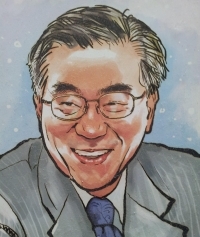
-중국 푸단대학교 한국연구원 객좌교수
-전 EDUIN News 대표
-전 OUR NEWS 대표
-제17대 대통령직인수위원회 정책기획팀장
-전 대통령실 홍보기획비서관
-사단법인 한국가정상담연구소 이사장
-저서: 북한급변사태와 한반도통일, 2012 다시우파다, 선거마케팅, 한국의 정치광고, 국회의원 선거매뉴얼 등 50여권