
Update2026.11.11 (수)

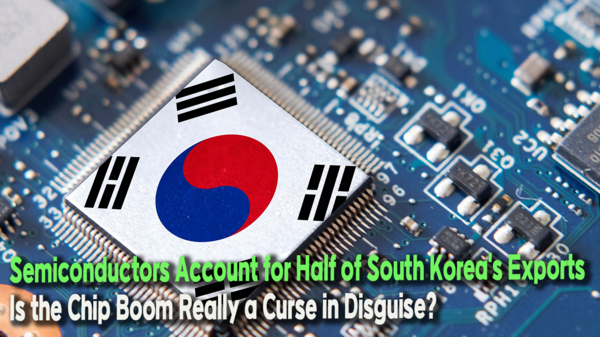
[The South Korean economy where three-quarters of export growth comes from semiconductors]
While semiconductors are propelling the South Korean economy into the era of $1 trillion in annual exports, warnings are mounting that this very boom could turn out to be a "curse in disguise," eroding the nation's economic resilience from within. In October, semiconductor exports surged to 3.6 times their level from a year earlier, making it virtually certain that annual exports will cross the $1 trillion threshold within the month. However, while IT accounts for half of all manufacturing output, its share of manufacturing employment lingers at a mere 2.6%. Clear signs of a "semiconductor Dutch disease" are also emerging, as capital and talent flock into chips while hollowing out the foundation of other industries. Compounding this is a demographic aging process that will unfold faster than in any other major economy over the next decade. The moment the chip cycle turns downward, South Korea will simultaneously face two massive bills: a hollowed-out manufacturing sector and an aged population. If the 1997 Asian financial crisis was a "blessing in disguise" that forced structural reform, the current supercycle risks becoming a trap that erases the very urgency to reform.
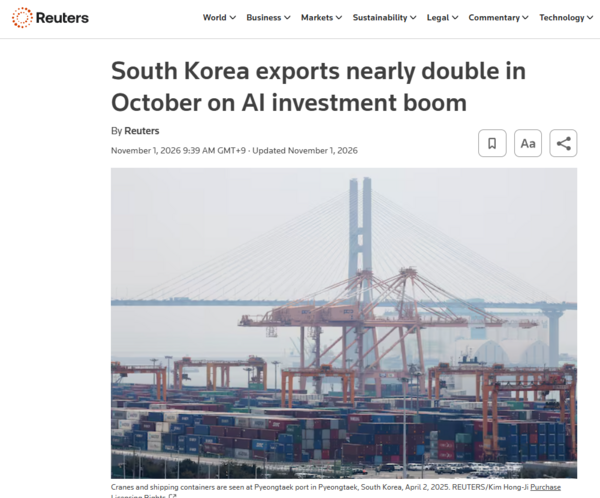
Citing data from the Ministry of Trade, Industry and Energy, Reuters reported on the 1st that South Korea's October exports jumped 93.7% year-on-year to $115.28 billion (approximately 155 trillion won), marking the second-largest monthly figure on record following September and registering the highest rate of increase since 1974. Part of this jump was driven by a calendar effect, as the Chuseok holiday shifted to September, adding two more working days. The skew, however, is even more dramatic. From October 1 to 20, semiconductors accounted for 44.7% of total exports, up 16.2 percentage points compared to a year earlier. Nearly half of South Korea’s total exports now depend on a single product.
Foreign observers are looking closely at the dark side behind the celebrations. In an October 30 column for Forbes, Asian economy columnist William Pesek diagnosed that South Korea has moved past the phase of riding the AI boom; now, the boom is riding the South Korean economy. Drawing parallels to the "resource curse" seen in nations reliant on oil, gold, or diamonds, he wrote that South Korea may soon show the world what happens when an entire economy becomes excessively dependent on AI. Domestic voices echo similar cautions: if the 1997 financial crisis was a "blessing in disguise" that mandated the exit of unviable financial institutions and the overhaul of chaebol governance, today's supercycle could perversely mask reform failures for years to come.
[The anatomy of concentration identified by the IMF and the Bank of Korea]
International organizations offer a consistent assessment. In October, the IMF raised its growth forecast for South Korea this year from 2.6% to 3.3%. At the same time, it cautioned that the benefits of the boom have not sufficiently trickled down to households and domestic demand, warning that heavy reliance on a single sector could leave the economy exposed if AI investment or chip demand falters. Jiyoung Choi, an executive director at the IMF, noted that if the AI wave stumbles, South Korea could face stock market adjustments, current account corrections, and corporate distress. The IMF further estimated that a sharp correction in AI demand could reduce Asian output by roughly 1.7% relative to baseline projections.
The root of these warnings lies with the Bank of Korea. According to a July report by the Bank of Korea, IT manufacturing's share of total manufacturing output surged from under 30% in the past to 51% in the first quarter of this year, yet its share of employment remained at just 2.6%. This indicates that the fruits of rising profits and wages are locked inside a specific sector and fail to spill over into broader household consumption. Furthermore, the domestic semiconductor industry relies on imports for about 60% of its manufacturing equipment, and overseas investment is expanding amid supply chain realignment, further limiting domestic ripple effects. In the first quarter, semiconductor prices jumped 92.5% year-on-year, and IT accounted for 73.4% of total export price inflation. Because this boom is primarily price-driven, the downside will be equally steep once prices turn.
In its report, the Bank of Korea noted that if the semiconductor boom persists over a prolonged period, attention must be paid to the potential onset of "Dutch disease"—akin to resource exporters like Australia in the 2000s—where high wages and high returns on investment in a specific sector siphon off talent and capital from other industries, eroding the broader growth base. Pesek reinforced this warning, citing the Bank of Korea as one of the most sober and clear-eyed monetary authorities in the world. Dutch disease was a term coined by The Economist in 1977. It describes the phenomenon in the 1960s where the discovery of North Sea gas fields led to a sharp appreciation of the guilder, causing the energy sector to absorb labor and capital from manufacturing and ultimately undermining overall industrial competitiveness.
[Won appreciation: Is the trigger for the disease being pulled?]
Until recently, the weak link in the semiconductor Dutch disease hypothesis was the exchange rate. The classic transmission channel involves heavy export-driven foreign exchange inflows pushing up the domestic currency, which then undermines the price competitiveness of other export industries; however, the Korean won remained surprisingly weak during the first half of the year. Buffeted by energy price shocks and heavy overseas investments by domestic residents, the won-dollar exchange rate touched 1,561.5 won on June 5, hitting a 17-year low for the won. As inflation climbed to 3.2%, the Bank of Korea raised interest rates in July for the first time in over three years, followed by an additional hike in August to bring the policy rate to 3.00%.
The trend reversed heading into the second half. By early November, when converting the exchange rates published by the Banque de France into dollar terms, the won-dollar rate hovered in the mid-1,330 won range, strengthening by more than 200 won from its June low. While the semiconductor sector can absorb won strength thanks to its pricing power, industries with razor-thin margins—such as automobiles, chemicals, steel, and machinery—face an entirely different reality. Taiwan offers a cautionary precedent. The Economist noted that Taiwan had suppressed its currency over the past year to avert Dutch disease, only to find that purchasing power eroded, home prices skyrocketed, and financial vulnerabilities accumulated—a predicament it labeled "Formosa flu." It is a classic dilemma: let the currency rise and manufacturing takes the hit; suppress the currency and households bear the brunt.
[The 'K-shaped boom'—the silicon-collar elite and the marginalized majority]
The dividends of this boom are already diverging along extreme lines. In April, Bloomberg highlighted the perils of a "K-shaped economy," reporting that under optimistic projections, bonuses in the semiconductor sector could approach $900,000 (around 1.2 billion won). MIT Technology Review reported on the emergence of a new elite class known as the "silicon collar," whose members earn roughly 20 times more than the average worker.
Where the money ends up flowing is another major concern. According to the SCMP, Kim Yong-beom, the presidential chief of staff for policy, warned that unless the windfalls of the boom are widely distributed, real estate speculation and inequality could intensify. The dynamic of a high-wage sector drawing away talent and driving up wage costs across other industries represents the exact labor transmission channel of Dutch disease. Dutch financial group ING also projected widening income inequality. In a market structure where just two semiconductor giants make up more than half of the KOSPI's market capitalization, wealth effects remain largely confined to asset-holding households.
[The 10-year demographic countdown]
The point where the "curse" hypothesis transcends simple sector-concentration warnings is demographics. According to a Goldman Sachs analysis cited by Fortune, South Korea's total fertility rate stands at 0.8, with people aged 65 and older accounting for roughly 20% of the population. Under UN projections, the dependency ratio will climb by 1.5 percentage points annually over the next decade—the fastest pace among the 70 countries analyzed by Goldman Sachs, outpacing even Japan's trajectory between 2000 and 2015. Despite skyrocketing chip exports and capital expenditure, retail sales remain stuck around 2019 levels, prompting Goldman Sachs to define the situation as a "K-shaped cycle."
The more acute issue lies in household asset composition. More than 60% of South Korean household net wealth is tied up in non-financial assets, while financial assets stand at roughly 100% of GDP in 2024—the lowest in the Goldman Sachs sample. Among older households with retirement savings, fewer than one in four can cover living expenses through financial assets alone. This stands in sharp contrast to Taiwan, where net financial assets equal approximately five times GDP. Meanwhile, the enrollment rate in reverse mortgages among homeowners aged 75 and older is a meager 1.8%. Goldman Sachs highlighted the monetization of housing equity for senior households and the broader diffusion of tech sector profits as urgent policy priorities. If the windfall of the boom flows right back into real estate, senior wealth will become even more illiquid, leaving no safety cushion to support private consumption once the boom ends.
[Fiscal optical illusion and the vanished urgency for structural reform]
The boom is also inflating fiscal metrics. As nominal GDP expands, the sovereign debt-to-GDP ratio appears lower, yet the actual debt load has not diminished. The National Assembly Budget Office projected that if rigid outlays such as welfare and pensions are maintained, national debt will reach 4,057 trillion won by 2050, more than triple its current size. Former Bank of Korea Governor Rhee Chang-yong remarked that the semiconductor boom alone cannot reverse the long-term trend of sluggish growth. He urged that the fiscal resources generated by the boom should not be poured solely into semiconductors, but directed toward tackling youth unemployment, countering low fertility, and strengthening the competitiveness of other industries.
Norway illustrates a viable path forward. Norway staved off Dutch disease by channeling oil revenues into a sovereign wealth fund invested abroad, keeping the principal untouched and withdrawing only within an expected real return of 3% under strict fiscal rules. Although the South Korean government plans to set up a "future fund" using surplus tax receipts, concerns persist that without Norway-style binding rules, the vehicle could easily devolve into another political piggy bank.
[Why Times Insight]
The true essence of the "curse in disguise" lies not in the boom itself, but in the fact that three distinct clocks are ticking down toward the exact same moment. The first is the semiconductor cycle clock. Dutch financial group ING expects DRAM prices to soften around 2028 as structural supply conditions improve. Because global players are aggressively expanding memory capacity simultaneously, the subsequent downturn could prove just as steep as the ascent. The second is the won appreciation clock. It takes a time lag of two to three years for currency strength to fully erode the profitability and capital investment of non-semiconductor manufacturing. The third is the demographic aging clock. The coming decade—during which the dependency ratio will climb faster than anywhere else in the world—coincides with an explosion in pension and healthcare outlays. Around 2030, when these three forces converge, the moment semiconductor tax receipts plunge, fiscal demands will reach their zenith, manufacturing that should serve as a shock absorber will already be hollowed out, and household wealth will remain trapped in real estate—culminating in a catastrophic "double cliff."
The 1997 financial crisis was a crisis of liquidity. Back then, South Korea possessed a youthful demographic profile and an intact manufacturing foundation, enabling a swift V-shaped recovery following painful restructuring. The looming crisis is fundamentally different. It is structural, slow-moving, and, above all, devoid of the young labor force required to engineer a recovery. It is a scenario where the industrial hollowing-out of the Netherlands and the lost three decades of Japan arrive simultaneously. The 1997 crisis struck overnight, but a crisis born of a boom accumulates silently amid the fireworks. The cost of postponing labor, pension, and education reforms is far more punitive precisely because it remains invisible in the short run. Winning the semiconductor race while losing the structural reform race would be the ultimate "curse in disguise." The solution is not to stifle semiconductors. It is to bank the windfall into a fund bound by strict fiscal rules, unlock the liquidity of aging households' property assets, and dismantle labor market rigidities. Structural reforms to revive market dynamism must be completed before the music stops. This is an imperative the South Korean government cannot afford to forget.


-중국 푸단대학교 한국연구원 객좌교수
-전 EDUIN News 대표
-전 OUR NEWS 대표
-제17대 대통령직인수위원회 정책기획팀장
-전 대통령실 홍보기획비서관
-사단법인 한국가정상담연구소 이사장
-저서: 북한급변사태와 한반도통일, 2012 다시우파다, 선거마케팅, 한국의 정치광고, 국회의원 선거매뉴얼 등 50여권