
Update2026.11.07 (토)

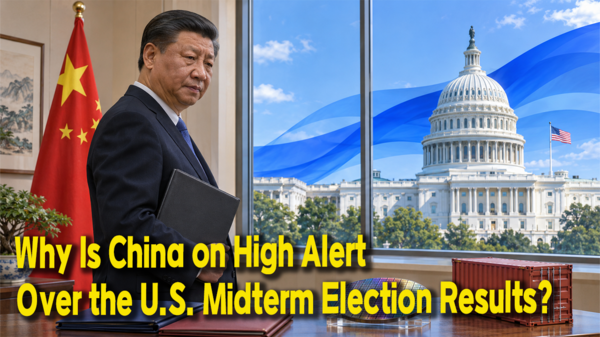
['Blue Wave' of the Democratic Party Shakes Xi Jinping’s U.S. Strategy]
With the Democratic Party recapturing both the Senate and the House of Representatives in the U.S. midterm elections, Chinese President Xi Jinping’s U.S. strategy has entered a state of emergency. Until now, China sought to navigate tariffs, high-tech sanctions, and the Taiwan issue through summit diplomacy with President Trump. However, the emergence of a Democrat-controlled Congress significantly increases the likelihood of roadblocks being thrown into such deals. In particular, regarding arms sales to Taiwan and export controls on semiconductors and AI, Beijing's burden is expected to mount further as China hawks within the Republican Party could join forces with Democrats. Contrary to expectations that a politically weakened U.S. president would benefit China, the realignment of power in Washington is emerging as a fresh variable ratcheting up pressure on Beijing.
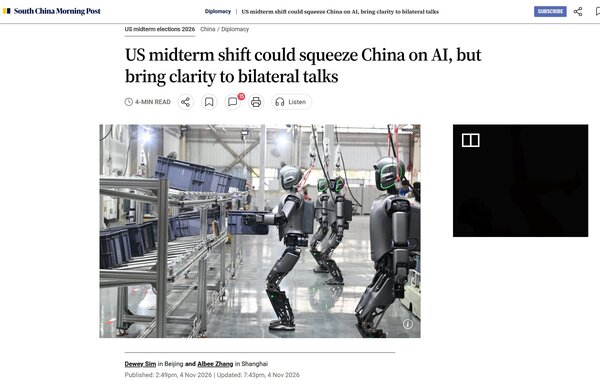
Hong Kong’s South China Morning Post (SCMP) reported on the 4th, citing Professor Zhao Minghao of Fudan University, that the Democratic victory represents a "blue wave" and predicted that a Congress controlled by Democrats will step up pressure on China regarding Taiwan, artificial intelligence, and export controls.
What warrants close attention here is that this does not necessarily mean the Democratic Party is more hawkish toward China than the Republican Party. While both parties view China as America's core strategic competitor, their approaches differ. Whereas Trump leans toward transactional deals using tariffs and leader-to-leader diplomacy, Democrats are far more likely to emphasize allied cooperation, technology regulations, human rights, and institutional checks. Ultimately, this means it has become much harder for China to adjust U.S. policy toward Beijing purely through personal negotiations with Trump.
[The Taiwan Issue China Fears Most: Talk of Codifying the 'Six Assurances' into Law]
The area where Beijing cannot help but react most sensitively is Taiwan. China defines the Taiwan question as an essential red line in U.S.-China relations. However, a strong bipartisan consensus exists within the U.S. Congress to check China and bolster Taiwan’s defensive capabilities.
A key point of focus is the so-called "Six Assurances" given to Taiwan by the Ronald Reagan administration in 1982. These principles include not setting a date for ending arms sales to Taiwan, not holding prior consultations with China on arms sales, and not pressuring Taiwan to negotiate with Beijing.
These principles serve as vital political commitments underpinning U.S. policy toward Taiwan. If Congress formalizes them into more binding statutory law, the political room for a president to scale back or recalibrate support for Taiwan in the name of negotiating with China would be severely curtailed.
Scholars in Taiwan are closely monitoring this possibility as well. According to provided materials, Professor Fan Shih-ping of National Taiwan Normal University raised the possibility that legislation related to Taiwan could accelerate now that the Democrats control Congress.
Additionally, a reported arms sales package to Taiwan valued at approximately $14 billion is emerging as a major point of contention. If reports are true that the Trump administration has been stalling relevant procedures in consideration of negotiations with China, a Democratic Congress could lean on the executive branch through hearings, budget reviews, and related legislation.
That said, Congress cannot instantaneously force the president to execute specific arms transfers, as authority over approval and implementation remains with the executive branch. The crux of the matter is that heightened congressional pressure makes it increasingly difficult for President Trump to freely utilize the Taiwan issue as a bargaining chip with China.
This structural shift is precisely what China fears. If Taiwan transitions away from being a subject of bilateral summit bargaining toward the realm of U.S. domestic law and bipartisan national security policy, Beijing’s diplomatic leverage will inevitably be constrained.
[Semiconductor and AI Export Controls: Another Barrier to China’s Technological Rise]
Pressure on China does not stop at the Taiwan issue. Rather, what directly impacts China’s economy and future industries is the likely tightening of restrictions surrounding advanced semiconductors and AI.
The United States already treats advanced AI semiconductors, chipmaking equipment, and the transfer of core technologies to China as national security matters. Even if the Trump administration tries to use certain technology exports as negotiation leverage, a Democratic Congress can rein this in via export license oversight, corporate inquiries, and budgetary controls.
SCMP reported on the 4th that following the Democratic victory in the U.S. midterms, the prospect of tighter regulatory oversight over the AI industry has surfaced as a major variable across Asian financial markets. This underscores how power shifts within the U.S. Congress reverberate far beyond foreign policy, impacting global technology investment and supply chains.
This presents a deeply uncomfortable situation for China. While the Xi Jinping administration has championed self-reliance in advanced chips and fostered the AI sector as national imperatives, securing high-performance semiconductors and cutting-edge manufacturing equipment remains an urgent challenge. As U.S. tech controls tighten, Chinese firms face added strain across performance, production costs, and development timelines.
Moreover, if semiconductor export controls are codified and fortified through statutory law and congressional oversight, easing them at presidential discretion becomes far less viable. Even if China manages to extract concessions in talks with Trump, the durability of those gains becomes highly uncertain. In the end, the realignment of congressional power acts as a new pressure factor weighing on China’s technological self-reliance strategy.
[Xi Jinping Ahead of the Shenzhen APEC: Is Trump’s Political Weakening an Opportunity or a Crisis?]
Against this backdrop, the stage China is watching closely is the APEC Economic Leaders' Meeting scheduled for November 18–19 in Shenzhen. According to the official schedule released by the Chinese government, this summit stands as one of the largest multilateral diplomatic events hosted by China in 2026.
Beijing is likely to use this platform to stabilize ties with the U.S. and pursue breakthroughs on critical friction points such as tariffs, high-tech regulations, and rare earths.
Yet the post-midterm landscape has grown complicated. While President Trump’s domestic political base has been dented by the election defeat, he retains considerable authority in foreign negotiations. Consequently, he might seek diplomatic achievements through summitry with China, or conversely, attempt to recover domestic political standing by doubling down on a hardline anti-China stance.
A Democratic Congress is not necessarily disadvantageous to China in every respect. If Democrats criticize Trump’s tariff policies over consumer inflation and corporate burdens, China might seize upon this as an opening in trade talks. However, any easing of tariff pressure will not translate to a relaxation of strategic checks regarding Taiwan or semiconductors.
Time is the most critical factor. The new Congress convenes on January 3 of next year. Even if Trump and Xi reach an agreement before that date, depending on its terms, it could face stringent oversight and legislative resistance from the incoming Congress.
While Xi has incentives to expedite talks with Trump, he must also weigh the risk that pushing a politically vulnerable Trump too hard could trigger an unexpectedly severe backlash. The dilemma confronting China is clear: a weakened Trump may create negotiating opportunities, but the weaker Trump becomes, the more unyielding congressional pushback against China will grow.
[Why Times Insight; Even If Trump Weakens, U.S. Pressure on China Will Not Abate]
These U.S. midterm elections deliver three overarching takeaways for Beijing. First, structural limits are emerging in Xi Jinping’s strategy of leader-to-leader diplomacy toward the U.S. China could attempt to strike trade and tech compromises directly with President Trump. Yet if Congress steps in with legislative and budgetary checks, summit agreements alone cannot readily alter U.S. policy toward China. Beijing must contend not merely with Trump the individual, but with the entire American political and national security apparatus.
Second, bipartisan U.S. resolve to counter China on Taiwan and advanced technologies is solidifying. A Democratic-led Congress does not mean every hawkish policy will advance automatically. Nevertheless, shared bipartisan interests in strengthening Taiwan's defenses and safeguarding advanced technologies form a formidable barrier that China cannot easily fracture. Over the long run, these institutional checks pose a far heavier burden for Beijing than tariffs.
Third, Trump’s domestic political weakening could introduce greater volatility into U.S.-China friction. Trump may attempt to manufacture diplomatic wins to break through domestic political headwinds, while a Democratic Congress vigorously opposes any concessions to China. If summit outcomes collide with domestic political demands, bilateral uncertainties will only escalate.
Ultimately, the development China must fear most from these midterms is not the Democratic victory itself, but the reality that Xi Jinping’s calculation—that U.S. pressure could be moderated through direct bargaining with Trump—may no longer hold.
Trump may well continue seeking deals with China, but whether any deal can halt the United States' broader strategic competition with Beijing is entirely another matter. This marks the most formidable strategic conundrum confronting Beijing in the wake of the U.S. midterm elections.
-중국 푸단대학교 한국연구원 객좌교수
-전 EDUIN News 대표
-전 OUR NEWS 대표
-제17대 대통령직인수위원회 정책기획팀장
-전 대통령실 홍보기획비서관
-사단법인 한국가정상담연구소 이사장
-저서: 북한급변사태와 한반도통일, 2012 다시우파다, 선거마케팅, 한국의 정치광고, 국회의원 선거매뉴얼 등 50여권