
Update2026.10.24 (토)

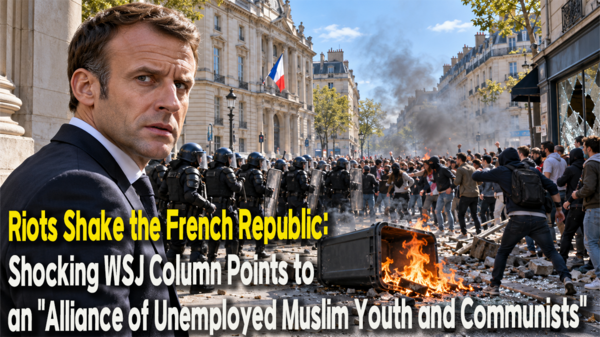
[WSJ: "More Than Student Protests"... Debate Swirls Over the Nature of the Riots]
Student protests across France have rapidly escalated into arson targeting public infrastructure and widespread looting, posing a severe test to the Republic's capacity to uphold public order. A controversial Wall Street Journal (WSJ) opinion column has ignited fierce debates over social integration by characterizing the unrest as an alliance between unemployed Muslim youth and communist activists. However, the actual composition of the rioters and the extent of any coordinated ties remain matters for official criminal investigation. What remains indisputable is that as grievances in classrooms spilled out into rage on the streets, the Macron administration found both its willingness to address citizens' demands and its ability to deter violent breakdown called into serious question.
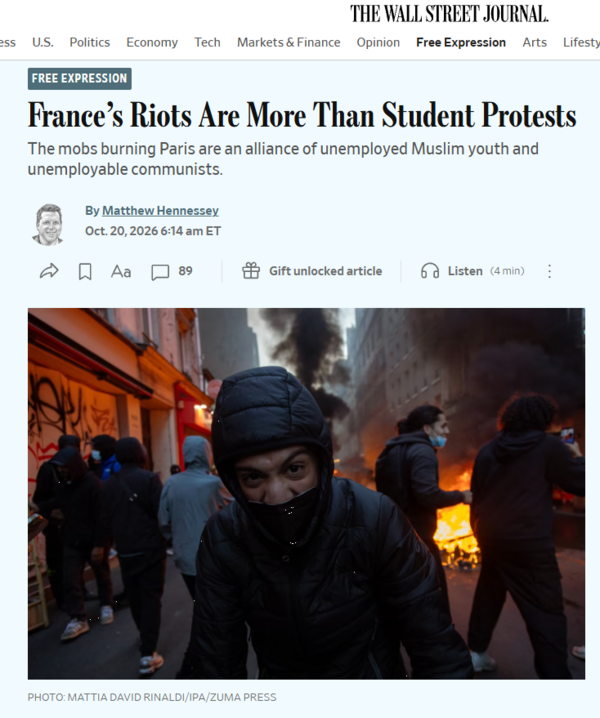
The Wall Street Journal (WSJ) challenged the prevailing narrative framing the unrest merely as student demonstrations through an opinion column by Matthew Hennessey, editor of WSJ Opinion's daily newsletter Free Expression.
Drawing on visual impressions from riot footage and demographic data regarding immigrant communities, the WSJ column posited that the unrest is driven by a convergence of unemployed Muslim youth and communist activists. The piece argued that complaints over education budgets or the rising cost of living alone cannot account for the sheer scale of urban destruction. The column, however, stopped short of presenting investigative evidence or empirical data to demonstrate formal collusion or delineate the exact proportion of participants from each group.
Concurrently, investigative reporting by the WSJ traced how the movement metastasized. Initial grievances over deteriorating school conditions quickly broadened into protests against inflation, degraded public services, and broader dissatisfaction with the government. This dynamic drew in organized labor, leftist activists, and remnants of the Yellow Vests (Gilets Jaunes). While the movement originated in the education sector, both the demographics on the streets and their core demands have long exceeded those initial boundaries.
[Youth at the Onset… Distinguishing Legitimate Protests from Later Rioting]
Minors constituted a significant majority during the opening stages of the demonstrations. Reuters cited the French Ministry of Justice noting that minors made up 87% of the 5,060 individuals arrested since the protests began. This statistic underscores the demographic character of the initial wave. By the 17th, the mobilization expanded into nationwide rallies drawing students, workers, trade unions, and Yellow Vest sympathizers. The Associated Press reported that broad, peaceful marches occurred alongside outbreaks of severe violence across several metropolitan areas. Here, a critical distinction is paramount: not all demonstrators are rioters, and students harbor legitimate civic grievances; nonetheless, legitimate demands cannot be allowed to obscure or excuse the criminal culpability of arson and looting.
[Limoges City Hall Torched: Government Points to the Far-Left and Opportunistic Looters]
The violence soon migrated from commercial storefronts and vehicles to municipal institutions. The arson attack on the Limoges City Hall delivered a profound psychological shock, showing that even physical symbols of the state and local administration could not be secured. According to the AP, the French government singled out radical far-left elements alongside opportunistic criminal groups—including marginalized, unemployed youth—as the primary instigators. Nonetheless, security analysts caution that small, militant far-left cadres alone cannot account for the nationwide scope of looting. This reality underscores the need for law enforcement to decouple politically motivated assaults from opportunistic street crime.
The tactical methods of radical extremists significantly complicate police interdiction. The Financial Times (FT) noted that the "Black Bloc"—characterized by head-to-toe black clothing and concealed identities—functions less as a centrally directed hierarchy and more as a shared, decentralized direct-action tactic. Dispersed methods of this nature cannot be dismantled simply by detaining key figureheads; they demand predictive intelligence, rapid tactical deployment, and meticulous digital tracking of perpetrators.
[Military Support Weighed: Government Concedes Early Operational Failures]
Reuters reported that the French government is exploring options to mobilize armed forces personnel in support functions alongside police to manage anticipated unrest. Prime Minister Sébastien Lecornu conceded failures in the state's initial tactical response, while Interior Minister Laurent Nuñez publicly accepted responsibility and offered an apology. While targeted curfews in select municipalities helped restore temporary calm, security agencies remain on high alert for fresh clashes. Frustrations originating in classrooms have thus ballooned into a national public safety crisis necessitating discussions of military logistical support.
The WSJ noted that roughly 200 investigators in the Paris metropolitan area alone are scouring through closed-circuit television (CCTV) feeds and social media footage to identify and track individuals implicated in looting and assaults on public buildings. A momentary lull in the streets does not signal the end of the crisis. Authorities face the dual challenge of enforcing legal accountability for criminal acts while preventing comparable disorder from paralyzing subsequent public gatherings.
[Immigration and Social Integration: Neither to Be Dismissed Nor Presumed]
In debating this crisis, setting students and immigrant communities against one another as inherently antagonistic blocs is an oversimplification. Students frequently come from immigrant households, and French citizens often possess diverse immigrant backgrounds. The latest demographic overview from the French National Institute of Statistics and Economic Studies (INSEE) estimates that immigrants accounted for 11.6% of the population in 2025, with roughly one-third having acquired French nationality. An immigrant background cannot be conflated with foreign status or presumed hostility toward the Republic.
Equally, there is no justification for avoiding hard scrutiny of France's integration policies. When localized areas suffer persistent cycles of interrupted education, chronic unemployment, and systemic insecurity, the efficacy of public policy must be challenged. What is required is not visual profiling based on race or appearance, but empirical assessments of school dropout rates, job market access, residential segregation, criminality, and institutional trust. Only through this level of rigor can society differentiate genuine criminal accountability from systemic, long-term policy failures.
[Fiscal Straitjackets Limit Macron: Centrist Coalition Under Pressure Ahead of Presidential Race]
The Macron administration now finds its hands tied by acute fiscal constraints. Reuters observed that deteriorating public finances make it increasingly unfeasible for the government to appease public anger through sweeping budgetary concessions, as it has in past crises. Addressing strained public services and alleviating household financial burdens require significant capital, yet fiscal space has dwindled. With ballooning costs tied to property damage repair and heightened security operations, the administration is confronting a compounding deficit of fiscal resources and the political trust required to advance reforms.
Across the political spectrum, Marine Le Pen and Jean-Luc Mélenchon have seized on the administration’s handling of the crisis to mobilize their respective bases. Protracted instability often tilts the political landscape toward hardline law-and-order platforms. While this dynamic does not guarantee an outright victory for any single candidate or cement an inevitable runoff matchup, the riots undeniably intensify the political drag on Macron’s final term and sharply narrow the maneuverability of the centrist bloc.
[Why Times Insight] A State Failing Both to Address Grievances and to Deter Violence
This crisis cannot be dismissed with a single brushstroke as an "immigrant insurrection." The more pressing questions are why the state failed to address underlying tensions while classroom discontent metastasized into national unrest, and why contingency planning was insufficient to curb widespread arson and looting at public gatherings.
The state’s fundamental responsibility is clear: it must resolve legitimate public demands concerning education and living standards while holding those who engage in violence strictly accountable. Squalid classroom conditions do not justify burning down a city hall, nor does the presence of arsonists invalidate the genuine grievances voiced by students and workers. Successfully managing both imperatives is the benchmark of statecraft.
Where organized radical left-wing involvement is substantiated, politically veiled violence must be prosecuted. Where dense immigrant suburbs suffer chronic exclusion from schooling and jobs, integration frameworks must be systematically overhauled. In either scenario, accountability and policy remedies must rest on concrete evidence rather than conjecture.
The greatest peril facing France is a vicious cycle: structural reforms blocked by street resistance, fiscal spending blocked by budgetary realities, and security operations paralyzed by public distrust. When a state can neither mitigate economic distress nor guarantee security on its streets, the public inevitably seeks more radical political alternatives. The challenge confronting the Macron administration extends far beyond quelling the current wave of unrest; it must re-establish that the Republic retains the capacity to protect its citizens and govern effectively.

-중국 푸단대학교 한국연구원 객좌교수
-전 EDUIN News 대표
-전 OUR NEWS 대표
-제17대 대통령직인수위원회 정책기획팀장
-전 대통령실 홍보기획비서관
-사단법인 한국가정상담연구소 이사장
-저서: 북한급변사태와 한반도통일, 2012 다시우파다, 선거마케팅, 한국의 정치광고, 국회의원 선거매뉴얼 등 50여권