
Update2026.10.24 (토)


[Street anger in France brings down both government bonds and bank stocks]
France is paying the price for covering the gap between state spending and its economic output with debt. Aging populations are driving up pension and healthcare costs while economic growth slows, and the debt accumulated during the low-interest-rate era is accruing increasingly expensive interest. Although national debt has reached 119% of Gross Domestic Product (GDP), the political establishment has failed to reach a consensus on spending adjustments. Concerns are erupting that if fiscal instability in a core European nation escalates into a crisis of confidence in sovereign debt and financial institutions, the shock could ripple across international financial markets.
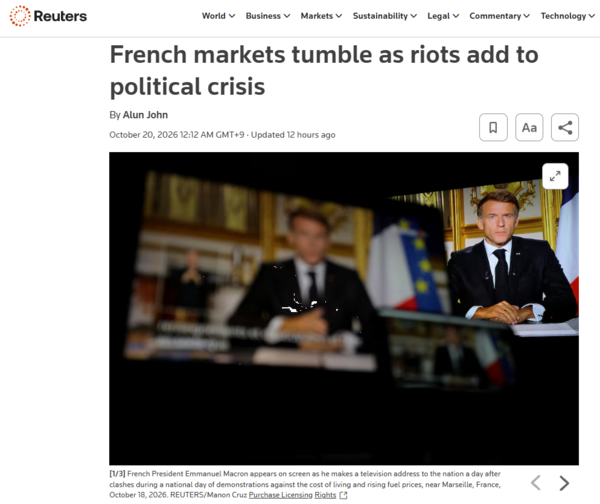
Reuters reported on October 20 (local time) that "French government bonds, stocks, and the euro fell together following mass protests in France," noting that "the French 10-year yield rose to around 4.9%, widening its spread with German bunds to roughly 1.46 percentage points. Shares of BNP Paribas and Société Générale each fell by about 3%, as the market feared that the violence would make deficit reduction and structural reforms even more difficult."
According to Reuters, what investors fear more than the protests themselves is the government's ability to respond. While citizens protest against living costs and deteriorating public services, the government lacks the fiscal headroom to keep expanding spending. Cutting expenditure fuels public backlash, whereas increasing borrowing to avoid conflict deepens distrust in the bond market. The French government finds itself trapped between street demands for more spending and market pressures for deficit reduction.
[3.6 trillion euros in national debt... Why does it keep ballooning?]
Citing the French National Institute of Statistics and Economic Studies (INSEE), Le Monde reported that public debt at the end of June stood at approximately 3.596 trillion euros (around 5,364 trillion KRW), or 119% of GDP—the highest level since 1946. Government projections show the debt-to-GDP ratio rising to 121.7% next year. As existing debt matures, it must be rolled over into new bonds, accompanied by additional borrowing to cover annual fiscal deficits.
The direct cause lies in a chronic imbalance between revenues and expenditures. According to INSEE, public spending in 2024 stood at 57.1% of GDP, while the fiscal deficit reached 5.8%. The state failed to secure sufficient revenues while maintaining broad functions such as pensions, healthcare, education, and public administration. The discrepancy between state-promised benefits and the revenues sustainably generated by the economy has been continuously covered by borrowing.
Demographic aging puts further pressure on this structure. An increasing retiree population raises pension and healthcare costs; if the working-age population cannot sufficiently support this burden, fiscal conditions degrade. This is why the IMF recommended enhancing pension sustainability and strengthening incentives to work longer. To maintain welfare systems, employment, productivity, and tax revenues must be capable of bearing those rising costs.
This burden is also reflected in the everyday lives of citizens. According to a report highlighted by Reuters on October 13, pension expenditure increased by 2.5 percentage points relative to GDP between 2000 and 2023, whereas education spending declined by 0.5 percentage points. It presents a paradox where high taxes are collected and state spending is massive, yet school environments fail to improve. As mandatory entitlement spending expands, fiscal headroom available for future investments and public service improvements contracts.
[Expanding benefits was easy, but adjusting costs was difficult]
The past expansion of welfare and the reduction of working hours under left-wing governments are essential factors when discussing the costs of the French model. However, it is difficult to attribute the entire debt burden solely to specific administrations. Deficits continued to accumulate under subsequent conservative and centrist governments, and borrowing expanded sharply during the COVID-19 pandemic and the energy crisis. The IMF identified large primary fiscal deficits during crisis response efforts over recent years as a key driver of the recent debt increase.
A primary fiscal deficit means that the government spends more than it earns, even excluding interest payments. Therefore, lowering interest rates alone will not solve the underlying issue. In 2023–2024, weaker-than-expected tax revenues overlapped with spending overruns in local governments and social security sectors. Beyond decisions to expand spending, failures to secure corresponding revenues and maintain budgetary control must also be addressed.
Reforms have been stalled by political resistance. Among the pension reforms pursued by the Macron administration, the raising of the retirement age and the extension of contribution periods have been deferred until 2028. While not permanently repealed, implementation of these core reforms has been delayed. Spending adjustments provoke immediate public pushback, whereas the burden of additional borrowing manifests only later. The more political leaders defer immediate conflict, the higher the eventual cost of adjustment becomes.
[Growth engines weaken while interest bills mount]
The labor market also poses a critical challenge. However, the 35-hour workweek should not be understood as an absolute legal cap on working hours. According to French government guidelines, overtime remains permissible. An IMF study published in 2007 analyzed that the policy had negative effects on employment among those directly subject to it, though this cannot be directly linked to the entirety of today's national debt. The core issue remains whether France can boost labor force participation and productivity to expand its fiscal base.
Slowing investment presents another burden. According to global professional services firm EY, foreign direct investment projects attracted by France in 2025 totaled 852, down 17% from the previous year. Although France maintained its top rank in Europe, its new investment momentum weakened at a time when its growth foundation needed expanding. While this does not signify a massive flight of existing capital, it signals unfavorable conditions for expanding employment and tax revenues.
The protective shield of low interest rates has also thinned. As cheaper bonds issued in the past mature, they are replaced by costlier new issues, gradually driving up interest costs. While interest rates on all debt do not jump immediately, prolonged high rates place sustained pressure on the budget. Even if identical tax revenues are collected, dedicating a larger portion to interest payments leaves less for education, investment, and welfare.
[How French debt could shake the world]
The first transmission channel is financial institutions. A sharp drop in government bond prices imposes loss burdens on holding banks, insurance companies, and funds. If declining sovereign confidence leads to higher funding costs and credit tightening for financial institutions, businesses and households suffer, further weakening tax revenues. Fiscal instability triggers financial instability, which in turn worsens fiscal health.
The second channel is international capital markets. According to IMF reports, approximately 55% of France's public debt was held by foreign investors at the end of 2025. While a diversified investor base offers advantages, it also serves as a channel through which losses cross national borders. If investors facing redemption or liquidity pressures liquidate other European bonds, the shock originating from France could spread. This represents a risk scenario grounded in interconnected financial structures.
Support from the European Central Bank (ECB) is not automatic either. Although the Transmission Protection Instrument (TPI) exists to counter unwarranted bond market volatility, its activation depends on evaluations of fiscal sustainability and compliance with EU recommendations. Being subject to an Excessive Deficit Procedure does not automatically exclude a nation from support. However, central bank mechanisms are not designed to resolve underlying sovereign fiscal problems on behalf of governments.
[Why Times Insight | Delaying reform causes the market to send the bill]
The core of the French crisis lies in the breakdown of balance between a political system that promises benefits and an economy that must bear the costs. Sustaining welfare requires securing revenues; when revenues fall short, spending priorities must be adjusted. Deferring these decisions transfers the burden onto interest payments and future taxation. Attempting to preserve existing entitlements risks eroding the very foundations of education, investment, and public services.
Street violence further complicates resolution. President Macron identified radical far-left elements and criminals as perpetrators of the violence. While some right-wing politicians raised allegations of links to Islamist groups, there is insufficient evidence to conclude that organized collusion exists. From a fiscal standpoint, the crucial risk is that violence narrows the political space for reform and deepens distrust in the state's capacity to execute policy.
It cannot be definitively concluded that a global financial crisis has begun today. The IMF noted that "short-term risks remain manageable given long debt maturities, a diversified investor base, and bank liquidity." However, having time to respond does not mean decisions can be endlessly postponed. If France fails to restore balance between spending and economic capacity on its own, markets will demand adjustment through higher interest rates. That bill will ultimately be handed to its citizens, and if confidence collapses, Europe and the global economy will not remain immune to the costs. This is precisely why we must closely monitor the turmoil unfolding in France.


-중국 푸단대학교 한국연구원 객좌교수
-전 EDUIN News 대표
-전 OUR NEWS 대표
-제17대 대통령직인수위원회 정책기획팀장
-전 대통령실 홍보기획비서관
-사단법인 한국가정상담연구소 이사장
-저서: 북한급변사태와 한반도통일, 2012 다시우파다, 선거마케팅, 한국의 정치광고, 국회의원 선거매뉴얼 등 50여권