
Update2026.10.24 (토)

[French Protests Expand as Living-Cost Anger Joins Student Demands]
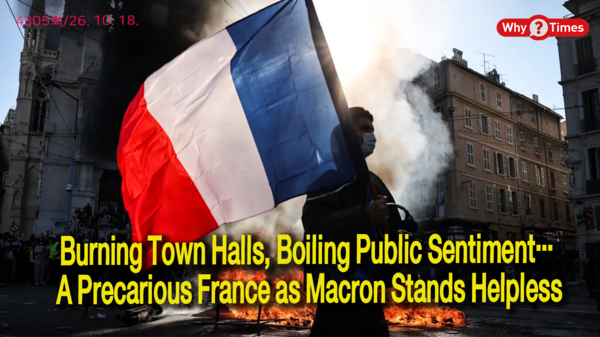
A 143-year-old town hall was engulfed in flames, and a bust of Marianne—a symbol of the French Republic—was toppled to the floor. Anger that began in classrooms among French students has merged with the discontent of citizens weary of rising living costs, spreading into a nationwide resistance. President Emmanuel Macron warned that those participating in violence would be punished, but a breakthrough to calm the rage on the streets remains elusive. Caught at the intersection of public livelihood, public order, and fiscal crises, France is testing the governing capacity of a president near the end of his term.
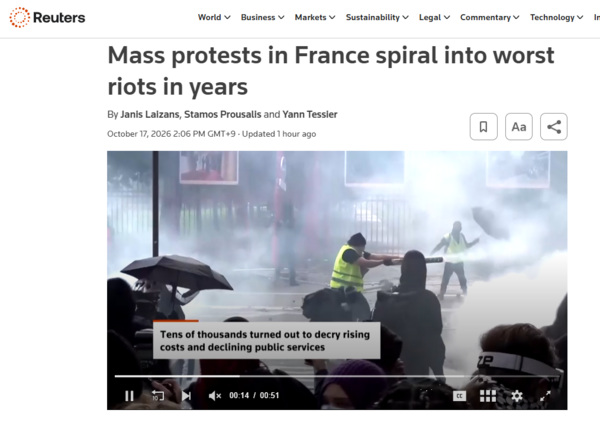
Reuters reported on the 17th (local time), "Nationwide protests took place in France against rising living costs and deteriorating public services, escalating into some of the most serious violence seen in decades in several cities." The Financial Times (FT) also noted, "Anger toward the government is growing as rising fuel and living costs compound students' frustrations over the educational environment."
Citing authority announcements on the night of the 17th, Reuters reported that "around 550,000 people participated across 110 marches nationwide, while organizers including the General Confederation of Labour (CGT) and student groups estimated the turnout at around 800,000." Reuters highlighted that "as student blockades and demands for better educational conditions absorbed the broader economic hardships of workers and citizens, the government finds itself confronting a wave of social discontent that extends far beyond individual education policies."
The difficulties expressed by citizens were concrete. A Yellow Vests movement participant interviewed by Reuters voiced frustration, noting that while they had protested in the past when gasoline was €1.40 per liter, it has now reached €2.20 per liter. They explained that not only education, healthcare, and judicial services, but also surrounding small business owners are struggling. For those who rely on cars for commuting and earning a living, rising fuel prices represent an unavoidable burden. In effect, grievances against the government have been building up both in classrooms for students and in household budgets for parents.
[Town Hall Ablaze… Even Symbols of the Republic Under Attack]
The most shocking scenes emerged from the central city of Limoges. According to EuroNews, the town hall built in 1883 caught fire, and as the flames spread, the clock tower and roof collapsed. Local authorities explained that, except for a portion of the western side, the roof collapsed into the floor below, destroying a substantial part of the building. A landmark that had symbolized municipal administration for 143 years was tragically destroyed overnight.
Ynetnews
In Marseille, a group barged into city hall, damaged property, and knocked over a bust of Marianne, a national symbol of the Republic. A municipal police station was also attacked. In Lyon, a group broke into a tourist information center, looting and committing arson. Authorities deployed two additional riot police units to Marseille. In a bitter paradox, facilities meant to serve the public were destroyed in the vicinity of protests demanding improved public services.
WION
Le Monde also reported that "looting of shops and vehicle arson occurred in Paris as well," adding that "Paris Deputy Mayor Emmanuel Grégoire stated that entire streets were systematically destroyed and that damages would be immense, while the Interior Minister explained that approximately 400 people were arrested nationwide and 60 security personnel were injured."
[Budget Increases Promised, but Why Aren't Classrooms Changing?]
Students' demands include hiring more teachers, improving classroom conditions, and repairing aging school facilities. There is a clear reason why students do not view government budget increases as a sufficient answer: growing numbers on a national budget sheet differ from the daily reality of classroom environments.
According to Le Monde, while the government's 2027 education budget proposal includes funding increases, it also contains a reduction of 1,588 permanent teaching positions. The government explains this as an adjustment following a decline in the student population. However, for students struggling with teacher shortages, what matters right now is whether there is a teacher available to conduct their classes. A gap exists between the "protection of education" touted by the government and the reality felt in classrooms by students.
In this context, AP News noted, "Severe injuries among youth during police responses further fueled the conflict," adding that "as thousands were arrested and injuries mounted over weeks of protests, protests against police tactics joined demands for better educational environments." AP News further reported that "criticism of the government's protest management also emerged from within certain police ranks." A conflict that started over school issues expanded into a clash between police and students, making resolution all the more difficult.
[Fiscal Constraints Stop Relief, Street Protests Block Austerity]
Living costs cannot be explained by average inflation alone. According to France's National Institute of Statistics and Economic Studies (INSEE), consumer prices in August rose 2.4% year-on-year, but energy prices surged by 16.7%. Prices rose most sharply for items that households spend money on frequently and cannot easily reduce. Even if overall inflation appears relatively low, the pressure felt by citizens can be far greater.
Money is required if the government wishes to address these grievances. Hiring more teachers, repairing schools, and easing living-cost burdens all require financial resources. However, France is simultaneously under pressure to restore its public finances. Reuters reported that "amid investor anxiety over government debt, the government's borrowing costs have surged to their highest levels in over two decades."
The government faces conflicting mandates. Cutting expenditure risks worsening public services and triggering stronger backlash. Conversely, significantly expanding support could undermine confidence in fiscal consolidation. To make matters worse, violence has introduced substantial repair costs for damaged infrastructure. It is a vicious cycle where economic anxiety feeds protests, and violence in turn increases fiscal and security burdens.
[No Political Exit in Sight Despite Warnings of Punishment]
According to EuroNews, President Macron declared that those who attacked public institutions and shops would be prosecuted and punished. Prime Minister Sébastien Lecornu also asserted, "We will not yield to violence," claiming that "certain far-left groups are attempting to use violence as a 'dress rehearsal' ahead of the presidential election." Conversely, Jean-Luc Mélenchon criticized the response, arguing that "police tactics exacerbated the confrontation."
However, even if the blame game drags on, the issues surrounding living costs and classrooms remain unresolved. Arresting criminals and persuading peaceful protesters are tasks that must be carried out simultaneously. This is precisely why Macron appears helpless: while he possesses police power and prosecutorial authority, he has yet to find a political breakthrough to reconcile conflicting demands and guide citizens back to normal life.
[Why Times Insight | More Dangerous Than Flames Is a Public That Disdistrusts the Government]
The danger of the current situation lies not only in arson and looting, but in the fact that separate grievances regarding education, living costs, and public services are converging upon the government at once. Unlike conflicts that can be resolved by withdrawing a single piece of legislation, overall discontent cannot easily be calmed with a single concession.
First, Macron can hardly avoid political responsibility for accumulated economic anxiety. Those engaging in violence must be held criminally accountable. At the same time, the government bears the responsibility of answering why citizens took to the streets in the first place. Criticizing radical instigators will not resolve teacher shortages or fuel price burdens. Attributing long-accumulated discontent solely to external forces risks deepening public distrust in the government.
Second, fiscal constraints severely restrict the president's ability to manage the crisis. Improving education and public services requires funds, while restoring fiscal health demands expenditure adjustments. Neither path can be pursued without pain. Ultimately, a leader must explain how burdens will be shared and why they must be endured. If the public loses trust in the government's fairness and competence, even necessary adjustments become another source of anger.
Third, preserving state authority requires punishment and persuasion to work hand in hand. Neglecting violence compromises public safety and erodes state authority. Conversely, antagonizing the entire protest movement risks alienating citizens who express their demands peacefully. Order must be restored while simultaneously addressing public livelihood issues, but as political confrontation intensifies, the space to achieve both narrows.
A burning town hall is a visible form of damage. A far deeper crisis is the fading belief that the government can improve daily life. Police forces can secure the streets, but they cannot repair broken trust. Macron can order punishments, but those orders alone cannot extinguish the public's rage. The true crisis facing a precarious France is that it must revive governance trust alongside the flames on the street.

-중국 푸단대학교 한국연구원 객좌교수
-전 EDUIN News 대표
-전 OUR NEWS 대표
-제17대 대통령직인수위원회 정책기획팀장
-전 대통령실 홍보기획비서관
-사단법인 한국가정상담연구소 이사장
-저서: 북한급변사태와 한반도통일, 2012 다시우파다, 선거마케팅, 한국의 정치광고, 국회의원 선거매뉴얼 등 50여권