
Update2026.10.24 (토)

[The Heart of Germany's Intelligence Agency Compromised… Former Head of BND Arrested]
The former head of Germany’s foreign intelligence agency, who once oversaw the country’s entire overseas intelligence apparatus, has been arrested on charges of using state secrets to compile analytical reports for a foreign intelligence service. Even more shocking is the prosecution’s determination that approximately 2,000 documents were funneled out between 2010 and 2022 through a key insider within the Federal Intelligence Service (BND). Moving beyond individual misconduct, the incident is escalating into a crisis of trust across the Western intelligence alliance, raising the direct question: “Is the intelligence shared with Germany truly safe?” It poses an identical, urgent question to South Korea, which faces simultaneous intelligence threats from North Korea and China: “Are our most critical secrets safe from insiders?”
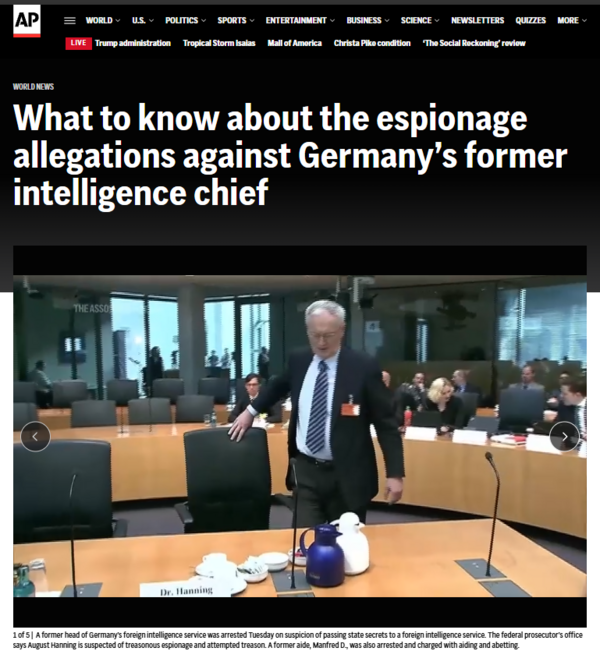
On the 8th, the Associated Press (AP) reported on the shocking development, stating, “An extraordinary scandal of unprecedented scale in the history of German intelligence services has erupted.” The report highlighted that “August Hanning, 80, who led the German Federal Intelligence Service (BND) from 1998 to 2005, was arrested on the 6th on suspicion of espionage and attempted treason, and was formally remanded in custody by a Federal Court of Justice judge on the 7th.” AP added, “Manfred D., a former close aide to Hanning and a senior BND executive suspected of providing him with classified documents, was also arrested,” evaluating that “this incident could become one of the most serious intelligence scandals in Germany since the end of the Cold War.”
[12 Years, 2,000 Documents… The Core Issue Is 'Who Unlocked the Door?']
AP noted, “According to prosecutors, Hanning is suspected of having received internal BND materials from his former close associate, Manfred D., in exchange for compensation starting around 2010.” The report pointed out that “this relationship continued until June 2022, with the number of documents passed to Hanning estimated to reach around 2,000.” The critical issue is that Manfred D. was no ordinary employee. He served as Hanning’s chief of staff and subsequently worked as a key advisor to successive BND directors before retiring as recently as March of this year.
Regarding this, Reuters reported, “Ultimately, if the prosecution’s allegations hold true, a former head of the BND gained access to the core of the organization for over a decade through a serving senior executive,” adding, “This raises the possibility that two individuals who knew the top tier of the intelligence agency better than anyone else became the most dangerous link in its security chain.”
[Even Chancellery Security Briefings Leaked… Has the Core of German National Security Been Exposed?]
The nature of the compromised documents makes the scandal even more grave. According to Reuters, the materials in question reportedly included intelligence briefing documents used in top-level German national security decision-making. Furthermore, concerns have been raised that the leaks may have contained intelligence regarding Iran’s nuclear program, the Russian military, and sensitive materials provided by foreign partner agencies.
The Financial Times (FT) also analyzed the situation, stating, “Going forward, the core of the investigation will not simply be the figure of '2,000 documents,' but what was contained within them, how Hanning utilized that information, and how far it actually spread.” The FT noted, “If it is confirmed that intelligence provided by allies such as the United States or the United Kingdom was passed to a third country, the character of this case will shift from a domestic German scandal to a major security incident affecting the entire Western intelligence alliance.”
[Not Direct Leaks, But More Cunning 'Intelligence Laundering']
According to Reuters, there is a particularly notable aspect to this case. Prosecutors do not view Hanning as having merely photocopied BND documents to hand over to a foreign entity. They are also investigating allegations that Hanning used the classified information received from Manfred D. to author separate analytical reports tailored for officials of a foreign intelligence agency. This point highlights a crucial evolution in modern espionage: secrets are not exclusively traded in the form of original documents stamped 'SECRET.' An analytical report that distils the essence of multiple classified files—augmented by the expertise and judgment of a former intelligence chief—holds immense value for a foreign intelligence service. This is a dimension that South Korea must pay close attention to.
[And Then Came Azerbaijan… Baku Responds with Strong Protests]
The affair expanded into a diplomatic issue with the emergence of Azerbaijan. While German prosecutors have not officially disclosed which foreign intelligence agency was involved, Der Spiegel reported that “investigating authorities are examining potential contacts between Hanning and officials from the Azerbaijani intelligence service.” Azerbaijan immediately denied the allegations and raised a formal protest with the German government. The fact that diplomatic fallout erupted following Der Spiegel’s report—even before prosecutors formally identified the foreign entity—demonstrates the extreme sensitivity of the case.
[What Germany Truly Fears Is Not Just '2,000 Documents']
There is a specific reason why this incident is fatal to Germany. An intelligence agency’s most valuable asset is not merely information; it is trust. Allied intelligence agencies, such as those of the U.S. or the U.K., share sensitive intelligence with the BND based on the trust that Germany will safeguard not only the data but also the sources and collection methods behind it.
However, if the prosecution's claim is confirmed—that a former top chief who once led the BND routinely received classified materials from a key internal figure over a prolonged period—allies will inevitably ask: “Is the intelligence we shared with Germany compromised as well?” The FT analyzed that “this incident is raising serious concerns not only regarding internal trust and data security within the BND, but also among Germany’s international intelligence partners.”
Some British media outlets have even raised the possibility that allied intelligence agencies, including MI6 and GCHQ, may conduct assessments to determine whether their own provided intelligence was exposed. However, the core takeaway currently confirmed across major foreign media is the clear possibility that allied intelligence was included, along with the severe risk of damage to intelligence-sharing trust.
[An Even More Shocking Question… Why Did the BND Not Know for 12 Years?]
Yet, an even more painful question confronts the German government: “What on earth was the BND’s internal counterintelligence network doing?” According to the prosecution, the leaks persisted for approximately 12 years, from 2010 to 2022. This was not a case of one or two documents, but roughly 2,000. Furthermore, the individuals involved were not unknown outsiders; one was the agency's former top director, and the other was a key figure who served in close proximity to the highest leadership for years.
Even more astounding is that the case was not uncovered through the BND’s own counterintelligence efforts. According to the AP, the investigation originated from a separate criminal inquiry into the child abduction case involving Christina Block, heiress to a famous German restaurant group. Evidence secured during that investigation unexpectedly led to Hanning’s classified documents, escalating a routine criminal case into a major national security scandal.
Ultimately, this reveals the staggering possibility that an organization handling the nation's most sensitive secrets failed to detect what was happening at its very heart for over a decade. If fully verified, the issue extends far beyond Hanning's personal betrayal. It inevitably forces a complete re-examination of whether the BND’s entire internal security infrastructure—access control, document exfiltration monitoring, management of contacts between current and former personnel, and insider threat detection systems—suffered a catastrophic systemic failure.
[Worst Possible Timing… Germany Was Expanding the BND to Counter Russia's 'Shadow War']
The timing could not be worse for the German government. German intelligence agencies recently issued public warnings that Russia's so-called 'shadow war' targeting Europe has entered a far more dangerous phase. As the threat of Russian sabotage, cyberattacks, and infrastructure targeting intensified, discussions were actively underway in Germany to strengthen the authority and collection capabilities of the BND.
Yet, at this precise moment, the BND’s former top chief has been arrested on espionage charges. The FT analyzed that “this incident could deal a severe blow to the German government’s efforts to elevate the BND’s international standing and expand its legal and operational autonomy.” At the exact moment Germany sought to empower its intelligence agency to catch foreign spies and saboteurs, the agency's internal security framework has fallen under deep suspicion—a profound paradox.
[Yet This Scene… Has Already Played Out in South Korea]
It is precisely here that the German scandal evokes a chilling sense of déjà vu for South Korea. In 2024, a civilian employee assigned to South Korea's Military Intelligence Command (MIC) was arrested on charges of leaking military secrets—including the identities of undercover 'black agents' operating abroad—to a Chinese national of Korean descent. The leaked files contained sensitive details regarding clandestine operatives conducting overseas intelligence missions targeted at North Korea.
The results of the investigation were even more shocking. Military prosecutors concluded that the employee had been recruited by a Chinese handler in Yanji, China, back in 2017, subsequently handing over military secrets—including the black agent roster—in exchange for financial compensation. The parallels to the German case are striking: it was not an external hacker breaching a state-of-the-art firewall. The failure stemmed from an insider with legitimate access to classified information. South Korea's Military Intelligence Command similarly reported to the National Assembly at the time that the breach was not caused by external hacking.
[Why Times Insight | The Most Dangerous Spy Is the 'Trusted Insider']
The starkest message the German scandal sends to South Korea is surprisingly simple: to steal state secrets, you do not necessarily need to hack an intelligence agency’s firewall. You only need to secure the person who holds the key to the vault. And the longer that person has been trusted within the organization, the greater the resulting damage.
August Hanning was no peripheral figure to the BND; he was the supreme commander who directly led Germany’s foreign intelligence agency. Manfred D. was likewise a long-serving insider in close proximity to top leadership with access to sensitive data. If the prosecution’s charges are proven true, the most horrifying revelation is this: the very individuals who knew the German intelligence agency best may have served as its weakest link.
Specifically, the German scandal poses three critical questions to South Korea:
“Does the threat of unauthorized access truly end upon retirement?”
“Can long-serving, loyal personnel be trusted unconditionally without continuous monitoring?”
“Are we capable of protecting intelligence entrusted to us by our allies to the very end?”
Unless we can definitively answer these questions, even the most advanced technical security systems will prove useless.
Germany is demonstrating just how catastrophic the price can be. Should the allegations against Hanning be confirmed, the greatest asset Germany loses will not merely be the 2,000 documents themselves.
It will be the answer to the question: “Is it safe to share intelligence with Germany?”
If allied intelligence services—including those of the United States and the United Kingdom—begin to harbor such doubts, the true loss suffered by Germany will be the trust of its alliance. This is why this case cannot be brushed aside as the isolated misconduct of a former intelligence chief. South Korea faces the exact same vulnerability. In a nation positioned directly adjacent to North Korea and China, holding world-class technologies in semiconductors, defense manufacturing, nuclear energy, and shipbuilding, the most dangerous security gaps do not lie solely beyond our borders. The most dangerous spy may not look suspicious from the outset; they may be the very person to whom the state entrusted its most critical secrets. This is why we must not view the scandal rocking the German BND as mere foreign news. Germany’s dilemma is ultimately South Korea’s dilemma: “Are we truly safe from the enemy within?”

-중국 푸단대학교 한국연구원 객좌교수
-전 EDUIN News 대표
-전 OUR NEWS 대표
-제17대 대통령직인수위원회 정책기획팀장
-전 대통령실 홍보기획비서관
-사단법인 한국가정상담연구소 이사장
-저서: 북한급변사태와 한반도통일, 2012 다시우파다, 선거마케팅, 한국의 정치광고, 국회의원 선거매뉴얼 등 50여권