
Update2026.10.24 (토)

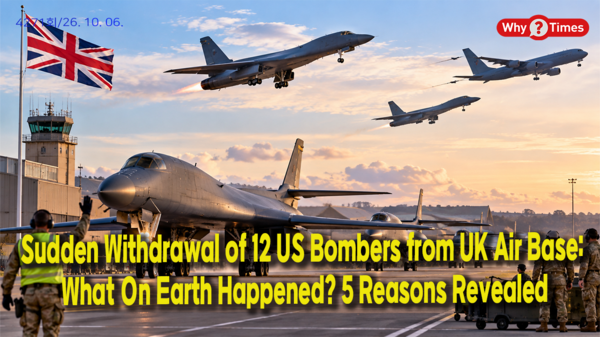
[A Hasty and 'Unusual Withdrawal' Supported by Aerial Refuelers]
The United States has abruptly withdrawn all 12 of its B-1B Lancer strategic bombers from RAF Fairford in the UK—a key staging ground for operations targeting Iran. The atmosphere surrounding the departure was starkly different from a routine rotation end. As investigations into a terror plot targeting the base unfolded alongside severe new intelligence reports, the US military appears to have decided against the risk of keeping its strategic assets grounded in one location. What exactly compelled Washington to pull out all 12 B-1 bombers at once?
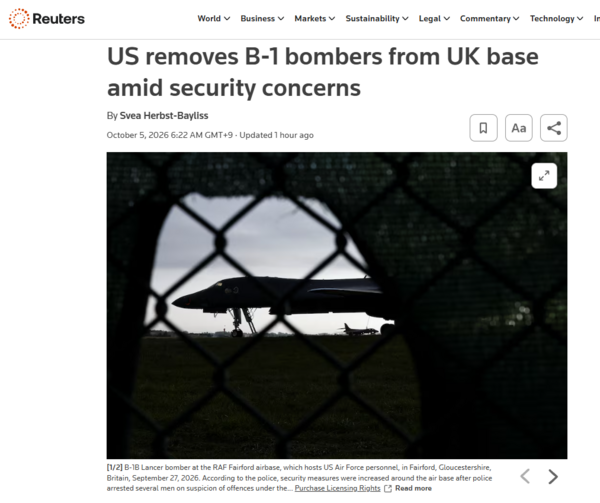
Reuters reported on October 5 that "this withdrawal was an emergency action entirely different in nature from a routine rotational deployment." It added that "while some bombers crossed the Atlantic first, aerial refueling tankers were hurriedly launched to support their transoceanic return flights, and the remaining aircraft departed the runway in rapid succession." Reuters further noted, "At least three bombers arrived on October 4 at Ellsworth Air Force Base in South Dakota, the home station of the B-1s; this decision was driven by security concerns over an attack plot targeting RAF Fairford." Civil flight tracking platforms also captured the bombers departing over the weekend.
In a statement released the same day, the US Department of Defense confirmed, "While operational security prevents us from confirming asset and troop movements in real time, we can now confirm that all US bombers deployed to Fairford have been repositioned to their home bases in the United States." The Pentagon added, "These bombers remain fully prepared to conduct strike missions directly from the US mainland." According to The New York Times, US European Command (EUCOM) acknowledged the return flights but declined to comment on reported threats, while the UK Ministry of Defence offered no comment.
[Reason for Withdrawal ① — Warnings from 3 Weeks Ago Escalated into an "Imminent Threat"]
The most direct cause was a shift in threat intelligence. Newly acquired intelligence served as the immediate trigger for the withdrawal. While US officials declined to disclose specific details, they explained that "this intelligence is an extension of initial threat warnings raised approximately three weeks ago." A US official told The New York Times that "over the last 24 hours, the specificity and urgency of the threat heightened noticeably, causing major concern among local commanders." Sources referenced the possibility that the base had become a target for hostile forces preparing a terrorist strike, emphasizing that the response was triggered by a "real-world operational situation"—meaning a reaction to concrete attack indicators rather than a purely precautionary repositioning.
Israel has been cited as the source of this intelligence. In an interview with Fox News, Israeli Prime Minister Benjamin Netanyahu claimed that "Israel passed intelligence to London regarding an imminent Iranian-backed attack." Israeli President Isaac Herzog also stated in a BBC interview that he "agrees with Prime Minister Netanyahu’s assessment that Iran was orchestrating the Fairford incident."
[Reason for Withdrawal ② — The 'Fairford Plot' Unveiled]
The second underlying factor stems from an incident near the air base in late September. According to Aviation Week, British counter-terrorism police arrested several men on the night of September 26–27 in Welford, a village northeast of the base, evacuated surrounding homes, and deployed army bomb disposal units to inspect vehicles. All five individuals arrested were British nationals in their 20s residing in London.
According to The Wall Street Journal, the suspects traveled toward Fairford in three white vans. Police reported that while no explosives were found, the vehicles contained significant quantities of fuel. Notably, the arrests occurred after one of the accomplices called the police directly. A senior US official explained to the WSJ that a branch of Iran's Islamic Revolutionary Guard Corps (IRGC) had recruited the British nationals, and that the multi-stage plot included disruptive actions in the surrounding area. US authorities believe the ultimate objective was to strike the bombers and assassinate base personnel.
The investigation subsequently expanded. The Associated Press reported that "on October 1, police arrested a 27-year-old British-Iranian dual national in London on suspicion of plotting acts of terrorism, raided two properties, and questioned a 26-year-old British man under caution." Detective Chief Superintendent Vicki Evans of Counter Terrorism Policing stated, "We are examining all lines of inquiry, including potential state-sponsored involvement." The dual national was later released on bail, leaving none of the six individuals tied to the case currently in custody.
[Reason for Withdrawal ③ — Strained US–UK Investigative Cooperation and Mutual Trust]
The third factor is growing US distrust regarding the British response. Assistant Commissioner Laurence Taylor of the UK Counter Terrorism Policing confirmed that "the five arrested individuals were released on bail less than 24 hours into their detention." President Donald Trump publicly expressed frustration over the decision, remarking, "I wouldn't have released them," while Secretary of State Marco Rubio explicitly stated that "foreign actors" were involved.
The UK government’s official stance arrived late. Prime Minister Andy Burnham stated in a September 30 BBC interview that "there are strong indications of Iranian involvement," but cautioned that "the investigation remains ongoing, complex, and serious." The WSJ noted that "some officials within the British government questioned the level of sophistication behind the plot itself." Faced with skyrocketing threat intelligence while suspects walked free, US military leadership opted to pull their high-value assets directly rather than await the outcome of British investigations.
[Reason for Withdrawal ④ — Base Vulnerabilities to Drones and Proxy Attacks]
The fourth factor involves structural limitations in force protection. It remains uncertain whether Iran possesses the capability to conduct precision strikes on the UK mainland using long-range missiles. CNN pointed out that "because Fairford is approximately 4,506 km from Tehran, it is unclear whether Iran has the capability for precision strikes at that distance." Instead, asymmetric attacks using locally recruited operatives or small uncrewed aerial vehicles (UAVs) pose a far more realistic threat. Military outlet The War Zone (TWZ) analyzed that "one-way attack drones launched from maritime vessels represent a highly realistic attack vector that Iran has trained for and equipped."
Following the incident, UK defense officials conceded the need to harden military bases, particularly against drone threats, according to the WSJ. Threat levels were also elevated at RAF Lakenheath in eastern England, which hosts F-35 and F-15E fighters. UK security agencies previously revealed that over the past year, they disrupted nearly 20 potentially lethal plots backed by Iran. Concentrating 12 strategic bombers—each valued at hundreds of millions of dollars—on an open airfield presented an inherent defense liability.
[Reason for Withdrawal ⑤ — Preserving the Irreplaceable Fleet of B-1 Bombers]
The fifth factor is the sheer scarcity of the B-1 fleet. The US Air Force maintains a total inventory of 44 B-1B bombers, with a maximum of around 21 aircraft available for operational strike missions at any given time. The 12 bombers stationed at Fairford represented more than half of America's total deployable B-1 force. Losing or damaging these assets in a single ground attack would create a severe void not only in anti-Iran operations, but in global US long-range strike readiness. The Pentagon’s deliberate emphasis on home-mainland strike capabilities in its statement reflects a calculated assessment: the risk of losing aircraft far outweighs the operational cost of forfeiting a forward operating base.
[Fairford: The 'European Staging Ground' for the War with Iran]
RAF Fairford, located roughly 160 km west of London, serves as the sole US heavy bomber Forward Operating Location (FOL) in Europe. Following the initiation of US and Israeli strikes on Iran on February 28, then-UK Prime Minister Keir Starmer initially denied US requests to use the base. However, after British bases in Cyprus suffered drone attacks on March 1, London approved base access solely for "defensive purposes" aimed at destroying Iranian missiles "at their source." At the peak of deployment in March, 15 B-1Bs and 6 B-52H bombers were concentrated at Fairford.
Following the April ceasefire, the B-52s returned home while 12 B-1s remained behind. As the ceasefire collapsed and combat resumed in late summer, political debate in the UK intensified. Under the new Burnham administration, the UK reconfirmed the existing access agreement. In response, the IRGC issued a statement in July explicitly singling out Fairford, declaring that any base used to launch attacks on Iranian territory was a legitimate target. Recent events suggest that warning matured into operational reality roughly two months later.
[Trump’s 'Easy Way, Hard Way'… While Naval Forces Augment]
The timing of the withdrawal coincides with President Trump weighing the resumption of full-scale airstrikes against Iran. Speaking to reporters on October 3 before departing for a rally in Ohio, President Trump stated: "I have to make a decision on Iran. Iran has taken a beating already. So now it's just a question of whether we do it the easy way or the hard way." He had previously rejected a 7-day ceasefire proposal offered by Iran, warning that airstrikes could resume after the midterm elections if no agreement is reached.
While Europe's air base node has been vacated, US naval power in the region is expanding. The USS Theodore Roosevelt Carrier Strike Group departed San Diego on September 27, followed by the Amphibious Ready Group centered around USS Makin Island carrying the 13th Marine Expeditionary Unit. Joining the USS George H.W. Bush and USS George Washington already in the Arabian Sea, as many as three US aircraft carriers could be deployed simultaneously to the Middle East by late October or November.
[Why Times Insight]
Militarily, this withdrawal represents a strategic 'repositioning' rather than a 'retreat.' With aerial refueling, B-1 bombers can strike targets in Iran directly from the US mainland—a capability explicitly highlighted by the Pentagon. However, the strategic implications are significant. Without firing a single missile capable of reaching the UK mainland, Iran achieved the removal of heavy US bombers from Europe solely through local proxies and threat intelligence. In terms of cost-efficiency, this stands as a textbook example of Iranian-style 'proxy asymmetric warfare' disrupting forward-deployed US power projection.
Frictions in the US–UK alliance are equally noteworthy. The UK permitted base access under the caveat of 'defensive purposes' and prioritized formal legal procedures throughout the investigation. The US interpreted this caution as a security vulnerability. Moving forward, security posture adjustments at other UK-hosted US facilities—such as RAF Lakenheath and RAF Mildenhall—alongside potential shifts in US operational axes toward Diego Garcia or mainland launches, will serve as leading indicators for the resumption of strikes on Iran. The contrasting signals—withdrawing bombers while surging aircraft carriers—indicate that the Trump administration is preparing an operational structure centered on naval platforms and mainland-based power projection for future military options.

-중국 푸단대학교 한국연구원 객좌교수
-전 EDUIN News 대표
-전 OUR NEWS 대표
-제17대 대통령직인수위원회 정책기획팀장
-전 대통령실 홍보기획비서관
-사단법인 한국가정상담연구소 이사장
-저서: 북한급변사태와 한반도통일, 2012 다시우파다, 선거마케팅, 한국의 정치광고, 국회의원 선거매뉴얼 등 50여권