
Update2026.10.24 (토)

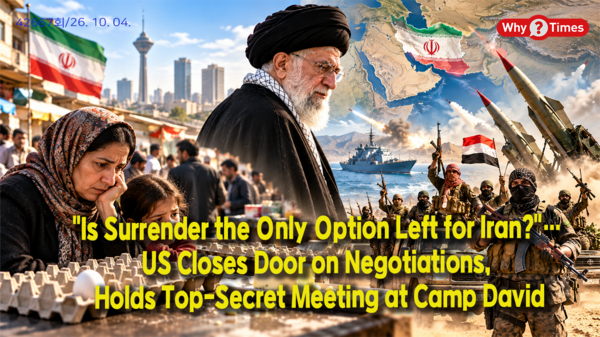
[2.688 Million Rial… The Floor Has Vanished from the Iranian Economy]
The two pillars supporting Iran—its economy and political power—are shaking simultaneously. The rial has plummeted to 2,688,000 rials per US dollar. Following a naval blockade, the United States is suffocating Tehran's revenue sources by tightening constraints on its automotive and railway sectors, as well as its sanction-evasion networks. Even more critical is that cracks are no longer just between moderates and hardliners, but are spreading within the hardline faction supporting the regime.
While Iran seeks negotiations, Washington has raised the bar instead of lowering it—ultimately expelling Iranian delegation members from the US after they defied departure orders. Almost simultaneously, top US foreign policy and national security officials met at Camp David to discuss the next phase of the Iran war. As the benefits of holding out disappear one by one, the central question for Iran is shifting from "Will they yield?" to "How much longer can they hold out?"
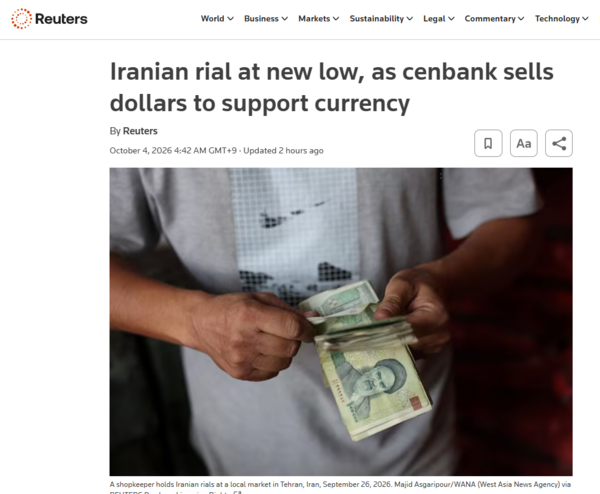
Reuters reported on the 4th that "the pace of the Iranian economy's decline is accelerating," adding that "the Iranian rial sank to a new record low of around 2,688,000 rials per dollar on the unofficial market, down further from 2,632,000 rials just a day earlier."
According to Reuters, the rial has lost more than half its value over the past year, while inflation has surpassed 70%. When Iran International calculated based on 2.5 million rials per dollar just a few days ago, the monthly minimum wage of 166 million rials was worth about $66. At the current exchange rate, that value has dropped to around $62. It is an economy where a full month of labor yields barely $60, falling far short of $100.
["Look at the Price of Eggs"… Fear Cannot Prevent Hunger]
The number that best illustrates Iran's crisis may not be the exchange rate or GDP, but the price of eggs in local markets. British journalist and author David Patrikarakos stated on Iran International's "Eye for Iran" that one indicator he is watching closely is the price of eggs. In conversations with people inside Iran during the conflict, discussions invariably returned to the cost of groceries and essential goods. His point is straightforward: while the regime can arrest protesters and use fear to force people off the streets and back into their homes, once citizens can no longer afford basic sustenance, repression alone can no longer resolve the crisis.
Iranian authorities are keenly aware of this reality. Mass arrests have continued since the outbreak of hostilties, with officials wary that economic hardship could trigger large-scale street demonstrations once again. However, strategic analyst Kamran Bokhari points out that oppression is not an infinite tool. If widespread crackdowns persist, a point may be reached where doubts begin to emerge even within the security forces sustaining the regime.
Iran International assessed that Iran is currently undergoing a "slow meltdown"—a state of gradual collapse where economic stagnation, deepening repression, and internal hardline fractures are occurring simultaneously.
[It Is No Longer 'Moderates vs. Hardliners']
There is a shift in this Iranian crisis that merits even greater attention than the economic collapse: the changing fault lines within the regime itself. In the past, political conflict in Iran was largely defined as a clash between reformist/moderate factions and conservative/hardline factions. Recent divisions, however, tell a different story.
Iran experts analyze that opinions within the hardline camp itself have begun to fracture over how to preserve the regime. Compromising with the US risks undermining the revolutionary legitimacy of the state, while refusing to compromise leads to further economic decay. Escalating the conflict increases the risk of direct US military intervention, yet inaction causes the rial and public livelihoods to collapse first. Ultimately, the central dilemma for the Iranian leadership has shifted from "How do we defeat the US?" to "How do we save the regime?"
Bokhari notes, "We must pay close attention to the moment when internal differences within the regime are no longer contained behind closed doors and instead play out publicly. If internal power struggles spill into the open, it signals not merely a political debate, but a weakening of regime control."
['North Korea-fication' or 'Houthi-fication'… Butter Disappears, Leaving Only Guns]
If the Iranian regime survives without collapsing immediately, what kind of state will it become? Experts suggest the worst-case scenario is either "North Korea-fication" or "Houthi-fication"—a transformation into a state with decaying institutions and an impoverished populace, where the regime intensifies domestic repression while continuing to project military influence abroad through missiles and proxy armed groups.
Iran expert Alberto Fernandez explained this through the "guns vs. butter" metaphor. The Islamic Republic never originally intended to be a nation that possessed only guns; it sought to project revolutionary military power abroad while maintaining a functioning society and middle class at home.
Now, however, the "butter" is disappearing. British journalist Patrikarakos points out that this directly conflicts with Iranian societal identity. For many highly educated Iranians who desire integration with the international community, North Korean-style isolation is an unacceptable future. Bokhari similarly notes, "They do not want to walk the path of North Korea." The question now is whether they can avoid it. He concludes that within the Iranian leadership, "regime survival has become the top priority above all else."
[Iran Seeks Negotiations; US Responds: "Leave"]
Iran's persistent attempts to engage in negotiations with the US are noteworthy. Rather than enduring economic pressure to buy time, Tehran is actively seeking an exit strategy that preserves face through diplomacy.
However, Washington's response has grown colder. According to Axios, US Secretary of State Marco Rubio demanded the immediate departure of the Iranian delegation remaining in the US following the conclusion of the UN General Assembly. This came shortly after recent talks ended without results. When two delegation members failed to comply with the departure order and remained in New York, the US reiterated its demand for their immediate exit. Consequently, one departed Friday night and the other Saturday morning. A US official described the move as straight-up "expulsion"—an extraordinary diplomatic development.
More significantly, this incident illustrates the current power dynamic in US-Iran negotiations. Washington appears to have moved from asking "How do we bring Iran to the negotiating table?" to evaluating "What must Iran give up first before we even open the door to negotiation?" While Iran searches for a diplomatic way out, the US continues to raise the price of admission.
[And That Day, the Camp David Meeting Was Held]
It was precisely under these circumstances that an even more significant move occurred. Axios reported that top diplomatic and national security officials from the Trump administration gathered covertly at Camp David on the 2nd for several hours to discuss the next phase of the Iran war and the issue of the Houthis in Yemen.
The meeting was chaired by Vice President JD Vance. Key figures in attendance included Secretary of State Marco Rubio, Secretary of Defense Pete Hegseth, Special Envoy Steve Witkoff, CIA Director John Ratcliffe, and Chairman of the Joint Chiefs of Staff Dan Caine. The meeting schedule had not been disclosed in advance.
The precedent here is particularly telling: according to Axios, the last time a similar national security meeting was held at Camp David was in June 2025—just days before Israel entered into war with Iran. In light of this, Axios noted that "the meeting took place as diplomatic negotiations stalled and President Trump considered the potential resumption of large-scale combat operations against Iran."
[Why Times Insight] Options Are Vanishing for Iran
Iran's most critical crisis is not simply a deteriorating economy; it is the systematic elimination of Tehran's available options. When sea lanes were blocked, Iran attempted to rely on overland transport, but the US extended sanctions to its automotive and railway industries. As channels for oil exports and foreign currency acquisition narrowed, the rial cratered to 2,688,000 per dollar, eventually forcing the central bank to release up to $2 billion to defend the exchange rate. While the regime attempts to suppress economic discontent through force, it now faces additional vulnerabilities: public sentiment, the loyalty of security forces, and growing fractures within hardline ranks.
Diplomacy offers little relief. Iran continues to cling to negotiation, but the US shows no inclination to lower its price for an exit. The two Iranian delegation members who initially failed to comply with US departure demands following the UN General Assembly were ultimately compelled to leave.
Almost simultaneously, top US foreign policy and security leadership convened at Camp David to deliberate on the next phase of the conflict. Tehran is left facing increasingly grim options: accepting US demands compromises the Islamic Republic's revolutionary legitimacy centered on anti-American resistance; standing firm accelerates the collapse of its economy and middle class; and returning to full-scale conflict risks confronting a renewed, large-scale US military campaign.
What is unfolding in Iran should not be viewed merely as an economic downturn. It represents a escalation sequence: an economic crisis transforming into a livelihood crisis, a livelihood crisis turning into a regime crisis, and a regime crisis triggering internal power struggles.
Iran has not surrendered, nor can an imminent collapse of the Islamic Republic be stated as certainty. However, one reality remains clear: what Tehran stands to gain by holding out is diminishing, while the cost of doing so is rising daily.
Washington's ultimate objective may not be a formal instrument of surrender, but rather creating a condition where Tehran is forced to relinquish its leverage step by step—its nuclear program, the Strait of Hormuz, regional proxy networks, and sanction relief demands.
The central question surrounding Iran has evolved. It is no longer "Will Iran yield to the United States?" but rather "How much longer can Iran endure without yielding?" The plummeting rial, internal hardline fractures, and the closed doors at Camp David suggest that time is rapidly running out.

-중국 푸단대학교 한국연구원 객좌교수
-전 EDUIN News 대표
-전 OUR NEWS 대표
-제17대 대통령직인수위원회 정책기획팀장
-전 대통령실 홍보기획비서관
-사단법인 한국가정상담연구소 이사장
-저서: 북한급변사태와 한반도통일, 2012 다시우파다, 선거마케팅, 한국의 정치광고, 국회의원 선거매뉴얼 등 50여권