
Update2026.10.24 (토)

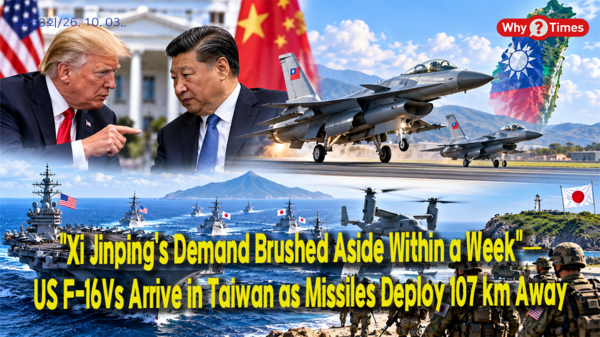
[Just 8 Days After Xi’s Departure… F-16Vs Touch Down in Taiwan]
Barely eight days after Chinese President Xi Jinping forcefully raised the Taiwan issue at the White House, a scene unfolded that Beijing least wanted to see. The first two US-made, state-of-the-art F-16V Block 70 fighter jets landed on October 2 in Taitung, eastern Taiwan. Furthermore, 17 days later, a massive US-Japan joint integrated exercise, "Keen Sword 27," is set to commence across Japan, including Yonaguni—located roughly 110 kilometers from Taiwan. Compounding this, the election of a Tokyo-backed candidate as Okinawa's governor for the first time in 12 years has fostered a far more favorable political environment for bolstering Tokyo’s Southwestern Island defenses. Although Xi pressed President Trump on Taiwan during the summit, military reality on the ground immediately following the meeting is moving in a direction starkly opposed to Beijing's desires.
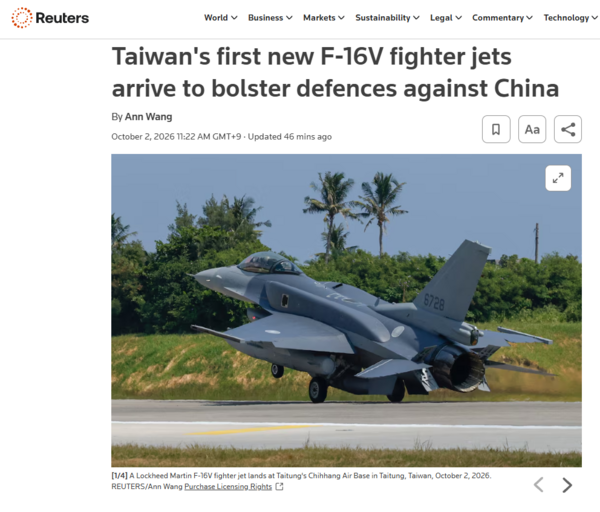
Reuters reported on October 2 that "a scene Chinese President Xi Jinping would have least wanted to see unfolded in eastern Taiwan on Friday," as "two F-16V Block 70 fighter jets, which departed from the US and traveled via Hawaii and Guam, touched down on the runway of Taitung Chihhang Air Base." The outlet noted that this marks the initial delivery of 66 newly built F-16Vs ordered by Taiwan from the US in 2019. Taiwanese President Lai Ching-te expressed gratitude to the US, while Defense Minister Wellington Koo stated that additional aircraft are scheduled to arrive by the end of the year.
The timeline is particularly striking. President Trump and President Xi held their White House summit on September 24. The landing of the F-16Vs in Taiwan came just eight days later. Reuters observed that "the Taiwan issue remained a major unresolved friction point even during the summit," noting that while Xi requested Trump to adopt a firm position that the US "opposes Taiwan independence," no announcement was made indicating any shift in existing US Taiwan policy.
[Fighter Jets Stalled in Hawaii… Ultimately Proceed to Taiwan]
An intriguing detail lies in the transit narrative. According to Reuters, the initial pair of F-16Vs remained in Hawaii longer than originally anticipated. In early September, the aircraft even took off from Hickam Air Force Base in Hawaii only to return shortly after, with exact reasons for the turnback undisclosed at the time. Given that arms sales to Taiwan represented a highly sensitive diplomatic topic surrounding the US-China summit, analysts speculate that the delivery timing to Taiwan was intentionally calibrated.
Following the summit, Washington's existing defense support policy for Taiwan remained unchanged. Taiwanese Defense Minister Wellington Koo stated on September 29 that Taiwan "had received no notification from the US regarding policy changes and continues to consult with Washington on arms sales." Despite Xi’s pressure on Taiwan during the summit, America’s fundamental armaments program for the island was never halted.
[It’s Not Just About 2 Jets… The Delivery of 66 Aircraft Has Begun]
From Beijing's perspective, the primary concern is not the number two, but the fact that the rollout is now underway. According to Reuters, these fighters represent the initial batch of a 66-aircraft acquisition program approved in 2019 valued at approximately $8 billion. Although software issues and other delays caused significant schedule slip, the physical arrival of the first airframes in Taiwan marks the transition of this large-scale force enhancement plan into actual operational deployment.
Taiwan has already upgraded a substantial portion of its legacy F-16A/B fleet to the F-16V standard. Once all 66 new-build airframes are fully delivered, Taiwan's F-16 inventory will exceed 200 aircraft. Equipped with advanced avionics and active electronically scanned array (AESA) radar systems, these new F-16Vs are assessed by Reuters as significantly bolstering the Taiwan Air Force's capability to counter China's latest fighters, such as the J-20.
The deployment location is also noteworthy. The jets arrived at Taitung Chihhang Air Base—located in eastern Taiwan behind the Central Mountain Range, rather than in the west. Enhancing air capabilities in eastern Taiwan holds strategic significance amid near-daily military pressure from Chinese forces. Ultimately, this delivery is not merely about adding two fighter jets; it signals the formal kickoff of Taiwan’s delayed next-generation F-16 capability deployment.
[Yet 17 Days Later… Moves Resume Right on Taiwan’s Doorstep]
The uncomfortable developments for Xi do not end there. Seventeen days after the F-16Vs reached Taiwan, the Japan Self-Defense Forces and US military will execute the joint exercise "Keen Sword 27" from October 19 to 29. Japan's Joint Staff officially announced that the exercise aims to verify and practice joint US-Japan response capabilities and JSDF integrated operational capabilities across a range of contingencies.
The Southwestern Islands, particularly Japan’s westernmost island of Yonaguni, command close attention. Yonaguni lies merely 110 kilometers from Taiwan. Okinawa and the Southwestern Islands sit directly along the "First Island Chain," a crucial bottleneck through which Chinese naval and air forces access the Western Pacific from the East China Sea. Consequently, the level of combined operational capability demonstrated by US and Japanese forces in the Southwestern Islands during a Taiwan contingency serves as a vital strategic variable for Beijing.
Thus, the arrival of F-16Vs in Taiwan aligns directly with intensified US-Japan combined exercises in the island chain neighboring Taiwan. One represents the reinforcement of Taiwan's self-defense air power, while the other enhances combined US-Japan response capabilities. While these two tracks do not constitute a single, formally combined defense plan, Beijing inevitably views them with high sensitivity as simultaneous military build-ups surrounding Taiwan.
[Political Shift in Okinawa… Local Dynamics Flip for First Time in 12 Years]
Another unwelcome development for Beijing has already materialized in local politics. On September 13, in the Okinawa gubernatorial election, candidate Kenta Goja—endorsed by the Sanae Takaichi administration—secured victory with approximately 59% of the vote, defeating incumbent Governor Denny Tamaki, who was seeking re-election. This brought a close to 12 years of opposition-led regional governance.
Okinawa is far more than a typical Japanese prefecture. It hosts a heavy concentration of US military facilities and encompasses Japanese territory nearest to Taiwan. Historically, strong local opposition existed regarding US base relocations and central government military enhancements. Reuters analyzed that the election outcome grants Tokyo greater political leeway to pursue force posture enhancements and the dual military use of civilian airports and seaports.
While this election does not mean local concerns over hosting military bases have vanished, nor does it imply blanket local approval for all central security policies, it presents a crucial strategic shift for China: political friction between Tokyo's central government and local authorities regarding Southwestern Island defense enhancements is likely to diminish compared to the past.
[What Did Xi Actually Achieve?]
Returning to the September 24 White House summit, Reuters reported that Xi urged Trump to adopt a explicit posture that the US "opposes Taiwan independence"—a stance notably stronger than Washington’s long-standing phrasing that it "does not support Taiwan independence." However, no statement was issued indicating that the Trump administration accepted this demand or altered US policy toward Taiwan.
Immediately following the summit, the Taiwanese government confirmed it had received no word from Washington regarding policy shifts, with bilateral arms sales consultations proceeding uninterrupted. On September 29, Republican Senator Roger Wicker, Chairman of the Senate Armed Services Committee, stressed that US security commitments to Taiwan must be honored, while other Senate Republicans urged the administration to expedite over $15 billion in backlogged defense assistance to Taiwan.
Just days later, the F-16Vs physically arrived in Taiwan. To be clear, these two jets were not newly authorized weapons following the summit; they stem from the 2019 contract. Therefore, this delivery should not be interpreted as a fresh decision by Trump meant explicitly to rebuff Xi's demands. Nevertheless, it clearly demonstrates that already established armaments programs and US-Taiwan defense cooperation are proceeding completely unimpeded post-summit.
[Strategic Insight | Xi Sought a Freeze, But the Clock Moved in Reverse]
Xi Jinping’s objective at the summit was unambiguous: to establish the Taiwan issue as an absolute red line in US-China relations and curb American military support for Taipei. To that end, he explicitly pressed Trump for a firmer stance opposing Taiwan independence. However, the summit produced no fundamental breakthrough regarding Taiwan on Beijing's terms.
Once the leaders stepped away from the table, military developments on the ground moved in direct opposition to Beijing's preferences. Taiwan received its first F-16Vs with further deliveries scheduled. Taipei continues its arms negotiations with Washington, backed by ongoing Congressional demands for swift defense deliveries. Concurrently, Japan is accelerating its Southwestern Island defense posture and combined US-Japan readiness.
What proves most problematic for Xi is not simply the physical arrival of two F-16V fighter jets. It is the reality that despite applying heavy pressure on Taiwan during the high-stakes summit, that pressure failed to derail existing US defense support for Taiwan or slow the strengthening of the US-Japan military posture around the island. With Okinawa's political landscape shifting in Tokyo's favor, defense enhancements across Japan's Southwestern Islands are poised to accelerate.
Summarizing the pre- and post-summit trajectory into a single narrative reveals a stark contrast: In the White House, Xi forcefully presented his demands on Taiwan. Yet just eight days later, F-16Vs touched down on a Taiwanese runway. And 17 days after that, US and Japanese forces will mobilize in the Southwestern Islands barely 100 kilometers away. The gap between Xi's diplomatic pressure at the summit and the operational military reality unfolding around Taiwan has become strikingly clear. In short, the world is witnessing Xi's demands to Washington being completely brushed aside within less than a week.
-중국 푸단대학교 한국연구원 객좌교수
-전 EDUIN News 대표
-전 OUR NEWS 대표
-제17대 대통령직인수위원회 정책기획팀장
-전 대통령실 홍보기획비서관
-사단법인 한국가정상담연구소 이사장
-저서: 북한급변사태와 한반도통일, 2012 다시우파다, 선거마케팅, 한국의 정치광고, 국회의원 선거매뉴얼 등 50여권