
Update2026.10.24 (토)

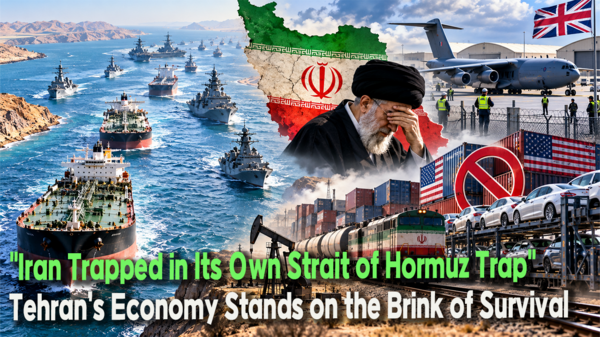
["US Expands Sanctions Pressure from Maritime to Overland Sectors"]
Tehran previously operated under the assumption that blocking the Strait of Hormuz would bring the international community to its knees. However, current developments demonstrate the exact opposite outcome. While oil flows from Gulf Arab producers have largely recovered, Iranian crude exports have cratered, and Washington is actively expanding its sanctions net beyond maritime choke points to target overland supply chains, railways, auto manufacturing, and foreign procurement networks.
This comprehensive blockade has pushed the Iranian economy into a severe crisis. Compounded by anti-terrorism investigations surrounding an incident near the UK’s RAF Fairford airbase involving potential Iranian state linkages, Tehran faces not only deep economic isolation but also the terrifying prospect of complete diplomatic and security encirclement.
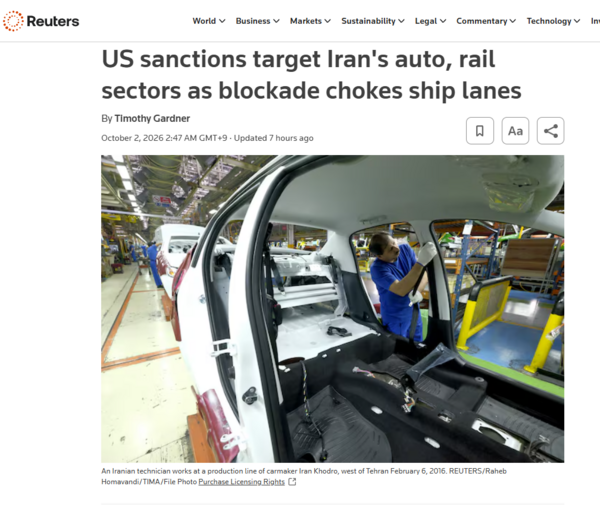
The Trump administration has levied fresh sanctions on Iran’s automotive and rail industries, alongside foreign suppliers supporting them. The Treasury Department's "Operation Economic Outcast" (dubbed "Economic D-Day" upon its launch) has officially broadened its scope beyond oil, shipping, and banking to directly choke off Iran’s overland industrial and logistics base.
The strategic rationale behind targeting automotive and rail is clear. When US naval blockades severely constrained Iranian oil exports through Hormuz, Tehran shifted heavily toward rail and road transport to move not only diverted crude but also fertilizers, petrochemicals, and general commercial cargo across land borders. By moving preemptively to sever these alternative overland corridors, Washington is closing off Iran's remaining economic bypasses.
These sanctions strike at the very heart of the Iranian domestic economy. Targets include Iran Khodro (IKCO) and SAIPA—two major auto manufacturers that together control over 90 percent of the domestic vehicle market—as well as the Islamic Republic of Iran Railways (RAI), Raja Passenger Trains, and prominent private freight rail operators. Foreign parts suppliers and intermediaries across Indonesia, the UAE, Türkiye, and Hong Kong feeding into Iran's automotive supply chain have likewise been designated.
US Treasury officials described the automotive and rail networks as critical remaining industrial lifelines for the regime. As Treasury Secretary Scott Bessent noted, these targeted actions are designed to systematically drain Tehran's remaining revenue streams.
Washington's strategy has evolved from simply stopping crude oil at sea to systematically tracking down Iran's substitute industries, transport routes, foreign vendors, and shadow-banking networks. Put simply: when Iran was blocked at sea, it pivoted to land; when it moved to land, US sanctions followed.
[Why Did It Come to This? The Collapse of Iranian Crude Exports]
The drive to target cars and trains originates from the collapse of Iran's core revenue engine: crude oil. Maritime tracking data shows that Iranian crude and condensate exports—which stood near 2.0 million barrels per day (bpd) in March—dropped precipitously to roughly 740,000 bpd in July, and tumbled further to between 220,000 and 255,000 bpd in August.
For decades, Tehran relied on "shadow fleets," ship-to-ship transfers, and origin-masking to bypass Western sanctions and supply buyers in China and elsewhere. However, the current physical maritime blockade presents a far more formidable barrier.
As a result, Iran faces crippling storage and production bottlenecks alongside lost sales. With tankers unable to dock or navigate past blockade lines, domestic oil fields have nowhere to send produced crude. Securing the primary revenue tap has allowed Washington to roll out secondary pressure against the domestic rail, automotive, metals, and shadow-finance networks that Tehran relies on to cushion the blow.
[Yet, Oil Flows Again Through Hormuz]
What makes the situation particularly acute for Tehran is the diminishing leverage of its primary strategic leverage point: the Strait of Hormuz. Following the onset of hostilities, Iran sought to shock global oil markets and apply leverage to Washington and Gulf capitals by threatening or disrupting traffic through Hormuz. The underlying calculation was that spiking global energy prices would force the US to the negotiating table.
However, market dynamics shifted over time. Data indicates that crude oil transit through the Strait of Hormuz has largely recovered toward pre-conflict levels. Gulf Arab producers expanded bypass pipelines and offshore transshipment options, while US-led maritime security measures established safer transit corridors.
This creates a central geopolitical paradox: Iran remains largely unable to sell its own crude, yet the oil of neighboring Gulf states continues to reach global markets. While Hormuz has not completely normalized—refined petroleum products and general commercial shipping still face elevated costs and security risks—the structural assumption that threatening Hormuz could indefinitely paralyze global energy trade has fractured. The Hormuz strategy, designed as a weapon against the world, has increasingly turned inward as a trap for Iran itself.
[Sea Lanes Blocked, Air Corridors Restricted… Overland Bottlenecks Form]
US pressure has not remained confined to maritime domains. Washington issued explicit warnings regarding sanctions risks to third-country airports, ground handlers, and refueling services providing support to Iranian carriers. Consequently, major hubs in the UAE, Iraq, and surrounding regions suspended or curtailed operations for Iranian airlines. While not a total shutdown of international air travel, it has rapidly narrowed Tehran's aviation access.
This left overland trade as the primary remaining alternative. Iran sought to expand cross-border commercial transport through Türkiye, Pakistan, Afghanistan, Iraq, and Turkmenistan, while increasing rail freight links with China. However, border infrastructure proved incapable of handling the sudden surge in cargo volume. At key Turkish border crossings, queues of up to 3,700 Iranian trucks formed, with drivers enduring long wait times to cross. Furthermore, rail freight capacity remains fundamentally limited compared to maritime shipping volumes. Driven onto land by sea blockades, Iranian logistics now face a dual barrier of new US sanctions and severe overland choke points.
[Rial at 2.5 Million to $1: Economic Blockade Hits the Dining Table]
The real-world impacts of this economic pressure are most visible in currency markets. The Iranian Rial crashed to an all-time low on unofficial foreign exchange markets, breaching 2,500,000 Rial per US Dollar. Compared to approximately 32,000 Rial per USD at the time of the 2015 JCPOA nuclear agreement, this reflects a historic depreciation.
As hard-currency inflows from crude sales dry up, import prices for raw materials and essential consumer goods continue to climb. Compounded by maritime shipping disruptions and rising overland freight costs, both corporate operations and household budgets face immense strain. While declaring an absolute economic collapse remains premature, Iran has clearly entered a complex economic survival crisis impacting oil revenue, foreign exchange, logistics, industrial production, and basic consumer purchasing power simultaneously.
[Compounded Crisis: The RAF Fairford Incident & Rising Security Risks]
Adding to Tehran’s domestic challenges, a separate international security incident in the United Kingdom risks further deepening its isolation. British counter-terrorism police are investigating potential foreign state involvement surrounding an incident near RAF Fairford, a military installation utilized by US forces. While no explosive devices were recovered at the scene and initial suspects were released on bail, the arrest of a British-Iranian dual national under terrorism charges signaled an escalation in the investigation.
To date, no conclusive evidence linking the Iranian government or the IRGC directly to the incident has been publicly established, and Tehran has denied involvement. However, should ongoing British investigations reveal direct state or proxy links, the consequences would be severe. It would risk expanding Iran’s current economic conflict with Washington into a broader security confrontation with European powers and Western allies.
[Why Times Insight | The Strait Built to Trap the World Traps Iran]
The fundamental vulnerability facing Tehran is less a matter of immediate battlefield defeat and more one of systemic economic asphyxiation. Washington is no longer restricting its focus to Iranian crude; it is systematically mapping and targeting every step of Tehran's economic adaptation. When Iran turns to rail, rail is sanctioned; when it relies on auto manufacturing and land freight, those supply chains and foreign vendors are targeted; when it uses shadow financial channels, those networks are tracked and cut off.
Equally critical is the paradox of Hormuz. Tehran attempted to leverage the strait to pressure the global economy, but regional energy networks have gradually adapted to bypass Iran. Alternative pipelines, offshore ship-to-ship transfers, and naval escort frameworks have restored much of the Gulf's oil export capacity, even as Iranian crude remains locked out.
While this does not imply an immediate collapse of state authority, time may prove to be the regime's most daunting challenge. Operating without sufficient oil revenues, hard currency, or imported industrial components—while domestic real incomes fall—creates an operational divide between maintaining military posture and sustaining the basic national economy. The Strait of Hormuz, once viewed as Iran’s ultimate geopolitical lever, has increasingly turned into an economic enclosure.

-중국 푸단대학교 한국연구원 객좌교수
-전 EDUIN News 대표
-전 OUR NEWS 대표
-제17대 대통령직인수위원회 정책기획팀장
-전 대통령실 홍보기획비서관
-사단법인 한국가정상담연구소 이사장
-저서: 북한급변사태와 한반도통일, 2012 다시우파다, 선거마케팅, 한국의 정치광고, 국회의원 선거매뉴얼 등 50여권