
Update2026.10.24 (토)

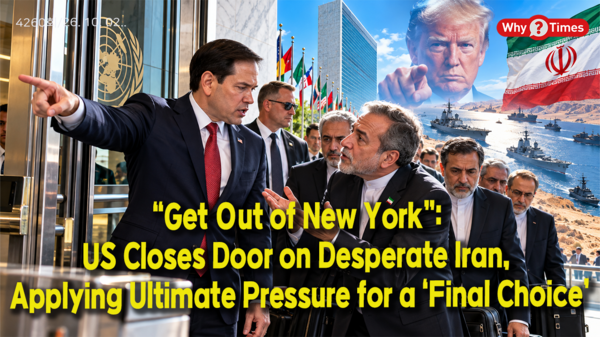
[“Iranian Delegation, Leave New York Immediately!”: Rubio Shuts Down the New York Negotiation Table]
Despite repeated rejections from Washington, Tehran attempted to cling to diplomatic negotiations by proposing a "7-day confidence-building measure." However, Washington responded with a sharp, uncompromising message. US Secretary of State Marco Rubio demanded that the Iranian delegation, including Foreign Minister Abbas Araghchi, leave New York immediately. Concurrently, while the US passed a counter-proposal back to Iran via Qatari mediators, the operational sequence of the negotiations was completely inverted. As pressure mounts on Iran to take the first step regarding the Strait of Hormuz and its nuclear program before any US concessions can be discussed, President Donald Trump warned that the situation will end "very soon, either by making a deal or blowing it up." With the power of Tehran’s cherished Hormuz card waning, Iran finds its strategic options narrowing significantly.
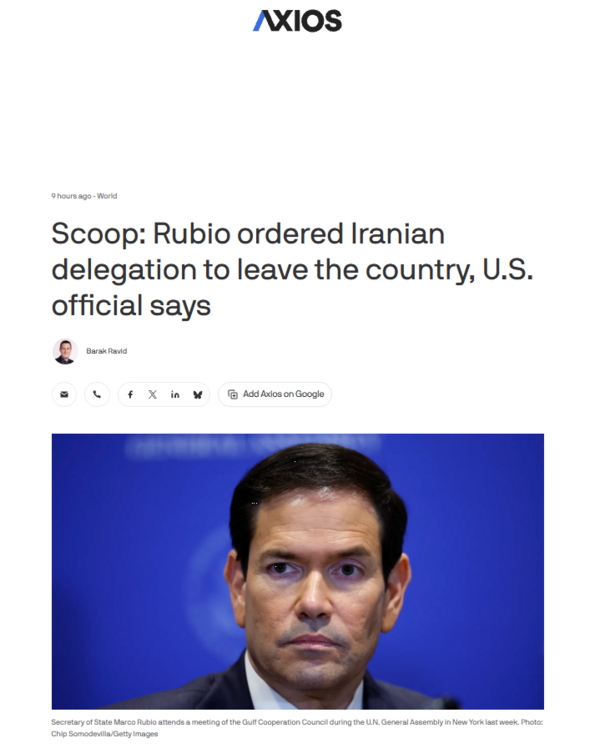
On October 1 (local time), immediately after US-Iran negotiations reached a deadlock, Secretary of State Marco Rubio took direct action. On the evening of September 28, Rubio demanded through the US Mission to the United Nations that the Iranian delegation, including Foreign Minister Araghchi, vacate New York without delay. A US official explained that the Iranian delegation was no longer welcome and that it was time for them to depart as the UN General Assembly had concluded. The action made it abundantly clear that US authorities held no lingering hesitation regarding the Iranian team.
Araghchi and his entourage headed to the airport a few hours later, boarding a 1:20 AM flight from New York to Doha on September 29. While the Iranian delegation was already scheduled to leave soon, Rubio’s demand was evaluated as a highly unusual diplomatic rebuke. Iranian officials denied the US narrative of an "expulsion," asserting that they departed according to their original itinerary.
The critical factor is not how many hours earlier they departed, but the underlying political reality: the US Secretary of State personally conveyed a "leave now" message to the Iranian Foreign Minister, who had remained in New York after the UN General Assembly to explore potential negotiations with Washington. This serves as a potent political signal that the United States no longer sees any need to pursue open diplomacy with Iran on the public stage of New York.
[Just Hours Earlier, the White House Saw ‘Potential for a Deal’]
What makes this turn of events even more striking is that the atmosphere just hours prior was completely different. As late as the morning of September 28, the White House anticipated possible progress in negotiations with Iran. Qatari mediators were conducting talks with Araghchi’s team in New York before traveling to Washington to continue discussions with US officials.
By the afternoon, however, the mood shifted dramatically. Negotiations stalled as both sides refused to back down over the sequencing of nuclear commitments, sanctions relief, and the reopening of the Strait of Hormuz. US officials concluded they held the upper hand in negotiations and saw no reason to rush into compromises to satisfy Iran’s demands.
That evening, Rubio issued the departure order. Just a week prior, the US and Iran had been communicating through mediators like Qatar in New York. Now, the New York venue is effectively closed, stripping Tehran of a key public arena intended for direct political leverage with Washington.
[Waiting in Doha: An American ‘Counter-Proposal’]
This does not mean the United States has severed all channels of communication with Iran. On the contrary, the most significant aspect of these developments is that almost simultaneously with Rubio closing the door in New York, Washington delivered its response to Iran via Qatar. After departing New York, Araghchi met Qatari mediators in Doha on September 29. The mediators handed Araghchi Washington’s formal response to Iran's "7-day confidence-building plan," which Qatari officials had received in Washington the previous day. The Iranian government confirmed that Araghchi received the US response and reported it to President Masoud Pezeshkian and the cabinet.
Ultimately, the message sent by the US to Iran is paradoxical: "Get out of New York. But if you want to negotiate, review our terms delivered through Qatar." The US has not abandoned negotiations altogether; rather, it is reshaping the venue, method, and above all, the operational sequencing of the talks entirely to its own advantage.
[The Dispute Shifts from ‘What to Do’ to ‘Who Moves First’]
This sequence forms the central point of contention in current talks. Reports citing a non-Iranian official briefed on the proceedings highlighted a crucial nuance: the core dispute is no longer the specific actions each side must take, but the exact order in which those actions are executed.
Iran has proposed a scheme where the US first eases its maritime blockade and crude oil sanctions while resolving frozen assets, after which a 7-day confidence-building window would lead to the restoration of normal navigation in the Strait of Hormuz. Under Tehran's framework, broader nuclear negotiations would follow. Washington’s calculation, however, is the exact inverse: Iran must take concrete steps on the nuclear front and initiate movements in the Strait of Hormuz before the US will entertain reciprocal measures like sanctions relief. In essence, the US has issued an ultimatum: accept this sequencing, or face an end to dialogue.
[Iran’s Biggest Card, ‘Hormuz,’ Begins to Falter]
At this juncture, a pivotal shift is disrupting the negotiation landscape: Middle Eastern crude oil exports are recovering toward pre-war levels. On October 1, analyses from Goldman Sachs and JPMorgan indicated that Middle Eastern crude oil exports have recovered to approximately 19 million barrels per day (bpd), nearly reaching pre-war figures. Around 60% of this volume passes through the Strait of Hormuz, while the remaining 40% utilizes alternative routes, including bypass pipelines to the Red Sea and the Persian Gulf.
Crucially, while the US maritime blockade has severely restricted Iran’s own crude exports, Gulf oil producers like Saudi Arabia and the UAE have expanded their bypass transit networks. This marks a major shift at the bargaining table. Previously, Tehran’s most potent leverage was its assertion that "Tehran holds the sole key to normalizing Hormuz." However, as global oil markets adapt even without Iran’s cooperation, the intrinsic value of Tehran’s primary bargaining chip is inevitably diminishing.
This shift underscores the increasingly aggressive rhetoric coming from President Trump. Trump recently claimed that "crude oil flows through Hormuz have substantially recovered," adding that "Iran will ultimately give up." This publicly signals Washington's confidence that it has largely neutralized Iran’s threat to blockade the strait.
[Bessent’s ‘Two-Week Clock’: Iran’s Financial Lifeline Dries Up]
Parallel to military pressure, the economic clock is ticking. US Treasury Secretary Scott Bessent recently estimated that "only about 15 million barrels of Iranian crude oil remain floating at sea," forecasting that "once these supplies are delivered to places like China, Iran’s trade capacity will plummet rapidly." While this "two-week" timeframe is not an official US ultimatum, it represents an economic projection grounded in Iran’s current inventory and export capacity.
Nonetheless, it offers a vital clue into Washington’s negotiation timetable. If Iran’s crude export capacity further shrinks while Gulf oil exports through Hormuz continue to recover, time works squarely in Washington's favor—creating a framework where Tehran needs a deal far more urgently than the United States. Indeed, US maritime blockades and sanctions are exerting severe pressure on the Iranian economy, placing a heavy burden on the rial's value and local living costs.
[Trump Drops the Ultimatum: “Either Make a Deal or Blow It Up”]
Against this backdrop, President Trump escalated the rhetoric further on September 30. Asked by reporters how a deal with Iran could be reached, Trump alluded to potential military action, framing the ultimate US choice as either striking Iran or reaching an agreement. He emphasized that either way, the situation will end "very soon".
While this statement cannot be interpreted as an immediate decision to launch airstrikes, it clearly demonstrates that Trump has placed both negotiations and military options on the table simultaneously to force Iran’s hand. Notably, these remarks came immediately after Rubio ordered Araghchi’s delegation out of New York and Washington delivered its counter-proposal to Tehran via Qatar. The door in New York is closed; the window in Doha remains open. However, standing right outside that window are the strict conditions set by the United States.
[Why Times Insight]
Viewing Rubio’s "immediate departure" demand and Trump’s "deal or blow it up" warning as a cohesive sequence reveals a clear shift in Washington's strategy. The US has not discarded negotiations with Iran. Instead, it has shut down the public stage in New York, left open only the indirect channel via Qatar, and established a framework where "Iran must be the first to move if it wants a deal."
At the core of this leverage lies the Strait of Hormuz. Tehran previously used the normalization of Hormuz as its ultimate bargaining chip to extract an end to the US blockade, sanctions relief, and the unfreezing of assets. However, as Middle Eastern crude exports rebound to pre-war levels and alternative pipeline routes expand, the potency of this card is weakening.
Combined with a blockade on its own crude exports and compounding domestic economic stress, Tehran will increasingly become the party desperate for a settlement as time passes. Washington is leveraging this temporal asymmetry as a primary bargaining tool. Thus, the ongoing struggle over "sequencing" is not a mere procedural squabble—it is a battle over whether the US lifts blockades and sanctions first, or whether Iran surrenders its nuclear and Hormuz leverage first.
Accepting the latter option means Iran would forfeit its strongest leverage points up front without guaranteed, concrete concessions from the US. This explains why hardliners in Tehran view Washington's terms as tantamount to complete surrender. The situation is evolving rapidly into one where the US holds maximum leverage over Iran. Rubio closed the New York door; Trump brought military options back to the fore; and Washington dispatched its unilateral terms to Tehran via Doha.
Tehran faces an agonizing choice: surrender its remaining leverage—Hormuz and its nuclear program—and accept Washington’s terms, or endure complete economic isolation and the threat of military conflict to hold its ground. US-Iran negotiations have reached a critical juncture where Iran is being backed into a corner to relinquish its strategic leverage.

-중국 푸단대학교 한국연구원 객좌교수
-전 EDUIN News 대표
-전 OUR NEWS 대표
-제17대 대통령직인수위원회 정책기획팀장
-전 대통령실 홍보기획비서관
-사단법인 한국가정상담연구소 이사장
-저서: 북한급변사태와 한반도통일, 2012 다시우파다, 선거마케팅, 한국의 정치광고, 국회의원 선거매뉴얼 등 50여권