
Update2026.10.24 (토)

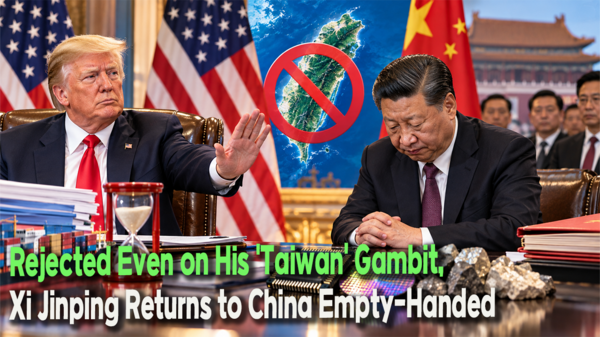
[“Say you oppose Taiwan independence”… Xi Jinping’s high-stakes gamble]
Despite receiving the highest level of state visit honors and launching massive state media coverage, Chinese President Xi Jinping returned home without securing any tangible achievements to present to the Chinese public, plunging Zhongnanhai into deep gloom. His most painstakingly pursued objective—altering the U.S. position to 'oppose Taiwan independence'—was rejected by President Trump. The tariff confrontation resulted only in a brief two-month truce rather than a long-term resolution, and no decisive breakthroughs were achieved regarding advanced technology or rare earths. Furthermore, the television propaganda effect intended to project his stature as a 'G2 leader' directly into American living rooms ran into trouble from day one, laying bare the stark contrast between a lavish state visit and meager results. This is the most painful point for Xi Jinping: the red carpet and gun salutes remained in Washington, while no decisive trophy remains to present to the Chinese public upon his return to Beijing.
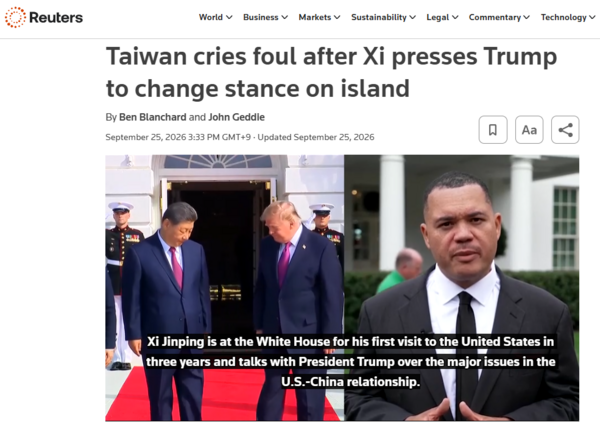
The analysis revealed that the most notable aspect of President Xi Jinping's visit to the United States was his direct pressure on President Trump to push U.S. phrasing on the Taiwan issue one step further. According to China's announcement of the meeting, Xi demanded at the White House that the U.S. must 'adhere to the correct position of opposing Taiwan independence.' This went beyond Washington's long-standing phrasing of 'do not support' Taiwan independence, demanding the explicit term 'oppose.'
Xi's demand was a pressure tactic designed to bring about a subtle yet meaningful shift in the established U.S. stance. While it may appear to be a difference of a single word, it holds immense significance for Beijing: if the United States officially declares that it 'opposes Taiwan independence,' China could promote this as a major diplomatic victory, signaling that Washington has moved a step closer to Beijing's position on the Taiwan issue. Moreover, even prior to the summit, expectations circulated that Xi would demand a complete halt to U.S. arms sales to Taiwan, citing the 1982 U.S.-China Joint Communiqué, making this one of Xi's central demands to Washington.
[Yet America’s answer was “We won’t change our words or our policy”]
However, the message emanating from Washington following the summit was precisely the opposite.
U.S. Ambassador to China David Perdue stated in an interview that "there is no change in Taiwan policy." He emphasized that "the U.S. continues to maintain its One China policy, the Taiwan Relations Act, the three U.S.-China Joint Communiqués, and the Six Assurances," adding, "We are not changing our phrasing. We are not changing our position."
Ambassador Perdue reaffirmed that "the U.S. does not support Taiwan independence, but we also do not support Chinese coercion," confirming that "current policy remains firmly in place." The Taiwan government also stated that it received identical assurances through multiple diplomatic channels from the U.S.
President Trump similarly stated that he "didn't talk much about Taiwan with Xi Jinping," adding that Xi "understands very well" how he feels about the Taiwan issue. Ultimately, the term 'oppose,' which Xi personally brought to the table, was nowhere to be found in Trump's public statements.
[The White House document didn't mention 'Taiwan' at all]
An even more symbolic scene unfolded in the post-summit press statements issued by both nations. While the Chinese side disclosed that Xi demanded an 'opposition to Taiwan independence' from the U.S., the fact sheet released by the White House after the meeting omitted any mention of Taiwan altogether. The U.S. document highlighted trade, investment, geopolitical issues involving Russia, North Korea, and Iran, as well as narcotics control, completely sidelining the Taiwan issue that China sought to emphasize. In the end, although Beijing underscored Xi's demands through its own press release, it failed to transform them into a joint achievement endorsed by the U.S.
This divergence illustrates the true character of the summit. Although both leaders sat at the same table, they offered contrasting accounts on sensitive issues, and the official U.S. baseline on Taiwan remained completely untouched. Analysts assessed that no distinct breakthroughs emerged from this summit across core issues such as AI, trade, Taiwan, and Iran.
[The $14 billion arms sale remains alive and active]
Another Taiwan-related issue Xi sought to resolve was U.S. arms sales. Heading into the summit, China was anticipated to demand an end to U.S. arms sales to Taiwan based on the August 17 Joint Communiqué of 1982. Currently, a new arms package for Taiwan worth approximately $14 billion remains pending.
Yet on this issue as well, China failed to secure its requested outcome of a 'sales halt.' Taiwanese diplomatic authorities stated that even following the summit, Washington maintains a clear understanding of Taiwan's defense needs and its commitment to expanding defense investment, with both sides continuing close communication.
[On tariffs, all China gained was a ‘two-month’ extension]
In the economic sphere, no long-term breakthrough materializes either. The United States and China extended their trade truce—set to expire in November—by approximately two months until January next year. However, this functions more as buying additional time to maintain negotiations rather than achieving a durable tariff settlement.
The key takeaway summarizing the summit is precisely this point: although both nations agreed to continue discussions on a broader trade deal, all that was actually secured at this summit was a brief two-month extension of the truce.
From Xi Jinping's perspective, U.S. tariff pressure was neither structurally dismantled nor was a long-term tariff exemption secured. Conversely, Trump did not extract every trade concession he sought from China either. Ultimately, both nations merely deferred an immediate clash, leaving the core underlying conflicts entirely unresolved.
[No breakthroughs in AI or advanced technology]
No game-changing agreements were disclosed regarding advanced technology either. While AI was cited as a major agenda item prior to the summit, no agreement emerged that fundamentally alters the U.S. system of technological controls on China. Issues surrounding rare earths and critical minerals likewise remain unresolved on the negotiating table.
Observers characterized the summit as having limited substantive content despite its elaborate symbolism, noting a lack of breakthroughs on sensitive topics such as AI, trade, Taiwan, and Iran. Consequently, China finds itself with virtually no structural concessions to present domestically as proof of easing U.S. technological pressure.
[To make matters worse, the very 'broadcast coverage' they wanted most vanished]
Setting policy issues aside, Xi faced an unexpected setback involving U.S. television broadcasts. Due to restrictions placed on press pool access at the White House, joint pool coverage by major U.S. television networks was suspended. As a result, primary first-day events of Xi's state visit were not broadcast live across U.S. television networks as originally anticipated.
Following a court decision restoring press access, joint pool coverage by U.S. broadcasters resumed. That day marked the first time during Xi's visit that U.S. television networks provided live pool footage. While China's external propaganda efforts were not completely derailed, the exposure of the most iconic first-day imagery within the United States was undeniably diminished—an unexpected stroke of bad luck for Beijing, as a state visit by the President represents a crucial diplomatic event to showcase China's standing domestically and internationally.
[The red carpet was lavish… But what was brought back?]
Paradoxically, the protocol received was of the highest order. President Trump accorded President Xi grand state honors. Ranging from White House ceremonies and a state dinner to a visit to the National Archives, the U.S. staged an event treating the Chinese president as one of the world's paramount leaders.
However, once inside the summit room, the atmosphere shifted completely. The wording of Taiwan policy remained unchanged. A halt to arms sales to Taiwan was not achieved. The trade war resulted not in an end, but in a mere two-month truce extension. No structural breakthroughs were announced regarding AI or advanced technology. To top it off, China even failed to secure full U.S. television broadcast coverage on the crucial first day. This explains why analysts evaluated the state visit as being "heavy on symbolism, but light on substance."
[Why Times Insight: The most uncomfortable question remaining for Xi Jinping: “So, what did you bring back?”]
In evaluating this visit to the United States, what matters is not speculating on Xi Jinping's facial expressions or psychological state. The core question is what tangible results he can present to the Chinese public and Communist Party elites as achievements extracted from America. What remains clear is that public concessions from the U.S. capable of shifting China's strategic interests were virtually non-existent. The fact that the U.S. refused to adopt even the single phrase 'oppose Taiwan independence' personally requested by Xi is deeply symbolic. Ambassador Perdue publicly drawing the line immediately after the meeting by stating "we are not changing our phrasing and we are not changing our position" made that reality all the more stark.
Thus, the scene that truly symbolizes this visit may not be the state dinner or the military band. While the red carpet rolled out before Xi Jinping was long, his list of diplomatic trophies to bring back to Beijing was vastly shorter. Some analysts suggest that the U.S. side, having already anticipated Xi's demands at this summit, intentionally elevated protocol to encourage the Chinese side, only to completely disregard Xi's core demands, effectively leaving China with no room to protest.
Ultimately, this summit resembled not the final round of U.S.-China competition, but a temporary pause delaying the next collision. One of the most critical signals indicating the next phase remains on President Trump's desk: the $14 billion arms sale package for Taiwan. Given that this issue is effectively settled with the U.S. having zero intention of making concessions to China, President Xi's outlook appears destined to remain gloomy.
-중국 푸단대학교 한국연구원 객좌교수
-전 EDUIN News 대표
-전 OUR NEWS 대표
-제17대 대통령직인수위원회 정책기획팀장
-전 대통령실 홍보기획비서관
-사단법인 한국가정상담연구소 이사장
-저서: 북한급변사태와 한반도통일, 2012 다시우파다, 선거마케팅, 한국의 정치광고, 국회의원 선거매뉴얼 등 50여권