
Update2026.10.24 (토)

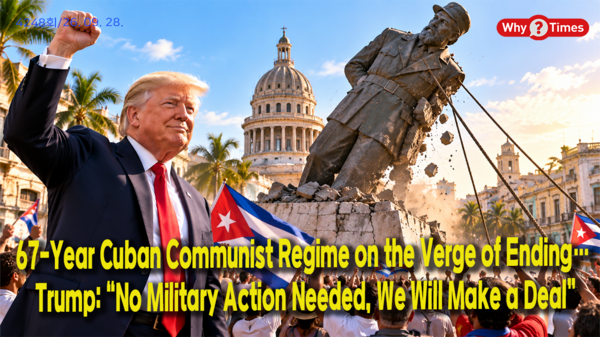
[“Military Action Won’t Be Necessary”… The Decisive Statement Cast by Trump]
The 67-year-old Cuban Communist regime stands at a critical crossroads. U.S. President Donald Trump declared that “we will make a deal with Cuba” and that “we won't need the military”. Coming just four days after he declared at the UN General Assembly that “freedom will be coming to Cuba,” Trump has now publicly begun mentioning the possibility of reaching a negotiated settlement rather than resorting to military action. Although a regime transition has not yet been agreed upon, how far Cuba—under extreme pressure on its oil supply chain following the removal of Venezuela’s Nicolas Maduro—will compromise with Washington has emerged as a major new variable in Latin American geopolitics.
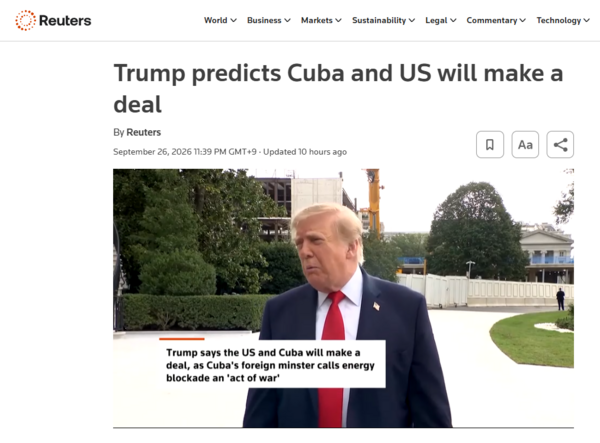
Reuters reported on the 26th (local time): “Speaking to reporters at the White House before departing for Tennessee, President Donald Trump stated, ‘I would say that Cuba and us will make a deal,’ adding, ‘I don’t think we’ll need the military’. He also noted that ‘Cuba is failing very badly’ and remarked that ‘we want to help Cuba, and we want to open Cuba up to our people’”. While this does not mean that the U.S. and Cuba have reached an actual agreement, it is a notable statement in that Trump publicly projected a resolution without military action.
Even more striking is the sharp contrast with Trump’s much harsher tone just four days earlier. Addressing the 81st UN General Assembly on the 22nd, he defined Cuba as a “failed state,” stating that “the communist regime is under great pressure” and proclaiming that “freedom will be coming to Cuba”. The president who was pushing for the ‘end of Communist Cuba’ turned around in just four days to say that a “deal can be made without the military”.
Connecting both statements clarifies the evolution of U.S. strategy. Rather than signaling a retreat of U.S. pressure on Havana, it suggests that Washington is maintaining maximum pressure while publicly floating the possibility of engineering political and economic transformations through negotiation. Indeed, the Trump administration expanded sanctions targeting the Cuban government and affiliated entities earlier in May.
[Yet Havana is Also Starting to Move]
What is even more critical is Cuba’s stance. According to Reuters, Cuban Foreign Minister Bruno Rodríguez strongly criticized U.S. pressure at the UN General Assembly on the 26th, yet did not close the door on the possibility of dialogue with Washington. This implies an intention to maintain potential contact with Washington, at least in its public messaging.
A subtle shift is discernible compared to just a few weeks ago. In a press conference on September 7, Foreign Minister Rodríguez stated there were "no negotiations and no agenda" with the U.S., adding that there were "no plans for future talks." However, even then, he expressed a willingness to maintain contact. Earlier in June, he explained that "talks initiated with the U.S. this year have hit a stalemate." While contact itself has existed between the two sides, significant discrepancies have persisted between U.S. and Cuban accounts regarding whether those contacts evolved into official negotiations or a formal roadmap.
[Professing “Defending Socialism” with Their Lips… But the Economy is Already Moving]
Change is manifesting in the economy well ahead of politics. Reuters reported on the 21st that "Cuba is expanding market-friendly measures—such as issuing higher-denomination banknotes and permitting private currency exchange bureaus for the first time in history—in response to severe cash shortages, soaring inflation, and a collapsing peso." The value of the Cuban peso has plummeted to roughly one-tenth of its 2021 level, with official statistics showing prices surging by over 25% this year alone.
Reuters evaluated this as a cautious step by Cuba away from traditional communist economic management. However, President Miguel Díaz-Canel continues to emphasize that these reforms do not signify an abandonment of socialism. This very point will be the crux of upcoming U.S.-Cuba negotiations: how far the gap can be bridged between the political and economic shifts demanded by Washington and the socialist framework the Cuban leadership insists on maintaining.
[After Removing Maduro, They Squeezed Cuba’s Lifeline]
To understand the current situation, one must look at Washington’s strategy toward Cuba since January of this year. The Trump administration significantly intensified pressure on Cuba after Venezuelan President Nicolás Maduro was ousted. Venezuela had long served as Cuba’s most vital political ally and primary energy supplier. The U.S. subsequently introduced a new framework of pressure, allowing additional tariffs on U.S.-bound exports from countries supplying oil to Cuba.
This pressure intersected with an energy crisis Cuba was already struggling to manage. On the 18th, Cuba’s national power grid collapsed once again across the entire island. It marked the sixth nationwide grid failure since January. Reuters noted that "aging generation and transmission infrastructure combined with severe fuel shortages are operating simultaneously". In some regions, rolling blackouts persisted for over 30 consecutive hours.
Thus, attributing Cuba’s economic distress solely to U.S. pressure is inaccurate. Aging infrastructure, low productivity, foreign currency shortages, and long-standing state economic mismanagements have accumulated over decades; the crisis deepened dramatically when U.S. sanctions and oil supply blockades were superimposed on these structural flaws. While Havana and Washington exchange diametrically opposed arguments over who bears blame for the crisis, there is little dispute that the island’s economic endurance is rapidly evaporating.
[Bypassing the Official Government… A Secret Channel with ‘Raúl’s Grandson’]
Simultaneously with public pressure, Washington has been pursuing behind-the-scenes contacts. Axios reported in February that "Secretary of State Marco Rubio has been secretly communicating with Raúl Guillermo Rodríguez Castro, grandson and close confidant of former National Council President Raúl Castro". Notably, this channel bypassed official Cuban government lines. Senior Trump administration officials described this at the time not as formal 'negotiations,' but rather as 'discussions' regarding Cuba’s future.
Two months later, the situation advanced another step. According to Axios, a U.S. State Department delegation visited Havana directly in April to meet with Cuban figures, including Raúl Guillermo, to discuss expanding democratic and economic freedoms. It was the first time in 10 years, since President Obama’s historic visit, that a U.S. government aircraft had landed in Cuba for such a purpose. Washington reportedly offered Starlink satellite support to expand internet access.
An even more intriguing development unfolded in July. According to Reuters, Raúl Guillermo stated in an interview with U.S. media that he was "willing to negotiate with President Trump." Shortly thereafter, the Cuban Prime Minister publicly emphasized that "there is no division within the leadership." A complex scenario thus emerged: while the official government asserted political unity, an insider tied to the core of Castro’s power structure publicly raised the prospect of talks with Washington.
[Will Venezuela’s ‘Managed Transition’ Be Applied to Cuba as Well?]
Venezuela provides a precedent here. On the 26th, President Trump stated that he had "directly discussed election issues with Delcy Rodríguez, Interim President of Venezuela." Even after Maduro’s departure, the existing state apparatus was not dismantled overnight; instead, the U.S. is conferring with the Rodríguez government on economic and political issues. Reuters observed that "U.S. influence over the Rodríguez government has deepened significantly of late."
Still, one cannot assume the Venezuelan model will be applied verbatim to Cuba. Cuba has maintained a single-party socialist state for 67 years since its 1959 revolution, with the military, the Communist Party, and state-owned enterprises intricately intertwined. However, if Washington seeks incremental political and economic shifts by engaging negotiable factions within the existing power structure rather than attempting a sudden total dismantlement, the Venezuelan experience serves as an important comparative case.
[Washington Negotiates, While Miami Designs ‘Post-Communist Cuba’]
Another notable movement is underway. The Wall Street Journal (WSJ) reported on the 21st that "Cuban-Americans in the United States are already preparing concrete plans with a 'post-Communist Cuba' in mind." Beyond schemes to attract U.S. investment capital, establish a stock exchange, and rebuild infrastructure such as power, telecommunications, and transportation, discussions are even taking place on constitutional and legal amendments necessary for a political transition.
[If Cuba Shakes, Latin America’s Political Landscape Quakes]
The trajectory of Cuba is vital because its implications extend far beyond a single island nation. As right-leaning or conservative political forces gain ground in elections across Latin America, the phrase 'Blue Tide' has re-emerged in regional discourse.
Attention is now turning toward Brazil. Brazil will hold its presidential election on October 4. According to Reuters, leftist icon President Luiz Inácio Lula da Silva is seeking a fourth term, competing against right-wing candidate Flávio Bolsonaro. While there is no basis to claim the Cuban issue alone will determine Brazil’s election, it is noteworthy that the debate over the future of the Cuban regime coincides with an election carrying intense symbolic weight for both left and right camps across Latin America.
[Why Times Insight: Cuba Starts to Move Without a Shot Being Fired]
The most critical takeaway here is not whether the Cuban Communist regime has already collapsed. What matters is that the Cuban leadership and Washington—adversaries for 67 years—have simultaneously begun speaking of ‘negotiation’ and ‘change’. Just four days ago at the UN, Trump proclaimed that “freedom will be coming to Cuba”; now he states that “we will make a deal with Cuba” and “the military won't be necessary”.
In the background lies nearly nine months of unrelenting pressure. After removing Venezuela’s Maduro, the U.S. choked off Cuba’s primary energy supply line and constructed a tariff mechanism capable of targeting nations supplying oil to Havana. Inside Cuba, the national power grid has collapsed six times this year, while the peso’s value and real purchasing power have plummeted. Concurrently, the Cuban government is resorting to economic reforms once deemed unthinkable, such as authorizing private exchange offices.
Changes have also taken place below the surface. Secretary of State Rubio bypassed official Cuban government lines to establish contact with Raúl Castro’s grandson, and a U.S. delegation entered Havana to discuss expanding economic and political freedoms. Cuban-Americans in Miami have already begun analyzing post-communist investments, infrastructure reconstruction, and constitutional reforms. While this does not imply a finalized regime transition agreement, it clearly demonstrates that in Washington, the ‘future of Cuba’ is no longer merely an abstract discourse.
Yet the final threshold remains the highest. The Cuban government maintains that it will not abandon its socialist system. Trump’s “deal” remains a projection by the U.S. President rather than an announced agreement. Rather than declaring the ‘end of the Cuban Communist regime,’ it is more precise to view this moment as a crucial crossroads where the 67-year-old system faces unprecedented external pressure, internal economic crisis, and demands for negotiation all at once.
The question ultimately reduces to one: In exchange for the 'deal' mentioned by Trump, how far will Cuba transform? Whether the regime that survived at America's doorstep for 67 years since Fidel Castro’s 1959 revolution will transition toward full political transformation, or merely choose economic opening and improved U.S. relations while preserving its socialist system, remains uncertain. What is clear is that the outcome will not be confined to Cuba alone. If Cuba takes steps toward actual political transition, it will mark one of the most symbolic shifts in post-Cold War Latin American history, introducing a major new variable into a regional political landscape that is already shifting significantly.
-중국 푸단대학교 한국연구원 객좌교수
-전 EDUIN News 대표
-전 OUR NEWS 대표
-제17대 대통령직인수위원회 정책기획팀장
-전 대통령실 홍보기획비서관
-사단법인 한국가정상담연구소 이사장
-저서: 북한급변사태와 한반도통일, 2012 다시우파다, 선거마케팅, 한국의 정치광고, 국회의원 선거매뉴얼 등 50여권