
Update2026.10.24 (토)

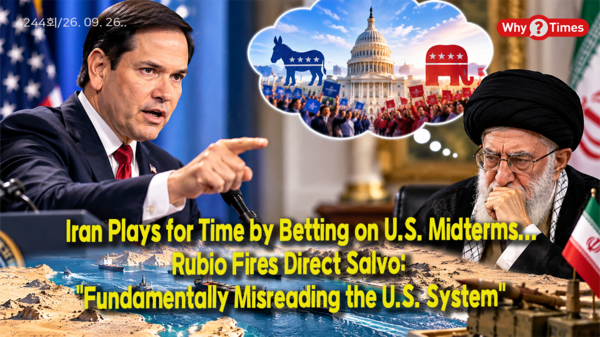
[“If Democrats Win, Trump’s Hands Are Tied? You’ve Misread America”]
Another front in the diplomatic battle surrounding Iran is shifting toward the U.S. midterm elections on November 3. U.S. Secretary of State Marco Rubio fired a direct salvo, stating, "If the Iranian leadership expects President Trump's pressure on Iran to weaken following a Democratic victory in the midterms, they are fundamentally misreading the American political system." Meanwhile, Tehran presented a "7-Day Roadmap" including the reopening of the Strait of Hormuz, and as Houthi attacks intensified, Saudi Arabia, Turkey, and Pakistan launched emergency military consultations.
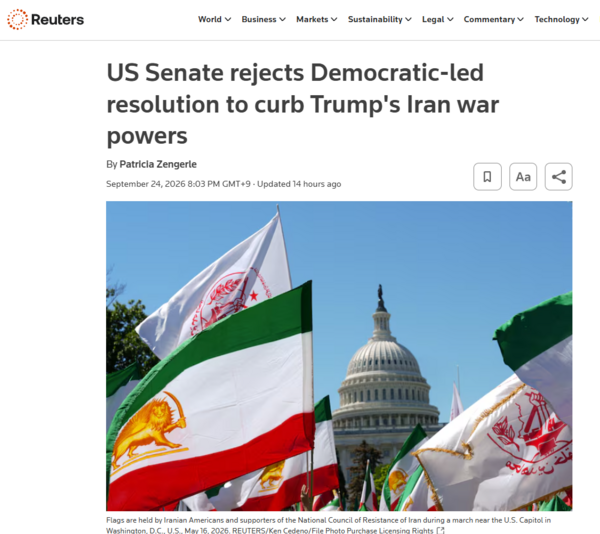
Reuters reported that a War Powers Resolution aimed at restricting President Trump's military action against Iran failed in the U.S. Senate by a vote of 49 to 50. This vote demonstrates two things simultaneously: that debate within U.S. politics over a prolonged war with Iran and presidential war powers has grown significantly, but also that Congress currently lacks sufficient votes to immediately restrain President Trump's military actions against Iran.
The Senate vote drew particular attention because it aligns with an unusually direct warning issued by U.S. Secretary of State Marco Rubio to the Iranian leadership in New York. Addressing speculation that Iran hopes a Democratic victory in the November midterm elections would limit President Trump's actions, Secretary Rubio delivered a sharp rebuke: "The Iranians are misreading our system," adding that "thinking the President will no longer be able to act against them after a Democratic victory is a delusion."
Rubio emphasized, "I served as a Senator for 14 years," noting that "while Congress possesses significant authority, that authority has its limits, particularly in national security, economic sanctions, and the use of military force, where the President holds broad powers." He argued, "If Iran is crafting its strategy solely by watching the U.S. domestic political calendar, it is fundamentally misreading the American political system."
Rubio placed particular emphasis on the Iranian nuclear issue. He explained, "To President Trump, the Iranian nuclear issue is not a matter of partisan politics, but a matter of national security." The White House also reaffirmed President Trump's stance during his speech at the UN General Assembly, stating he "will never allow Iran to acquire nuclear weapons."
[Yet Tehran Comes Out with a ‘7-Day Roadmap’]
Amid these circumstances, Tehran brought another bargaining chip to the table. Iranian Foreign Minister Abbas Araghchi publicly disclosed that "a new proposal was delivered to the United States through intermediaries in New York." It is the so-called "7-Day Roadmap," designed to halt regional hostilities within seven days and link that directly to reopening the Strait of Hormuz. Latest reports from Reuters and Al Jazeera also confirmed this proposal.
The conditions proposed by Iran are quite specific. According to Araghchi, hostilities across all fronts, including Lebanon, must cease within seven days, while the U.S. must lift its blockade on Iranian ports, unfreeze Iranian assets, and waive sanctions on Iranian crude oil. In exchange, the Strait of Hormuz would reopen on the seventh day, followed by the start of negotiations with the U.S. on the nuclear issue and other pending matters.
Therefore, the core of future negotiations will likely hinge on "who moves first." While Tehran demands that the U.S. ease blockades and sanctions first, Washington inevitably faces the burden of relinquishing its primary leverage without guaranteed reopening of the Strait of Hormuz or tangible progress on the nuclear issue. Reuters previously reported that "Iran is prepared to reopen Hormuz within a week, provided the U.S. eases military pressure and lifts port blockades."
[Pezeshkian Also States: “We Do Not Want to Continue the War”]
Moves to seek an exit ramp can also be read in statements from Iranian President Masoud Pezeshkian. In a Fox News interview, Pezeshkian remarked to the effect that "we do not want to continue a war with the United States, and if we can resolve issues through dialogue, there is no need to kill each other." However, he shifted responsibility back onto Washington, asserting that the U.S. must decide whether to end the war.
Particularly noteworthy were his comments regarding the Houthis. Pezeshkian denied direct command by the Iranian government, stating, "The Houthis are responsible for their own actions." He added, "We have contact with them, but we do not have a systematic relationship." While debate continues over the degree of Iranian military influence over the Houthis, it is clear that the Iranian President attempted to publicly distance Tehran from Houthi military actions.
[Meanwhile, the Houthi Front Is Explosively Escalating]
In contrast to diplomatic maneuvers, tensions on the battlefield are rising sharply. According to Reuters, the Houthis claimed to have launched dozens of missiles and drones toward Saudi targets, while Saudi authorities stated they intercepted six ballistic missiles fired by the Houthis. Prior to this, Saudi Arabia issued emergency alerts for Mecca, Jeddah, and Yanbu, a key crude oil export port on the Red Sea.
Saudi Arabia’s highest religious authority also issued an unusually strong message. According to Reuters, the top cleric exhorted military personnel to remain prepared to fight until the Houthis are ousted from power. As Houthi attacks expand beyond simple border disputes to directly threaten key religious and economic centers like Mecca, Jeddah, and Yanbu, Riyadh’s sense of crisis is heightening significantly.
[Saudi Arabia, Turkey, and Pakistan Begin to Move]
An even more significant development is that Saudi Arabia’s allies have begun to move. Reuters reported: "Foreign ministers from Saudi Arabia, Turkey, and Pakistan met within the framework of the 'Mecca Joint Defence Agreement' to condemn attacks on Mecca and civilian infrastructure, reaffirming Saudi Arabia’s right to self-defense." It added, "The three nations agreed to convene an emergency meeting of their Chiefs of General Staff to discuss measures to support Saudi Arabia."
Notably, this agreement contains a collective defense provision stipulating that "an attack against one party shall be considered an attack against all parties." However, this does not immediately signify direct military entry by Turkey and Pakistan. The confirmed stage at present involves emergency consultations among military leadership to discuss support measures for Saudi Arabia.
Nevertheless, statements indicating the potential expansion of cooperation have emerged. Numan Kurtulmuş, Speaker of the Grand National Assembly of Turkey, mentioned the possibility that defense cooperation among Saudi Arabia, Turkey, and Pakistan could eventually expand into a broader Islamic security alliance. While currently a conceptual political statement, it highlights the potential for a new regional security architecture centered around Saudi Arabia if Houthi attacks persist.
[From Military Pressure to 'Economic Blockade'... Iran's Aviation Network Shaken]
Washington's pressure is expanding beyond the military realm into finance and logistics. As part of "Operation Economic Outcast," the U.S. Treasury Department's Office of Foreign Assets Control (OFAC) imposed sanctions on 36 entities deemed to be supporting the Iranian aviation industry. Among these, 27 were Iranian airlines. The U.S. warned foreign companies and financial institutions that conducting transactions with sanctioned Iranian airlines carries the risk of being cut off from the U.S. financial system.
Reuters reported that "the first visible ripples of this secondary sanctions strategy are appearing," noting that "Iranian airlines have begun facing operational restrictions in neighboring countries, including the UAE and Oman." Reuters analyzed that "if these flight blockades persist, they could further deepen the isolation of Iran, which is already suffering under naval blockades and economic hardship."
The U.S. strategy itself is moving in this direction. When the Treasury Department announced "Economic D-Day," it expanded the scope of pressure so that third-country companies engaging in transactions with core sectors of the Iranian economy—such as aviation, shipping, technology, gold, and digital assets—could also become targets of secondary sanctions. Ultimately, the U.S. strategy goes beyond sanctioning Iran itself; it forces international financial and logistical networks to choose: "Continue trading with Iran, and third-country firms will pay a price."
[Why Times Insight — Ultimately a Battle of 'Who Runs Out of Time First']
What is most compelling in this situation is that both Washington and Tehran believe time is working against the other. From Iran’s perspective, it may hold out hope that U.S. debates over war powers and the upcoming midterm elections will narrow the Trump administration’s room for maneuver. Conversely, Rubio argues that very expectation represents a calculation that drastically underestimates the U.S. President’s sanction and military authorities. Indeed, in the Senate vote, a resolution aimed at restricting Trump’s military actions against Iran was defeated by a razor-thin margin of a single vote.
However, while Tehran waits, the environment surrounding Iran is shifting. Iran presented a 7-day negotiation proposal to the U.S., and President Pezeshkian signaled that Iran does not want to continue the war. At the same time, as Houthi attacks intensify, Saudi Arabia, Turkey, and Pakistan are launching emergency military consultations, and U.S. secondary sanctions are beginning to squeeze Iran’s aviation network. Looking at these factors alone, the environment does not allow Tehran to simply sit back and do nothing until November.
That said, Washington does not enjoy unlimited time either. The fact that the War Powers Resolution came down to a 49-50 vote illustrates significant internal disagreement within U.S. politics. The potential impact of a prolonged war and energy supply disruptions on U.S. domestic politics is another variable the Trump administration must weigh. Therefore, interpretations that Iran is attempting to leverage the U.S. political calendar as bargaining chips cannot be dismissed entirely.
Ultimately, this showdown cannot be reduced to a simple formula like "if Democrats win the midterms, Iran survives." While midterm elections can alter the American political environment, presidential authority does not evaporate overnight following an election. Conversely, the Trump administration cannot ignore domestic political and economic costs. Thus, the battle taking place between the U.S. and Iran leading up to November 3 is both a clash of missiles and sanctions and a war of attrition over "who runs out of time first." Rubio’s latest warning can be understood as Washington's message regarding that very "calculation of time."

-중국 푸단대학교 한국연구원 객좌교수
-전 EDUIN News 대표
-전 OUR NEWS 대표
-제17대 대통령직인수위원회 정책기획팀장
-전 대통령실 홍보기획비서관
-사단법인 한국가정상담연구소 이사장
-저서: 북한급변사태와 한반도통일, 2012 다시우파다, 선거마케팅, 한국의 정치광고, 국회의원 선거매뉴얼 등 50여권