
Update2026.10.24 (토)

[Trump’s Tarmac Greeting: Why Go to Such Lengths?]
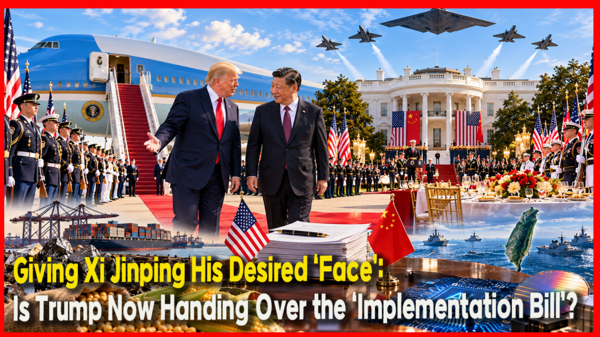
U.S. President Donald Trump traveled directly to the airfield to greet Chinese President Xi Jinping upon his arrival. The reception extended into official White House welcoming ceremonies, flyovers by a B-2 stealth bomber and four F-22 fighters, and a lavish state dinner. This extraordinary level of protocol was grand enough to spark open dissatisfaction within the Republican Party over "excessive hospitality." Why did President Trump go so far to accommodate President Xi? What is clear is that the true report card of this state visit will emerge only after the red carpet is rolled away. China secured the grand ceremonial honors necessary to elevate Xi's "face" (체면/mianzi), but the U.S. faces pressing issues that require concrete deliverables: rare earth supplies, agricultural purchases, trade truce extensions, artificial intelligence, and Taiwan. Therefore, the crux of this summit is not how lavishly Trump treated Xi, but what will be exchanged behind closed doors in actual negotiations.
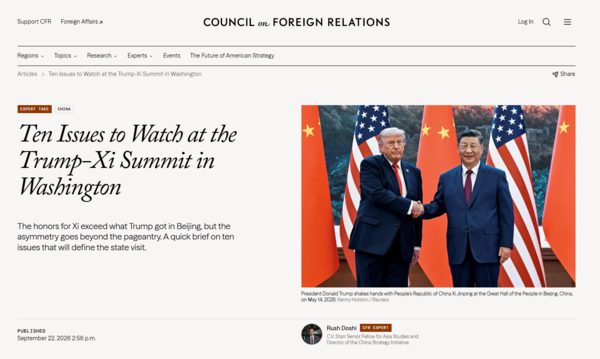
The Council on Foreign Relations (CFR) noted that Chinese President Xi Jinping arrived at Joint Base Andrews in Maryland for a three-day state visit to the U.S. Instead of waiting at the White House, President Trump personally met Xi on the tarmac—a rare protocol for an American president—marking Xi’s first official state visit to the U.S. since the Barack Obama administration in 2015.
The CFR highlighted that the planned honors were even more elaborate: White House ceremonies, bilateral talks, a state dinner, and a flyover featuring a B-2 stealth bomber flanked by four F-22 fighters. Analysts observe that this hospitality stands out significantly even when compared to the reception extended to Trump during his visit to Beijing.
This level of ceremonial treatment fully satisfied Beijing’s desired image of "State Visitor Xi Jinping." However, this is precisely where Washington's questioning begins: Why did Trump go to such lengths to grant Xi this level of prestige? The CFR suggests there is a clear strategic calculation behind such extravagant protocol.
[“Friendly on the Surface, Non-Pro-China Key Figures in the Background”]
Regarding this dynamic, Steve Yates, Senior Research Fellow at The Heritage Foundation's Asian Studies Center, pointed out that while Trump projects a warm personal relationship with Xi and China on the surface, the key figures managing U.S. economic, diplomatic, intelligence, and military resources around the president are far from pro-China. This points to a clear division of roles between the president and his core team.
Yates specifically highlighted Treasury Secretary Scott Bessent, Secretary of State Marco Rubio, CIA Director John Ratcliffe, and Defense Secretary Pete Hegseth. Viewed through this lens, public displays of presidential warmth should not be conflated with the actual direction of U.S. policy toward China.
Thus, smiles on the tarmac and pressure in the negotiating room are not contradictory. It points to a two-track strategy: maintaining smooth personal leader-to-leader relations while aggressively demanding concrete performance and concessions from China during actual negotiations.
[Trump Already Holds an ‘Implementation Scorecard’ in Hand]
The most tangible metric Trump will review during this summit is China’s track record in fulfilling its promises. Following their Busan summit, the U.S. and China paused their escalating trade war. At that time, China agreed to ease export controls on rare earths and critical minerals while increasing purchases of U.S. agricultural products such as soybeans. In exchange, the U.S. deferred applying higher reciprocal tariffs on Chinese goods.
A distinction must be made here. According to Reuters, the purchase of 200 Boeing aircraft was not part of the Busan agreement, but a separate commitment made during Trump’s visit to Beijing. The White House announced at the time that China had approved an initial purchase of 200 Boeing aircraft and committed to purchasing at least $17 billion annually in U.S. agricultural products from 2026 to 2028, in addition to soybeans.
Soybean purchases are actively underway. Reuters reported that in a single week preceding Xi's visit, China purchased approximately 1 million metric tons of U.S. soybeans, bringing its annual procurement close to half of its 25 million metric ton commitment for 2026.
The rare earths issue is vastly more complex. China controls roughly 70% of global rare earth mining and over 85% of refining and processing, providing Beijing with a formidable card whenever Washington applies pressure. Reuters cited expert analysis suggesting that this very reliance on rare earths led the Trump administration to adopt a less aggressive posture ahead of the summit.
Ultimately, Trump is likely looking at numbers rather than mere assurances. The exact volume of soybeans purchased, the actual mechanics of rare earth supply pledges, the progress of Boeing contracts, and future implementation commitments will serve as the explicit benchmarks for negotiation.
[The November 10 Deadline: More Critical Than the Red Carpet]
Time is running short. Following the Busan agreement, the U.S. extended the tariff suspension on Chinese imports through November 10, 2026. While Treasury Secretary Bessent and Chinese Vice Premier He Lifeng met in New York ahead of the summit to discuss extending the trade truce and addressing rare earths, no official conclusion regarding an extension was announced.
This brings us to the two defining terms of the summit: ‘Face’ for Beijing, and ‘Pragmatic Interest’ for Washington. Trump provided Xi with a high-profile photo opportunity—the U.S. President greeting him directly on the runway before a global audience. He arranged an official White House ceremony, a state dinner, and flyovers by strategic bombers and stealth fighters. China has secured much of the ceremonial prestige it sought. The burden now shifts to the other side: What will Xi offer the U.S. in return?
[The Most Dangerous Flashpoint: Taiwan]
An issue far more sensitive than economics is Taiwan. Reuters reported expectations that Xi will cite the 1982 U.S.-China Joint Communiqué to demand a complete halt to U.S. arms sales to Taiwan, extending to stopping deliveries of weapons already ordered.
However, the U.S. operates under the Taiwan Relations Act, a distinct legal and policy foundation designed to ensure Taiwan maintains sufficient self-defense capabilities. Furthermore, the Ronald Reagan administration in 1982 established that reductions in U.S. arms sales to Taiwan were contingent upon China’s commitment to a peaceful approach toward Taiwan.
Consequently, Taiwan represents the true strategic battleground of this summit. China seeks stabilization in bilateral relations and economic cooperation while pressing for a reduction in U.S. military support for Taiwan. Conversely, how strictly Trump separates economic deals from the Taiwan issue serves as one of the summit's most sensitive tests.
[Why Xi Bypassed New York]
President Xi's itinerary is equally noteworthy. Although the 81st UN General Assembly High-Level Week is taking place in New York, Xi’s official U.S. schedule focuses strictly on Washington for his summit with Trump rather than taking the UN stage. Choosing direct summit diplomacy in Washington over a high-profile UN gathering packed with world leaders reflects the immense weight Beijing places on these negotiations with the U.S.
Some analysts speculate that bypassing the UN General Assembly stems from health concerns. The Wall Street Journal reported that questions about Xi’s health arose after he missed a dinner at a BRICS summit earlier in the month, with sources indicating he felt unwell. While health rumors also circulated prior to his U.S. trip, it remains speculative whether health concerns alone dictated avoiding an exhausting Washington-to-New York schedule.
[Why Times Insight — Was the Red Carpet Truly an ‘Advance Payment’?]
It remains to be seen whether Trump’s red-carpet reception was a simple courtesy or an "advance payment" collected prior to tough negotiations. In Washington, opinion is divided between those who view the hospitality as conceding too much leverage and those who regard diplomatic protocol as entirely separate from actual China policy.
Yet one fact is clear: Xi has secured the highest level of diplomatic prestige that Beijing deeply values. The ultimate evaluation of this summit now rests on the concrete results each side secures. Quantifiable metrics—soybean volume, rare earth supply guarantees, Boeing contracts, and the extension of the trade truce—will form the first real scorecard.
Taiwan presents a far more difficult test. While Xi is expected to press for an end to U.S. arms sales, strong Congressional support and established legal frameworks underpin continued U.S. defense backing for Taiwan. Even if economic compromises are reached, fundamental gaps regarding Taiwan are unlikely to close easily.
The decisive moments of this state visit did not end on the tarmac. The runway provided the ceremonial "face" Xi sought. The negotiating rooms at the White House will now test how much "substance" the U.S. can extract. Whether Trump's lavish welcome was a calculated down payment for concessions or an overpayment to China will be revealed by the final joint agreements and subsequent execution.
-중국 푸단대학교 한국연구원 객좌교수
-전 EDUIN News 대표
-전 OUR NEWS 대표
-제17대 대통령직인수위원회 정책기획팀장
-전 대통령실 홍보기획비서관
-사단법인 한국가정상담연구소 이사장
-저서: 북한급변사태와 한반도통일, 2012 다시우파다, 선거마케팅, 한국의 정치광고, 국회의원 선거매뉴얼 등 50여권