
Update2026.10.24 (토)

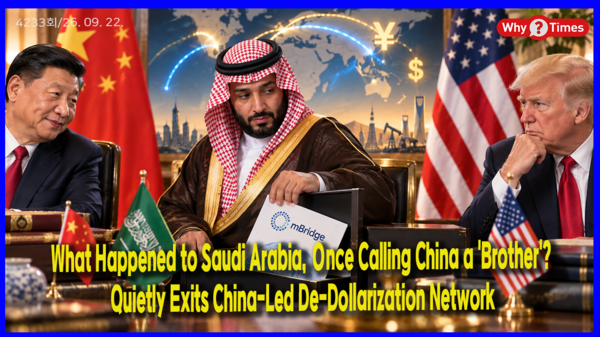
[Saudi Arabia’s 'Quiet Exit' Revealed After 16 Months]
A significant shift has surfaced in Saudi Arabia, a nation that has strengthened its strategic alignment with China while asserting an independent voice in its relations with the United States. It was revealed 16 months after the fact that Saudi Arabia quietly stepped away last year from mBridge, a cross-border digital currency payment platform in which China plays a central role. While the Saudi Central Bank (SAMA) downplays political interpretations by citing the "scheduled completion of a technical trial," this revelation emerges precisely as Houthi missiles and drones threaten Riyadh and critical oil infrastructure. This contrast raises a fundamental question: no matter how close economic ties with China become, can Beijing replace Washington in guaranteeing national security?
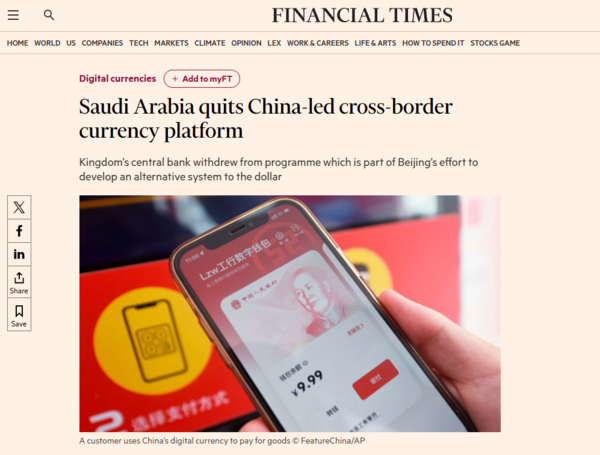
Financial Times reported that the Saudi Central Bank (SAMA) exited the mBridge wholesale Central Bank Digital Currency (CBDC) payment platform last year. SAMA confirmed the development to Financial Times. As a major crude exporter and historic US regional ally, Saudi Arabia's initial joining of the project had drawn significant international financial scrutiny.
mBridge is a wholesale digital currency payment platform developed by the Bank for International Settlements (BIS) Innovation Hub alongside the People’s Bank of China’s Digital Currency Institute, the Hong Kong Monetary Authority, the Bank of Thailand, and the Central Bank of the UAE. The platform utilizes CBDCs to make cross-border payments and foreign exchange transactions between central and commercial banks faster and less costly. SAMA joined as a full participant in June 2024.
Saudi Arabia's full participation, however, was brief. SAMA stated that it successfully completed its planned Proof of Concept (PoC) on May 13, 2025, whereupon its participating member status ended. Under SAMA’s explanation, the departure was not a sudden political rupture, but the planned conclusion of a technical trial. An insider interviewed by Financial Times also noted that Saudi Arabia’s operational scope had been limited, cautioning against drawing overly broad geopolitical inferences.
[Why Was It Kept Under Wraps for 16 Months?]
Questions remain regarding why the exit of one of the world's leading oil producers from mBridge went largely unreported for over a year. Sources cited by Financial Times indicated that while Saudi Arabia sought to avoid high-profile public association with the project, it maintained lower-visibility engagement behind the scenes. This makes framing the move as an outright abandonment of financial cooperation with Beijing inaccurate.
Yet, that ambiguity underscores Riyadh's posture. As noted by Financial Times, ending formal participation in a novel cross-border payment project under intense US scrutiny—while preserving broader economic ties with China—illustrates the delicate balancing act Riyadh executes between Washington and Beijing. Direct evidence that US pressure explicitly caused SAMA's departure has not been made public.
[Why Washington Kept a Close Eye on mBridge]
mBridge was not established as a purely Chinese "de-dollarization network". The official objective articulated by the BIS was addressing high costs, slow speeds, and operational complexities in legacy cross-border settlements through CBDCs and distributed ledger technology. Launched in 2021 as a collaborative effort involving the BIS Innovation Hub alongside central monetary authorities in Thailand, the UAE, China, and Hong Kong, it was never a single-nation initiative.
Nevertheless, the geopolitical implications drew scrutiny. Financial Times observed that scaling such platforms could enable direct cross-border CBDC clearing, bypassing correspondent banking networks and reducing reliance on the US dollar. Consequently, US officials closely monitored mBridge over concerns it could be utilized to bypass dollar-centric global financial rails. The inclusion of Saudi Arabia, a major global energy exporter, amplified the platform's symbolic weight.
The BIS withdrew from its leadership role in mBridge in October 2024. Agustín Carstens, then General Manager of the BIS, publicly rejected political interpretations, explaining that the institution was "graduating" from the project as participating central banks were equipped to advance it independently. Carstens explicitly denied that mBridge served as a sanctions-evasion mechanism for BRICS, noting that full commercial deployment remained years away.
[Saudi Arabia's Current Security Reality]
The context surrounding this development is shaped by Saudi Arabia's immediate security challenges. According to Reuters, Iran-aligned Houthi forces in Yemen intensified offensives toward Saudi territory, claiming strikes using missiles and drones against "sensitive targets" in Riyadh. Saudi authorities stated they intercepted a missile heading toward Riyadh, while Houthis claimed strikes targeting Aramco facilities in Yanbu along the Red Sea coast.
These attacks disrupted core energy transit routes. Houthi strikes created operational friction along East-West pipeline networks designed to bypass the Strait of Hormuz, while affecting crude transfers through Yanbu port. Despite decades of defense expenditures, low-cost drone and missile vectors continue to pose operational risks to strategic energy infrastructure.
[Saudi Arabia’s SOS, Yet Washington Remained Unmoved]
Washington's military posture remains a central factor. As Houthi offensives threatened maritime routes around the Bab-el-Mandeb Strait, Saudi Arabia requested direct American military intervention. Washington, however, limited its role primarily to intelligence and targeting support. Reuters noted US reluctance to open another direct combat front against the Houthis while managing military commitments elsewhere in the region.
This dynamic poses strategic friction for Riyadh. Despite acquiring advanced US defense systems and integrating into US-centric air defense and intelligence networks, Washington proved hesitant to engage directly in combat operations during this specific crisis. For Washington, opening dual operational fronts risks escalating broader Middle Eastern regional conflicts.
[Riyadh Turns to Diplomatic Channels with China]
An additional diplomatic dynamic emerged when Reuters reported that Saudi Arabia engaged Beijing diplomatically to leverage its influence over Tehran to curb Houthi escalations. Subsequent reporting confirmed efforts encouraging China to press Iran to restrain Houthi strike patterns.
This illustrates the structural complexity of contemporary Saudi diplomacy. While reliant on US hardware and defense architectures, Riyadh faces Washington's reluctance for direct intervention. Consequently, it seeks to utilize Beijing’s diplomatic leverage over Tehran to mitigate proxy attacks. Riyadh maintains a framework requiring engagement with both Washington and Beijing rather than aligning exclusively with one.
The capabilities offered by each power differ fundamentally. China serves as a primary trade partner and maintains diplomatic channels with Iran, providing utility as a diplomatic mediator. Conversely, for air defense, surveillance, and military architecture required to counter missile and drone threats, the long-standing security framework with the United States remains central. Recent developments emphasize the distinction between economic-diplomatic ties and defense-security dependencies.
[Contextualizing the mBridge Departure]
Timeline considerations are critical to assessing this move. SAMA formally completed its mBridge PoC and concluded its participating status on May 13, 2025—well before the recent wave of Houthi offensives. Linking SAMA’s departure directly as a panic response to recent tactical military strikes does not align with the established sequence of events. Furthermore, no public evidence indicates SAMA's exit was forced by explicit US intervention.
The broader significance lies in how current regional security pressures test Saudi Arabia’s dual-balancing strategy. Having expanded economic and financial engagement with Beijing while seeking normalized regional relations, actual military friction demonstrates that Riyadh continues to rely on US security infrastructure alongside Chinese diplomatic channels.
[Earning Money with China, But Can China Guarantee Security?]
The core issue facing Riyadh extends beyond choosing between Washington or Beijing. China offers expansive consumer markets, investment capital, and energy trade, alongside diplomatic mediation via its ties with Tehran. However, providing active defense guarantees against missile and drone threats targeting capital infrastructure involves a fundamentally different set of military capabilities. Beijing’s response relies on diplomatic pressure through Tehran rather than direct military power projection.
Simultaneously, Washington no longer automatically deploys force in response to regional partner requests. Saudi Arabia recognizes that replacing core defense dependencies with China remains impractical, even as Washington acts with greater strategic selectivity.
The disclosure of SAMA’s mBridge departure reflects this broader landscape. It does not signal a severance of ties with Beijing or a complete return to sole reliance on Washington. Rather, it highlights Riyadh's calibrated approach: pursuing economic engagement with China, exercising caution within dollar-centric financial architectures, and maintaining reliance on US security frameworks when physical threats arise.
[Why Times Insight]
Saudi Arabia has utilized its energy assets and new economic partnerships, including China, to secure greater strategic autonomy in its relationship with Washington. Joining projects like mBridge reflected this diversification push. However, current security dynamics in the Middle East demonstrate that diversifying commercial partners differs fundamentally from substituting a national security framework.
While no direct cause-and-effect link exists between the May 2025 mBridge PoC conclusion and recent security developments, the sequence highlights structural trade-offs. Quietly concluding formal participation in a prominent digital currency project while relying on US military assets and Chinese diplomatic channels underscores the operational realities facing regional states.
Seeking alternative commercial partners does not instantly replace established global financial and defense structures. As aerial threats target capital and energy assets, Saudi Arabia’s diplomatic posture is being evaluated not merely on commercial terms, but against core national security requirements.

-중국 푸단대학교 한국연구원 객좌교수
-전 EDUIN News 대표
-전 OUR NEWS 대표
-제17대 대통령직인수위원회 정책기획팀장
-전 대통령실 홍보기획비서관
-사단법인 한국가정상담연구소 이사장
-저서: 북한급변사태와 한반도통일, 2012 다시우파다, 선거마케팅, 한국의 정치광고, 국회의원 선거매뉴얼 등 50여권