
Update2026.10.24 (토)

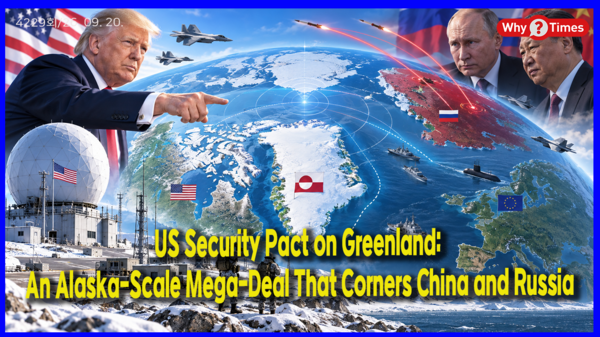
[Newsham: "A Mega-Deal Rivaling Seward’s Acquisition of Alaska"]
President Donald Trump’s announcement of a new security agreement for Greenland has effectively backed China and Russia into a strategic corner. While the United States did not purchase Greenland outright, it secured the vast majority of its core strategic objectives. In that regard, the deal represents a historic breakthrough comparable to the 1867 purchase of Alaska from the Russian Empire.
This tripartite agreement between the United States, Denmark, and Greenland expands the U.S. military role while preserving Greenland’s sovereignty and territorial integrity. Crucially, it establishes a framework restricting hostile powers—specifically China and Russia—from establishing military bases or making investments in sensitive sectors on the island. President Trump characterized the arrangement as granting the U.S. "permanent control" over Greenland’s security. The formal signing is expected to take place on the sidelines of the UN General Assembly in New York, followed by necessary parliamentary approval processes.
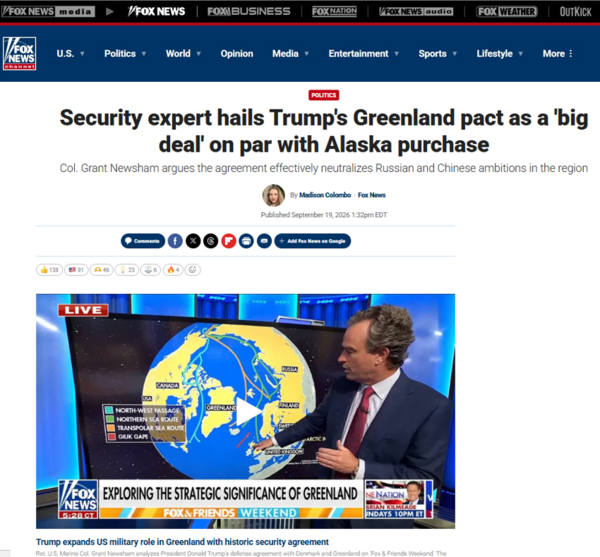
In an interview with Fox News, Grant Newsham—a retired U.S. Marine Corps colonel and senior fellow at the Center for Security Policy—offered one of the strongest endorsements of the deal. He lauded it as a "big deal" akin to Secretary of State William Seward’s purchase of Alaska.
While acknowledging the decisive difference—that Washington paid $7.2 million in 1867 to acquire full sovereignty over Alaska, whereas it is not purchasing Greenland today—Newsham argued that the pact firmly locks the "critical geography and key terrain" of northeastern North America into the Western strategic sphere.
Newsham highlighted the immediate impact on Beijing and Moscow, noting that the agreement prevents both powers from gaining a foothold in Greenland, either militarily or economically. Without transferring territorial ownership, the U.S. has severely constricted the ability of its primary rivals to use Greenland as a strategic springboard.
[Why Trump Really Wanted Greenland]
Greenland’s true strategic significance is difficult to grasp on a flat map; it must be viewed looking down at the globe from the North Pole. Positioned between North America and Europe, Greenland bridges the Arctic Ocean and the North Atlantic. It functions as an indispensable early-warning outpost for detecting incoming polar-route missiles aimed at North America, as well as a vital monitoring point for Russian naval and air sorties entering the North Atlantic.
According to Reuters, the U.S. Space Force already operates Pituffik Space Base (formerly Thule Air Base) in northwestern Greenland. Under the 1951 defense agreement with Denmark, Washington already possessed broad rights for military access and base operations. Thus, the new pact does not represent a brand-new entry into an uncharted territory, but rather a long-term expansion and solidification of existing U.S. military posture.
In announcing the agreement, Trump declared that the U.S. would immediately pursue a larger military presence in key areas across the island. Secretary of State Marco Rubio similarly emphasized that Greenland will permanently remain integrated into North America’s strategic defense zone while excluding hostile actors.
[Alaska–Canada–Greenland: Completing North America’s Northern Defense Line]
This is where the military significance of the deal becomes paramount. From a macro-defense perspective, North America’s northern frontier consists of three pillars: Alaska in the west, Canada in the center, and Greenland in the east. Securing a reinforced, long-term foundation for U.S. operations in Greenland fortifies the eastern anchor of this continental defense axis.
Russia maintains the world's longest Arctic coastline alongside substantial polar military bases and strategic nuclear submarine fleets. As the U.S. enhances its early-warning, space surveillance, missile defense, and troop deployment capabilities in Greenland, the island’s importance in the broader U.S.-Russia polar security competition will only grow.
This dynamic underlines why Newsham compared the pact to the acquisition of Alaska. Even without land ownership, Washington has effectively anchored crucial strategic real estate to the defense architectures of the U.S. and NATO for decades to come.
[For China, Blocking Economic Footholds Is More Critical Than Military Bases]
For Beijing, the implications are somewhat different. China does not deploy large-scale military forces near Greenland in the manner Russia does. Rather, Washington's main concern has been China’s potential to gain strategic leverage through long-term investments in resource extraction, infrastructure, and commercial ports.
According to reporting by The Washington Post on the negotiation details, the agreement stipulates that military bases on Greenland are restricted to NATO members, while sensitive strategic investments are limited to NATO and EU partners. If finalized as written, this clause erects a formidable barrier against Beijing. It severely restricts Chinese access not just to potential military sites, but to critical infrastructure and strategic assets tied to national security.
A distinction should be noted between rhetoric and practical mechanics: while Trump stated that adversaries cannot make sensitive investments without explicit U.S. written approval, The Washington Post cited officials familiar with the talks who noted that Washington does not hold an absolute, unilateral veto over all local Greenlandic decisions.
[Crucial Provision: Agreement Remains Intact "Even If Greenland Gains Independence"]
The most consequential element of the pact lies in its durability. As reported by The Washington Post citing negotiation insiders, the framework is designed to remain valid even if Greenland eventually declares independence from the Kingdom of Denmark.
For the U.S., this serves as a vital safeguard. It ensures that regardless of political shifts in Nuuk, American military access and continental defense structures will not be abruptly destabilized. This provides the backing for Secretary Rubio’s assertion that the agreement "permanently" resolves U.S. security concerns in the region.
This raises a key question: Did Washington ever truly need formal ownership of Greenland? If the primary U.S. goals were continental defense, Arctic access, and denial of strategic space to Russia and China, those ends have been largely attained without needing to acquire the territory outright.
[To Be Clear: "The U.S. Did Not Take Over Greenland"]
A clear boundary must be drawn. Countering Trump's use of the phrase "permanent control," officials in Copenhagen and Nuuk have repeatedly stressed that the agreement respects the sovereignty and territorial integrity of the Kingdom of Denmark, as well as the Greenlandic people's right to self-determination.
Greenland’s Prime Minister, Jens-Frederik Nielsen, welcomed the pact for recognizing Greenland’s interests and standing in international cooperation. NATO also issued a statement supporting the deal, noting that it will strengthen security, stability, and alliance cooperation across the Arctic and North Atlantic.
Furthermore, because the final document has yet to be publicly released, key operational specifics—such as exact troop numbers, designated deployment zones, precise definitions of "sensitive investments," and impacts on raw material mining—remain to be fully clarified.
Phrases implying that the U.S. has "effectively occupied" Greenland are inaccurate. A precise description is that Washington has engineered a security framework that expands long-term U.S. military access and denies access to China and Russia, all without taking over Greenland's sovereignty.
[Why Times Insight]
President Trump previously insisted that the United States ought to acquire Greenland. That stance prompted pushback from Denmark, Greenland, and broader European allies, stirring internal friction within NATO.
Yet the resulting compromise is compelling. The United States did not buy Greenland. It did not alter international borders or plant a new flag. Nevertheless, it successfully altered the geopolitical playing field—denying China and Russia the room to build economic or military footholds while consolidating long-term U.S. power projection in the Arctic.
In 1867, William Seward bought Alaska for $7.2 million. Trump reached a security deal without purchasing the land. Legally and politically, the two events are distinct. Yet Newsham's characterization of this agreement as an "Alaska-scale deal" is understandable. In the theater of Arctic superpower rivalry, the primary value of this pact lies not in what land America owns, but in what it prevents China and Russia from doing.
The U.S. did not acquire ownership of Greenland. However, if the pact enters into force as reported, Washington gains something far more valuable: a reinforced leadership position in setting the security order that determines who guards the northern gates of North America—and who is kept outside.


-중국 푸단대학교 한국연구원 객좌교수
-전 EDUIN News 대표
-전 OUR NEWS 대표
-제17대 대통령직인수위원회 정책기획팀장
-전 대통령실 홍보기획비서관
-사단법인 한국가정상담연구소 이사장
-저서: 북한급변사태와 한반도통일, 2012 다시우파다, 선거마케팅, 한국의 정치광고, 국회의원 선거매뉴얼 등 50여권