
Update2026.10.24 (토)

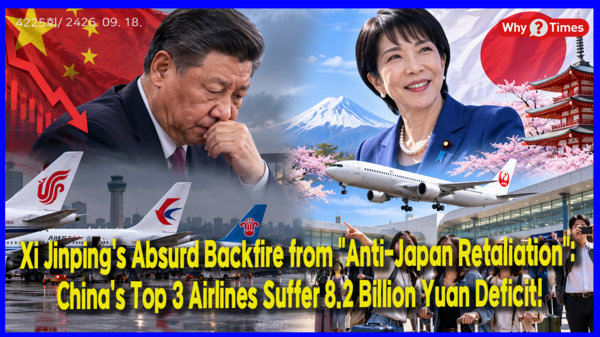
[Intended to Strike Japan… Yet Only Japanese Routes Plunge 44% in September]
Chinese President Xi Jinping’s retaliatory measures against Japan—triggered by Japanese Prime Minister Sanae Takaichi’s remarks regarding Taiwan—have proven to inflict virtually no damage on Japan, while dealing immense economic harm to China itself. In an attempt to pressure Tokyo, Xi restricted overseas travel for Chinese citizens by drastically slashing Japanese routes operated by Chinese carriers. However, as Japanese airlines maintained their Chinese routes, they reaped unexpected windfall gains. In fact, China's three major state-owned carriers—Air China, China Eastern Airlines, and China Southern Airlines—recorded a combined net loss of 8.2 billion yuan (approximately $1.22 billion) in the first half of this year alone. Beijing’s push to discourage travel to Japan and sharply reduce flights for geopolitical reasons ultimately backfired, inflicting severe collateral damage on its own economy.
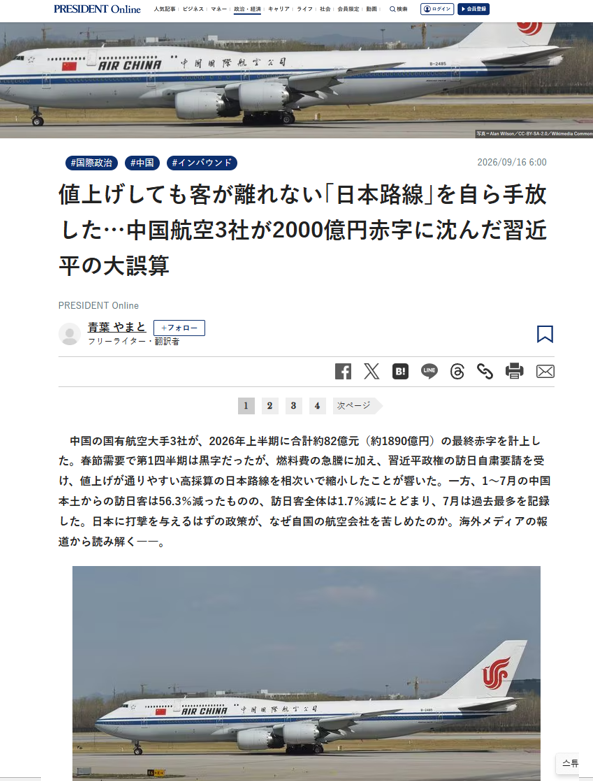
According to a September 16 report by PRESIDENT Online, a leading Japanese business knowledge platform, China’s overall international flight supply grew by 7.6% in September, with South Korean routes expanding 26.1% to 1.12 million seats to become China’s largest international aviation market. In stark contrast, Japanese routes plummeted 44.3% to just 567,802 seats. The report noted that this drop stemmed not from a contraction in China’s overall international aviation sector, but from a targeted, disproportionate reduction in Japanese routes while expanding other international corridors.
PRESIDENT Online further highlighted that Air China, China Eastern, and China Southern incurred a combined net loss of 8.2 billion yuan ($1.22 billion) in the first half of the year. While the most direct driver of this deficit was the sharp rise in aviation fuel prices following the Middle East war, Beijing’s pressure campaign forced Chinese airlines to curtail access to the highly profitable Japanese market at the exact moment a cost shock hit, narrowing their operational options and demonstrating the boomerang effect of the "anti-Japan card."
Statistics for September from OAG, a U.S.-UK-based aviation data and analytics firm, illustrate the core dynamic of this crisis. OAG reported that China’s total seat capacity rose 6.2% year-on-year to 87.3 million seats, with domestic capacity increasing 5.9% and international capacity rising 7.6%. Routes to Türkiye surged 61% and the Philippines jumped 52%, underscoring that the 44.3% plunge in Japanese routes cannot be attributed to a general downturn in China's aviation market.
Reuters explained that the rapid chill in the Sino-Japanese aviation market began following Prime Minister Sanae Takaichi’s remarks on Taiwan last November, where she indicated that an armed Chinese attack on Taiwan could constitute a "survival-threatening situation" for Japan. Beijing reacted strongly, urging its citizens to refrain from traveling to Japan, while Chinese airlines sequentially cut Japanese routes. The geopolitical tension remains ongoing, as evidenced by Chinese Defense Minister Dong Jun’s speech at the Beijing Xiangshan Forum on September 16, where he warned against "historical regression" and the revival of "militarism"—a statement widely interpreted as indirect criticism of Japan.
[The Real Problem: Japan Was a "Lucrative Market" for Chinese Carriers]
The fundamental flaw in cutting Japanese routes was that this market was far more than just another overseas destination for Chinese airlines. Based on OAG data, PRESIDENT Online reported that China’s top three state-owned carriers rely on international routes for roughly 30% of their revenue, with Japan serving as one of the primary growth drivers in 2025. China Eastern’s capacity on Japanese routes had previously reached 2.4 million seats (up 27% year-on-year), while China Southern’s Japanese market capacity reached 1.3 million seats (a 45% increase), surpassing its South Korean market volume.
Furthermore, domestic routes in China face intense competition from high-speed rail, limiting airlines' ability to raise fares amid a sluggish economy. North American routes have also failed to fully recover due to lingering flight restrictions between Washington and Beijing. Consequently, Japan and Europe represented two of the few international markets where airlines could adjust fares upward. While Chinese civil aviation regulations allow carriers to pass up to 80% of fuel price increases on to passenger fares, HSBC estimated the actual pass-through rate at roughly 60%, as excessive price hikes cause domestic travelers to pivot to high-speed rail or alternative destinations.
[Severing the "Golden Route" Right as Fuel Prices Soared]
The timing proved particularly damaging for Chinese carriers. According to Reuters, global jet fuel prices spiked following the outbreak of the Middle East war, pushing the H1 fuel expenses of China's top three airlines up by 35% to 38% year-on-year. Lacking extensive fuel hedging strategies, Chinese airlines were particularly vulnerable to surges in crude oil prices. Although international passenger demand recovery boosted overall revenue by approximately 10%, it failed to offset the overwhelming fuel cost burden.
The contrast with earlier performance is stark. Boosted by Lunar New Year travel demand, the three carriers posted a combined profit of 4.82 billion yuan in Q1. However, just three months later, cumulative H1 results collapsed into an 8.2 billion yuan net deficit. HSBC forecasts full-year losses for the three airlines to reach 168 billion yuan—a sharp reversal from the market's initial expectation of a 1.3 billion yuan profit.
It was precisely against this backdrop that the reduction of Japanese routes took effect. According to PRESIDENT Online, all scheduled flights across 49 routes to and from Japan were suspended in February, with the top three Chinese airlines issuing ticket changes or refunds for unused segments. By December 2025, Chinese carrier capacity to Japan had already been scaled back from a planned 1.85 million seats (9,813 flights) to 1.42 million seats (7,432 flights)—a 23.2% reduction in seats and a 24.3% drop in flights. Rather than a temporary disruption, this capacity reduction deepened further to 44.3% by September.
[Chinese Tourists Halved, but Japan Weathered the Shock]
Did Beijing succeed in damaging Japan’s tourism industry? While China’s measures were not entirely without impact, they failed to destabilize Japan's broader tourism market to the extent anticipated. Analysis of Japan National Tourism Organization (JNTO) data by PRESIDENT Online showed that mainland Chinese visitors to Japan plummeted 56.3% year-on-year between January and July. However, total international arrivals to Japan during the same period declined by a mere 1.7%, as visitors from other countries largely filled the vacuum left by Chinese tourists.
The decisive figures emerged in July. According to JNTO, international visitor arrivals to Japan reached 3,442,100 in July—a 0.1% year-on-year increase that set an all-time high for the month of July. Arrivals from 17 markets, including South Korea, Indonesia, and Mexico, reached historical highs for July, while monthly visitors from Taiwan exceeded 700,000 for the first time. These metrics demonstrate that Japan's overall tourism sector remained resilient despite the sharp drop in Chinese travelers.
Ultimately, flight cutbacks by Chinese carriers allowed Japanese airlines to benefit from reduced market supply, leading to higher yields and indirect gains on certain routes. While the 82 billion yuan loss incurred by Chinese airlines did not translate directly into equivalent profits for ANA and JAL, the deficit remains a direct consequence of Xi Jinping's anti-Japan policy. Cutting lucrative Japanese routes during a severe operational environment marked by spiking fuel prices effectively stripped Chinese carriers of a vital profit center, compounding their financial strain.
[Why Times Insight]
Beijing has long weaponized its 1.4 billion population and vast outbound travel market to exert diplomatic leverage. During geopolitical disputes, it restricts group tours or discourages travel to pressure foreign tourism, aviation, hotel, and duty-free sectors. However, for this leverage strategy to prove effective, a fundamental prerequisite must hold: non-Chinese tourists must be unable to replace the missing Chinese travel volume.
In this case, that core assumption proved flawed. Although mainland Chinese visitors plunged 56.3% from January to July, Japan's total foreign arrivals fell by just 1.7%, ultimately hitting an all-time record high in July. Meanwhile, Chinese airlines increased overall international capacity by 7.6% as of September while cutting Japanese routes by more than 44%. Consequently, a significant portion of the economic burden intended for Japan fell back onto Chinese enterprises.
This is not to suggest that the entire 82 billion yuan deficit was solely caused by anti-Japan policies; elevated jet fuel costs remained the primary driver, and Japan was not completely immune to the reduction in Chinese travelers. Nevertheless, this episode clearly illustrates a structural limitation: when China deploys tourism and flight capacity as geopolitical weapons, its own domestic enterprises inevitably share in the economic fallout.
With Chinese international flight capacity expanding overall while Japanese routes remain down by over 44% in September, the opportunity cost for Chinese carriers will continue to mount the longer this political choice persists. The ultimate paradox of Xi Jinping's anti-Japan tourism strategy is that an economic weapon deployed to strike a rival ended up inflicting severe self-inflicted wounds on China's own state enterprises.


-중국 푸단대학교 한국연구원 객좌교수
-전 EDUIN News 대표
-전 OUR NEWS 대표
-제17대 대통령직인수위원회 정책기획팀장
-전 대통령실 홍보기획비서관
-사단법인 한국가정상담연구소 이사장
-저서: 북한급변사태와 한반도통일, 2012 다시우파다, 선거마케팅, 한국의 정치광고, 국회의원 선거매뉴얼 등 50여권