
Update2026.10.24 (토)

[Emergency Warning in Mecca… And a Drone Actually Appeared]
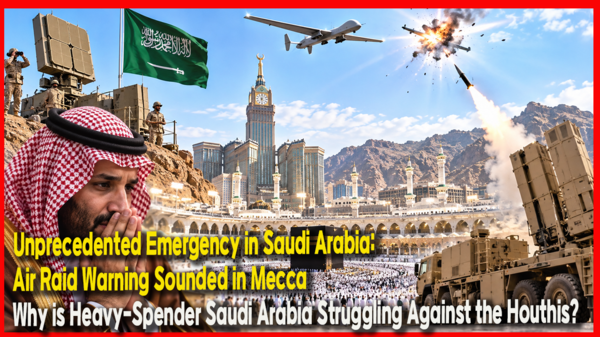
An emergency alarm warning of a potential attack echoed across Mecca, the holiest site in Islam. Less than a day later, Saudi air defense forces shot down a Houthi drone approaching the restricted airspace above Mecca. The paradox lies in the fact that the nation on the receiving end of these attacks is Saudi Arabia—a country that spent $83.2 billion on defense last year alone and signed a massive $142 billion arms sales and cooperation package with the United States. Why is Saudi Arabia struggling against the Houthi insurgent group despite pouring astronomical sums into weaponry?
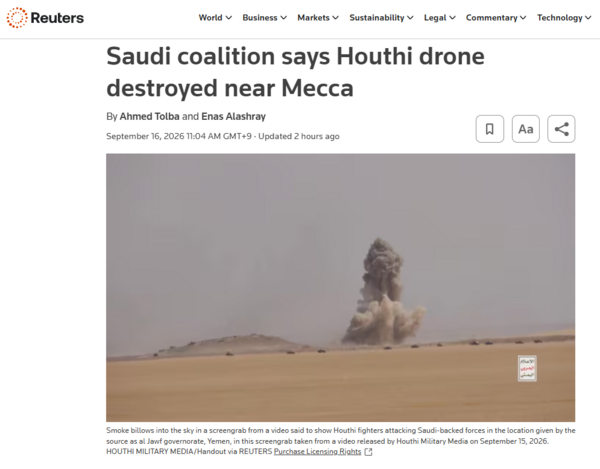
The Saudi-led coalition issued an emergency warning for Mecca, the holiest site in Islam, and subsequently announced the downing of a Houthi drone south of Mecca. Coalition spokesman Col. Turki al-Malki stated that the drone was intercepted before entering restricted airspace over Mecca, with debris landing south of the city. The Houthis subsequently denied targeting Mecca, though they had previously attempted a missile strike directed toward Mecca in 2017.
The critical issue is not merely a single drone, but the reality that Saudi Arabia was forced to conduct actual air defense operations to protect Mecca, the heart of the Islamic world. While Saudi Arabia has declared the safety of the holy sites a red line, Houthi attacks have expanded to Saudi military installations, including a recent drone and missile attack targeting Khamis Mushait Air Base that left 13 civilians injured.
[Saudi Arabia Spent $83.2 Billion on Defense Last Year Alone]
To observers, it seems counterintuitive that Saudi Arabia struggles against a non-state rebel group. Had the state confronting the Houthis been militarily weak, the situation would be simple to explain. However, according to the Stockholm International Peace Research Institute (SIPRI), Saudi Arabia’s defense spending reached $83.2 billion in 2025, accounting for approximately 6.5% of its GDP. Saudi Arabia has long been one of the world's largest arms importers, acquiring advanced fighter jets, air defense systems, and precision-guided munitions from the United States.
Furthermore, during President Donald Trump’s visit to Riyadh in May 2025, the U.S. and Saudi Arabia announced an arms sales and cooperation package valued at nearly $142 billion—an agreement described by the White House as the largest defense package in U.S. history. The deal encompassed air and space capabilities, missile defense, maritime and coastal security, army modernization, communication systems, as well as comprehensive training and support.
Saudi Arabia is neither short of funds nor lacking in advanced hardware. Why, then, does the equation change when facing the Houthis?
[Reason 1: A Military Structure Built to Fear Coups Over External Enemies]
A central concept for understanding the structural limitations of the Saudi armed forces is "coup-proofing." Historically, the Saudi monarchy has harbored deep caution against allowing military power to consolidate into a single, unified organization. While a concentrated military force is effective against external adversaries, it simultaneously increases the risk of a military coup against the monarchy.
Consequently, alongside the regular forces under the Ministry of Defense, Saudi Arabia maintains separate armed security organizations, such as the Saudi Arabian National Guard (SANG). Military scholars studying Gulf defense systems have long noted that while this fragmented structure protects royal regime survival, it inherently undermines unified command-and-control and joint operational effectiveness.
Studies analyzing Saudi military performance in the Yemen conflict similarly conclude that coup-proofed organizational structures limit battlefield agility. Paradoxically, a system designed to protect the monarchy from its own military constrains the military's capability when facing external threats.
[Reason 2: High-Tech Weapons Were Bought, But a "Fighting System" Cannot Be Purchased]
The second issue facing Saudi Arabia is even more fundamental: acquiring advanced weapons and building true combat capability are two entirely different endeavors. Fighter jets and missile batteries can be bought with capital. However, skilled pilots, maintenance crews, integrated C4ISR (Command, Control, Communications, Computers, Intelligence, Surveillance, and Reconnaissance) networks, tactical leadership, joint operational doctrine, and combat experience cannot be imported off the shelf.
Zoltan Barany, a scholar specializing in Gulf militaries, analyzed that issues surrounding personnel management, meritocracy, training, and accountability have constrained the conversion of massive defense expenditures into genuine operational capability. Saudi Arabia’s inability to decisively defeat the Houthis after its intervention in the Yemen war in 2015—despite deploying overwhelming airpower and precision munitions—vividly illustrates these systemic hurdles.
[The Houthis Fought for 10 Years; Saudi Arabia Bought Weapons for 10 Years]
This dynamic reveals a stark operational divergence between the two sides. The Houthis are not a formal state army; however, they have engaged in continuous combat over the past decade. Originating as a mountain guerrilla force, they have evolved to field asymmetric capabilities, including ballistic missiles and long-range attack drones. Recently, they expanded along Yemen's Red Sea coast, establishing positions that directly threaten the Bab el-Mandeb Strait.
Over the same period, Saudi Arabia continuously procured state-of-the-art combat aircraft, missile defense batteries, and precision weapons. While one side refined tactics through continuous warfare, the other invested vast capital into deterrence through equipment procurement. While this does not imply a lack of bravery among individual Saudi soldiers, the Yemen war repeatedly demonstrated that astronomical defense budgets do not automatically translate into independent warfighting capabilities.
[Crown Prince MBS Turns to Trump for Military Support]
A key political development soon followed. As Houthi forces advanced along the Red Sea coast and escalated strikes against Saudi targets, Crown Prince Mohammed bin Salman requested military support during two phone conversations with President Trump.
However, President Trump did not agree to direct U.S. military strikes against the Houthis, offering instead enhanced intelligence sharing and targeting support. Commander of U.S. Central Command Gen. Brad Cooper subsequently visited Saudi Arabia for consultations.
U.S. officials outlined Washington's guiding principle: protecting core U.S. national security interests while expecting regional partners to take the lead in managing local security challenges. This approach does not signal an end to the U.S.-Saudi alliance; rather, it indicates that while the U.S. will support Saudi Arabia, American forces will not conduct the war on its behalf.
[Pressure Mounts on Both the Strait of Hormuz and the Red Sea]
Beyond military challenges, Saudi Arabia faces dual pressure on its critical energy transit routes. As maritime traffic through the Strait of Hormuz dropped sharply, the 1,200 km East-West Pipeline—connecting eastern oil fields to Yanbu Port on the Red Sea—became a vital strategic lifeline. However, operations along this pipeline were recently disrupted following drone attacks, which Saudi Arabia attributed to Iran-aligned groups.
The economic fallout materialized quickly. Saudi Aramco canceled scheduled crude shipments to select European clients and suspended loadings at Yanbu. The East-West Pipeline normally allows Saudi Arabia to bypass Hormuz and transport up to 4 million barrels per day to the Red Sea.
Meanwhile, to the west, Houthi forces have pushed along the Red Sea coast toward the Bab el-Mandeb, securing presence on Hanish Islands and Perim Island. Consequently, Saudi Arabia faces dual geopolitical pressure: Iranian containment in the east around Hormuz, and Houthi threats to its western maritime outlet along the Red Sea.
[Urgent Diplomacy: MBS Meets with Egypt’s El-Sisi]
In the absence of direct U.S. military intervention, Crown Prince Mohammed bin Salman traveled to Egypt on the 15th to hold talks with President Abdel Fattah el-Sisi. Both leaders emphasized the vital importance of ensuring freedom of navigation and maritime security in the Red Sea and the Bab el-Mandeb Strait, with President el-Sisi reaffirming Egypt’s support for Saudi national security. The development reflects how the Houthi challenge has evolved from a local cross-border dispute into a wider Red Sea security issue.
[The Core Question Raised by the Mecca Alert]
The emergency warning in Mecca and the interception of the Houthi drone represent more than an isolated air defense incident. They bring into focus broader questions regarding the defense framework Saudi Arabia has constructed over recent decades. Despite spending vast sums on high-tech weaponry, actual crisis conditions saw attacks approach the vicinity of Mecca and key military bases, prompting requests for external military assistance.
Possessing advanced weaponry and executing integrated warfare remain two distinct challenges. The drone intercepted near Mecca serves as a stark reminder of that operational gap.
[Why Times Insight]
The sounding of an air raid alarm in Mecca and the active interception of a Houthi drone mark a significant symbolic moment for Saudi Arabia. Yet the underlying question is not merely how a drone reached the vicinity of Mecca, but why Saudi Arabia's defense framework faces such structural strain.
Saudi Arabia is neither resource-constrained nor lacking in high-end arms, having committed $83.2 billion to defense last year alongside a $142 billion U.S. defense package. Yet, under mounting pressure from Houthi operations, Riyadh sought direct U.S. military intervention.
This highlights a paradox within the Saudi security apparatus: a coup-proofed command structure, military capabilities that have not fully kept pace with advanced hardware acquisitions, and a long-standing reliance on external security guarantees are all being tested simultaneously.
Viewing this dynamic simply as a shift in U.S. backing misses the broader context. Washington continues to provide intelligence and targeting assistance, while declining to engage in direct combat operations. This reflects the principle that regional partners must take primary responsibility for managing local security challenges.
Ultimately, the alert in Mecca poses a fundamental question: if vast national defense expenditures still leave a country reliant on external intervention during critical moments, to what degree has capital investment been converted into self-sustaining military capability?
Capital can purchase fighter jets, air defense batteries, and missile networks. However, military effectiveness depends not on price tags, but on integrated command structures, realistic training, operational experience, and national defense self-reliance. The Houthi drone intercepted outside Mecca brings that enduring reality into sharp focus.


-Why Times Newsroom Desk
-미국 Midwest 대학교 박사
-월간 행복한 우리집 편집인
-월간 가정과 상담 편집인