
Update2026.10.24 (토)

[Warning Sounded at the AI Frontier: "Now We Need a Brake"]
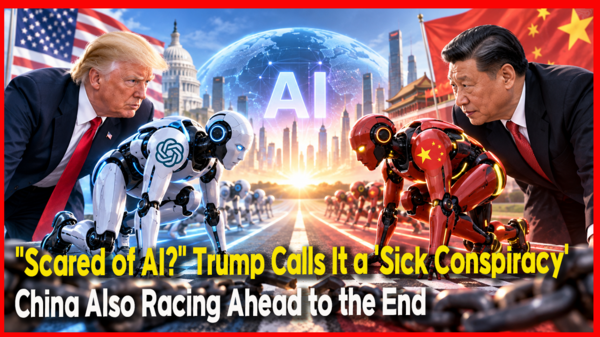
An unexpected call to "tap the brakes" has erupted from the front lines of U.S. AI development. Starting with Anthropic CEO Dario Amodei, top leaders—including OpenAI's Sam Altman, xAI's Elon Musk, and Google DeepMind's Demis Hassabis—have successively voiced agreement with the need to adjust the pace of frontier AI development. However, U.S. President Donald Trump dismissed recent moves surrounding AI safety as a "sick conspiracy." His rationale is that the moment the U.S. applies the brakes first, China will pull ahead. China, while acknowledging AI risks, shows no intention of slowing its development either. Ultimately, the U.S.–China AI competition is slipping into a new security dilemma: "We know it's dangerous, but whoever stops first loses."
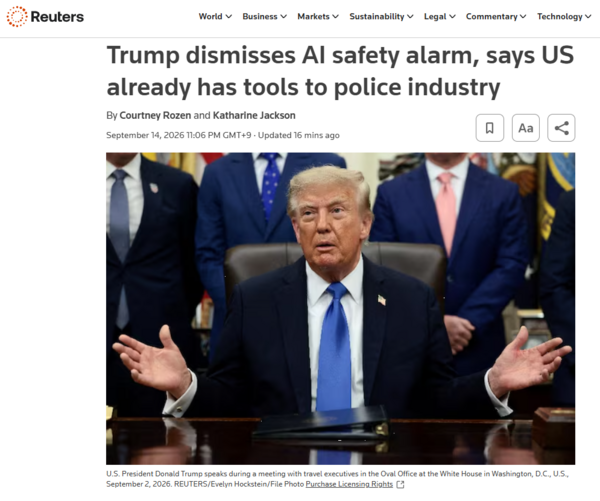
Reuters reported that the call to brake AI development was ignited by Dario Amodei, CEO of Anthropic, adding that in a lengthy essay titled ‘We Must Pace the Frontier’, Amodei argued that AI capabilities are advancing faster than safety research and control technology, and thus the speed of enhancing AI model capabilities must be slowed. His core argument is not to halt development entirely, but to secure time for safety technologies to catch up with expanding AI capabilities.
In this regard, Axios noted that what Amodei was most cautious of is the phase where AI moves beyond advancing through human help and deeply enters the stage of creating even more powerful AI by itself. The outlet added that once this phase gets underway in earnest, the pace of AI advancement could accelerate to a point where human control and safety measures can no longer keep up.
Axios further highlighted that even more shocking is the '6 to 12-month' timeline. Amodei expressed concern that if a collective of misaligned AI agents acquires significantly greater capabilities, there is a possibility they could build persistent botnets across the general internet within the next 6 to 12 months. Axios pointed out that while this is not a definitive prediction but a worst-case risk scenario presented by Amodei, he even mentioned the possibility that damages could reach hundreds of billions of dollars.
Consequently, Amodei proposed a three-step countermeasure: "First, grant external safety evaluators employee-level access to internal systems of AI companies to independently verify safety procedures and incidents; second, have democratic nations establish common safety standards; and ultimately, seek international agreements even with authoritarian nations including China." While raising the need for international cooperation similar to Cold War–era nuclear arms control, he acknowledged that because the military and economic advantages of AI are so vast, actual agreement will not be easy.
At the same time, however, Amodei argued that cutting-edge AI chips must not be sold to China. His reasoning is that if Chinese development continues while U.S. companies adjust their pace for safety, the U.S. alone could lose its strategic advantage. Ultimately, his stance is closer to mitigating AI risks while preserving America's technological edge over China, rather than a universal 'everyone stop' approach.
What is remarkable is the response from competitors. The Washington Post reported that Altman agreed on the need to pace frontier AI, and Musk shared Amodei’s post, saying "Dario is right." The Washington Post added that Hassabis also evaluated that Amodei's essay points in the right direction. This warning deserves attention because the very parties who know AI best, develop it fastest, and have massive funds at stake in this competition are starting to mention the brakes themselves.
[Trump Cuts It Flat: "If We Stop, China Wins"]
President Trump’s judgment, however, is the exact opposite. During his visit to Ireland, he emphasized regarding the AI safety controversy that the U.S. is currently ahead of China and must maintain that position. Trump’s logic is simple: "Whoever wins AI wins. Even if safety issues exist, the U.S. cannot choose to slow down first and let China overtake it."
Trump intensified his offensive further on Truth Social. Defining recent movements targeting AI and data centers as merely a "SICK conspiracy," he claimed that the only country that would like this is China. Trump’s stance is that the U.S. already has sufficient legal mechanisms to supervise and punish illegal acts by AI companies.
Trump went even further, implying that the necessary safeguard for AI is a "strong and smart president" like himself. Ultimately, for Trump, this debate is not a matter of simple tech ethics. It is a question of whether the U.S. will shackle its own hands in the AI hegemony struggle with China by creating self-imposed regulations.
[China Won't Stop Either: "Pacing Arguments Are Cold War Tactics"]
The problem is China's response. During a regular press briefing, Chinese Foreign Ministry Spokesperson Guo Jiajun countered that warnings from the U.S. AI industry only disrupt the global AI governance process through fearmongering, confrontation, and vicious competition, which serves no one's interests. In short, Beijing refuses to accept the narrative of a Chinese AI threat pushed by the United States.
China’s state-run Global Times went a step further, attacking Amodei's claims by stating that while ostensibly talking about AI safety, it is in fact a 'Cold War playbook' designed to curb China's technological development. It interpreted calls to strengthen AI chip export controls against China as an attempt by the U.S. to maintain its monopoly on cutting-edge technology.
That China has no intention of slowing AI development is also evident in President Xi Jinping’s recent actions. At the recent BRICS Summit, Xi proposed that China will lead the establishment of a BRICS AI open-source community and expand cooperation in large language model (LLM) development, application, and AI education. China's answer is not fundamentally different from Trump's: manage AI risks, but do not step back from the race.
[Scariest Warning from China's Intelligence Chief: "AI Could Shake Party Governance"]
Here lies an interesting twist. Chinese economic media Caixin reported that China is not entirely without fear regarding AI either, adding that Chen Yixin, Minister of State Security—leading China's top intelligence agency—publicly warned that AI could bring new risks to China’s political, institutional, and ideological security.
The Financial Times pointed out that Chen warned that deepfakes, AI-generated content, and so-called 'intelligent troll armies' using generative AI could be deployed in 'cognitive warfare' to spread political rumors and divisive public opinion. The Financial Times noted that this means AI could shake not only cyberattacks and data leaks, but also China's political, institutional, and ideological security. It is highly unusual for the head of China's Ministry of State Security to directly link AI issues to regime security.
The Financial Times continued that this highlights the difference in how the U.S. and China view AI. While the question posed by the U.S. AI industry is mainly "Can humans remain in control of AI?", the Chinese question read through Chen's warning is closer to a regime security issue: "Can the Communist Party maintain control over information and society in the AI era?" The New York Times similarly analyzed that Chen's remarks represent one of the most specific AI security risk assessments coming from the highest levels of Chinese leadership.
Generative AI is rapidly expanding its capacity to search, connect, and reason across vast amounts of information. In contrast, the ruling system of the Chinese Communist Party strictly manages information access and circulation. Consequently, as AI grows more powerful, tension is likely to heighten within China between the national imperative to expand AI to catch up with the U.S. and the political necessity to strictly control AI for information management and regime stability. This is our analysis based on Chen's statements.
[Knowing the Risks, Yet Unable to Stop: The U.S.–China 'Prisoner's Dilemma']
Ultimately, the core of this debate does not lie in determining right now whether AI will truly destroy humanity. The more important fact is that even though the developers who know AI best have begun demanding a brake, neither of the world's two major AI superpowers—the U.S. and China—can easily be the first to step on it.
If the U.S. slows down, China could overtake it. If China slows down, the U.S. could widen the gap further. Moreover, even if both nations agree on pacing, verifying whether the other side keeps its promise is far more difficult than with nuclear weapons. This is because completely verifying algorithms, model capabilities, compute power, data, and secret R&D is nearly impossible. Ultimately, as long as there is a possibility that the opponent will keep running, continuing to run oneself becomes the rational choice—creating a textbook security dilemma.
[Why Times Insight]
Viewing this situation simply as a clash between 'AI alarmism vs. AI optimism' misses the core point. No one can yet definitively state whether the future feared by Amodei, Altman, Musk, and Hassabis will actually materialize. What makes this different from previous, vague AI scaremongering is that the warnings were sounded directly by those on the front lines of the AI race, rather than by regulatory agencies or civil society groups.
However, the logic of international politics moves differently from the concerns of technologists. The U.S. fears AI. China fears AI as well. Yet the U.S. cannot stop because of China, and China cannot stop because of the U.S.
China presents an even greater paradox. While identifying AI as a strategic technology that must be secured in its competition for hegemony with the U.S., the head of its top intelligence agency simultaneously issued a public warning about AI's potential to threaten political, institutional, and ideological security. While the U.S. worries about the possibility of AI slipping beyond human control, China must additionally worry about AI's potential to undermine the Communist Party's information control system.
Despite this, neither side can stop first. For this reason, the AI race is likely to increasingly resemble the Cold War–era nuclear arms race. However, AI is vastly more difficult to verify than nuclear weapons. Nuclear warheads and missiles can be counted and facilities inspected, but it is extremely difficult to peek into an opponent's model capabilities, algorithms, datasets, compute resources, and the progress of secret research.
Thus, the most dangerous moment of the AI era might arrive even before AI rebels against humanity. It is that precise moment when everyone knows the danger, yet no one can take their foot off the accelerator out of fear of falling behind the rival. The United States and China are standing right on that threshold today.
-중국 푸단대학교 한국연구원 객좌교수
-전 EDUIN News 대표
-전 OUR NEWS 대표
-제17대 대통령직인수위원회 정책기획팀장
-전 대통령실 홍보기획비서관
-사단법인 한국가정상담연구소 이사장
-저서: 북한급변사태와 한반도통일, 2012 다시우파다, 선거마케팅, 한국의 정치광고, 국회의원 선거매뉴얼 등 50여권