
Update2026.10.24 (토)

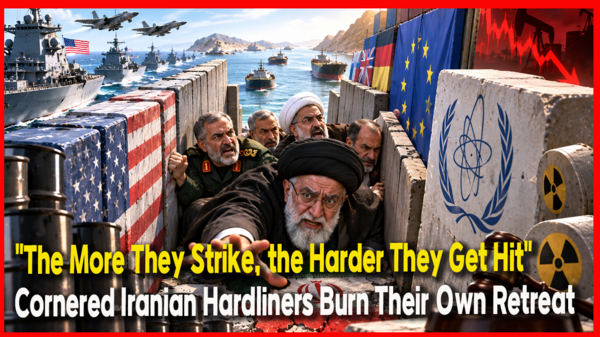
[The Latest Situation is Even More Dangerous: Tehran Pulls Out the NPT Withdrawal Card]
Iranian hardliners are running out of ground. As US sanctions and maritime pressure tighten the economic noose, launching attacks against US forces and in the Strait of Hormuz has only invited harsher military and economic retaliation. By threatening to withdraw from the Non-Proliferation Treaty (NPT) in response to the IAEA referring Iran to the UN Security Council, Tehran is further narrowing its own diplomatic escape routes. The core issue is not simply that hardliners are fighting, but that with every engagement, their remaining strategic cards disappear one by one.
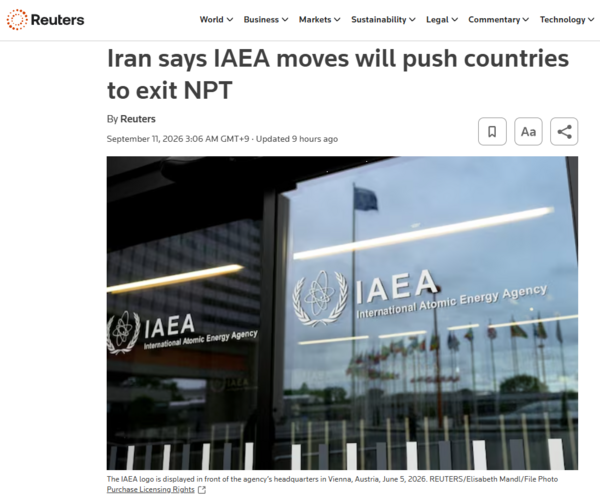
Reuters reported on September 11 that the narrowing choices for Iranian hardliners are most visible in the nuclear arena. After the IAEA Board of Governors voted on September 9 to report Iran to the UN Security Council, calls to exit the NPT resurfaced in Tehran. On September 10, Mohsen Rezaee, Secretary of Iran’s Supreme National Security Council, warned that political actions by the IAEA could push nations toward NPT withdrawal, while Iranian MP Alireza Abbasi stated parliament might review Iran's membership status in the treaty.
AP News noted that this IAEA action marks the first such move in 20 years, passing with 23 of the 35 member states voting in favor, while Russia, China, and Niger opposed, and 8 abstained. Led by the US, the UK, France, and Germany, the resolution centered on Iran's failure to provide credible explanations or cooperation regarding uranium traces at undeclared sites, with the IAEA demanding assurances that nuclear materials have not been diverted for non-peaceful purposes.
AP News further observed that while NPT withdrawal might look like a final leverage card for hardliners to press the West, pairing Security Council referral with an NPT exit forces Iran to rely even more heavily on diplomatic cover from Russia and China, shrinking the minimal diplomatic space left for future negotiations with Western powers. Each card drawn against external pressure simultaneously destroys a bridge back to diplomacy.
[Falling into the Same Trap in Hormuz: Striking Back Only Brings Larger Retaliation]
The military front follows the exact same pattern. AP News, citing Iranian state media, reported that the Islamic Revolutionary Guard Corps (IRGC) claimed to have attacked 8 oil tankers and 2 US military vessels in retaliation for US strikes on 5 Iranian tankers, while separately targeting 10 ships attempting to pass through an Iran-designated control zone. US officials denied that any American warships were hit, and the full extent of Iran's claimed damages remains unverified independently.
According to Reuters, this confrontation expanded into the largest maritime clash in the six-month-old US-Iran war. The United States sank 5 Iranian crude carriers in retaliation for IRGC ballistic missile attacks on US warships, prompting Iran to retaliate against vessels near Hormuz and a US base in Jordan. Instead of forcing the adversary to back down, each strike serves as justification for the next round of retaliation, locking both sides into a dangerous spiral.
[However, Iran is Running Out of Time: Food Inflation Hits 128%]
The critical question is whether Iran has the economic stamina to endure a prolonged war of attrition with the United States. Citing data from the Statistical Center of Iran, IranWire reported that the year-on-year inflation rate for food, beverages, and tobacco reached approximately 128% in August, with edible oils soaring by an astonishing 258.2%. The basic cost of living felt by ordinary citizens has surged past sustainable levels.
Overall consumer prices paints an equally grim picture. According to Iranian Central Bank data cited by IranWire, the August Consumer Price Index jumped 84.4% year-on-year, pushing cumulative 12-month inflation to 65.1%. A prolonged war, a collapsing exchange rate, severe commodity shortages, and skyrocketing logistics costs are compounding inflationary pressure across the entire economy.
Growth forecasts are similarly bleak. In its updated World Economic Outlook published in July, the IMF projected Iran's economy to contract by 5.4% in 2026. Although the IMF modestly raised its outlook by 0.7 percentage points to reflect better-than-expected crude exports in March and April, the final projection remained deeply negative. If maritime transport and crude exports face renewed disruptions, the real economic shock could prove far worse.
[US Economic Blockade Escalates: "We Will Pursue Anyone Doing Business"]
Compounding the military pressure, Washington is intensifying its economic stranglehold. US Treasury Secretary Scott Bessent announced on September 10 that the US will impose sanctions on another major Iranian-linked bank next week. Washington's existing sanction apparatus already targets crude exports, shipping, arms procurement, financial intermediaries, cryptocurrency networks, and aviation routes, having added nearly 60 individuals, entities, and vessels to its blockade list in August alone.
Bessent explicitly signaled that the US intends to impose unbearable financial costs on any enterprise or individual attempting to conduct business with the regime. The objective extends beyond sanctioning Tehran directly; it aims to systematically dismantle the financial, shipping, and technological networks Iran uses to evade sanctions, cutting off lifelines like front companies and third-country financial channels.
[Hardliners Double Down: "Force Must Be Used to Subdue the US"]
As economic pain intensifies, Iranian hardliners are pushing for an even more aggressive posture. Iranian Parliament Speaker Mohammad Bagher Ghalibaf recently declared that if the US fails to honor its commitments, Iran will use the language of force to compel compliance, warning that reopening the Strait of Hormuz depends on US actions and that further US blockades will trigger a military response.
Radical voices in parliament are pushing even further. MP Hossein-Ali Haji-Deligani argued that Iran must conduct nuclear tests and acquire weapons capable of providing real deterrence, even advocating for preemptive strikes against adversaries. Within hardline circles, the strategy is shifting from passive resistance toward inflicting direct military costs on the US and its regional allies.
Iran International analyzed this shift as a transformation in Iran's war strategy, moving beyond a simple blockade of Hormuz toward inflicting costs across the broader spectrum of US military and economic interests. Hardliners are seeking breakthroughs not through retreat, but by expanding the theater of war.
[Washington Refuses to Back Down: Trump Says "Not Looking at Negotiations Right Now"]
Contrary to hardline calculations, Washington shows no urgency to negotiate. President Donald Trump stated on September 9 that while negotiations are possible down the road, they are not currently under consideration. He argued that Iran cannot endure prolonged US economic pressure, predicting the war would end shortly after the November 3 midterm elections.
Trump maintained this firm stance in statements released on September 11. When asked if he regretted launching the war with Iran, he insisted he would make the same decision again, emphasizing the critical objective of preventing Iran from acquiring nuclear weapons. Despite domestic criticism that the conflict could impact the midterms, Washington is sending zero signals of altering its pressure campaign.
[A More Severe Trap: Hardliners Are Burning Their Own Way Out]
The second trap is even more dangerous: as hardliners escalate military intensity, they destroy the political space required to return to diplomacy. Attacking US warships invites heavier retaliatory strikes; disrupting Hormuz leads to the destruction of Iranian tankers. Confronting the IAEA pushes the issue to the Security Council, and exiting the NPT shuts down remaining diplomatic avenues for resolving the nuclear crisis.
Consequently, hardliners are left exclusively with extreme choices. Refraining from attacks undermines their narrative of resistance, while attacking invites larger retaliation. Entering negotiations draws accusations of surrender, while refusing them guarantees continued economic strangulation. Remaining in the NPT subjects Tehran to intense inspection pressures, while withdrawing deepens international isolation. This is the dual trap Iranian hardliners have constructed for themselves.
[Why Times Insight: Iran's True Crisis is Not 'Defeat,' but the 'Extinction of Options']
Iranian hardliners face a critical question: Has this escalation expanded Iran's strategic breathing room? The reality suggests the exact opposite. Retaliation grows heavier, maritime export routes become more perilous, and the domestic economy continues to deteriorate. Food inflation has hit 128%, the US dollar exchange rate has broken record highs above 234,000 tomans, and the nuclear file has landed back at the UN Security Council for the first time in two decades.
In response, hardliners offer more pressure in Hormuz, calls for preemptive strikes, nuclear test rhetoric, and threats to exit the NPT. While intended to build leverage, these actions risk burning the very last diplomatic exits. Escalating military action forces every subsequent choice onto a higher, more extreme rung of the escalation ladder.
This marks the most dangerous juncture for Iranian hardliners. Escalation is not generating leverage; it is consuming their remaining options. A state reduced to its final, most desperate card is not a state operating from strength—it is one facing maximum strategic peril. Iran's primary threat is not merely external pressure from the US, but its own systematic destruction of every path back.

-중국 푸단대학교 한국연구원 객좌교수
-전 EDUIN News 대표
-전 OUR NEWS 대표
-제17대 대통령직인수위원회 정책기획팀장
-전 대통령실 홍보기획비서관
-사단법인 한국가정상담연구소 이사장
-저서: 북한급변사태와 한반도통일, 2012 다시우파다, 선거마케팅, 한국의 정치광고, 국회의원 선거매뉴얼 등 50여권