
Update2026.10.24 (토)

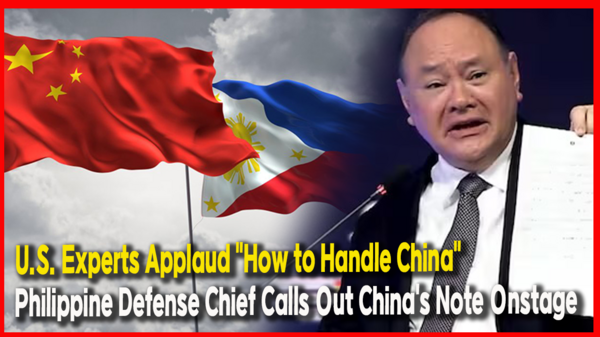
[Philippine Defense Chief Teodoro Directly Slams Chinese Note as "Trampling on International Maritime Law"]
During the Seoul Defense Dialogue (SDD), Philippine Secretary of National Defense Gilberto Teodoro Jr. publicly read a handwritten note passed to him on stage from a Chinese representative, sharply criticizing it as an act of coercion that disrespects international law. U.S. foreign policy and security experts overwhelmingly welcomed his reaction, hailing it as a textbook example of how to handle China. By firmly countering the arrogant behavior of Chinese diplomatic personnel in a public setting, Teodoro dealt a sharp rhetorical blow that left Chinese representatives with little defense.
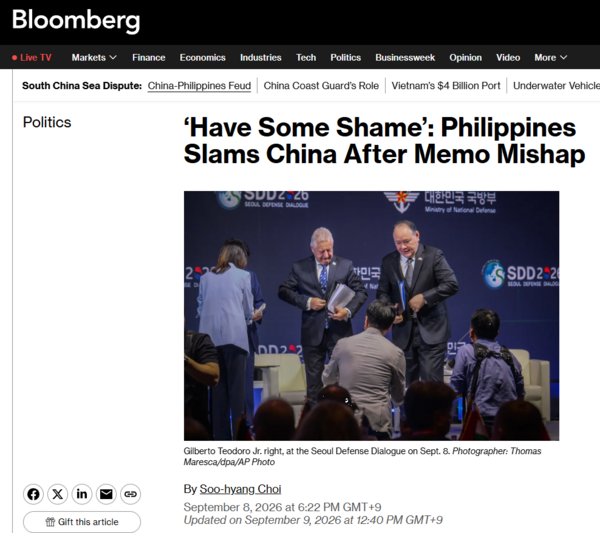
During Plenary Session 1 of the Seoul Defense Dialogue (SDD), hosted by South Korea's Ministry of National Defense at The Grand Lotte Seoul, a staff member delivered a note to Secretary Teodoro while he was addressing the audience. Pausing his remarks, Teodoro noted, "I think this is from China," and read the message aloud. The note asserted Beijing's position that the 2016 South China Sea arbitral ruling was "illegal, null, and void," arguing that it violated fundamental principles of international law and the principle of state consent. According to forum organizers, the note originated from a military attaché at the Chinese Embassy in Seoul. The attaché handed it to a staff member, who mistakenly assumed it was a message from Teodoro’s own delegation and brought it directly to him on stage.
["This is Not a Gray Zone; It Is Actual Coercion"]
Holding up the paper to the audience, Secretary Teodoro stated, "This is not a gray zone anymore. This is actual coercion, bullying, and aggression." He noted that if this reflected China's official stance, it was not merely a violation of international law, but amounted to throwing the United Nations Convention on the Law of the Sea (UNCLOS) to the floor and trampling on it. He added that passing such a note to a speaker answering questions on stage was disrespectful to the host country, South Korea, as well as to everyone in attendance. Addressing the issue of civil conduct, he remarked that what China needs is "basic decency and behavior." Drawing applause from the room, he added in Filipino: "Be a little decent, have a little shame." Referring to the individual who initiated the note, he quipped, "You've just done your country a great service. I hope you don't suffer in a gulag for it." Chinese Embassy spokesperson Liu Chang reaffirmed Beijing's standard stance, reiterating that the so-called arbitral award remains an illegal and invalid piece of paper that does not alter China's territorial sovereignty or maritime rights in the South China Sea.
["How to Handle China"... U.S. Experts Praise Direct Response]
The incident quickly gained traction across social media and policy circles in the U.S. Michael Sobolik, Senior Fellow at the Hudson Institute, described Teodoro's response as refreshingly clear on X (formerly Twitter), stating that highlighting how Chinese pressure on neighboring states has moved past gray-zone tactics adds clarity and stability to international politics. Steve Yates, Senior Fellow at the Heritage Foundation, remarked that this is what it sounds like when an Asian nation speaks up for itself and engages in credible security partnership with the United States—a development negative for the Chinese Communist Party but positive for the U.S.
Miles Yu, Director of the China Center at the Hudson Institute and former China policy advisor at the State Department, noted that Teodoro voiced what many felt publicly and that China needs basic decency. Former State Department spokesperson Morgan Ortagus summarized it succinctly: "This is how to handle China."
Palantir founder Joe Lonsdale criticized CCP tactics as lacking dignity and commended figures like Teodoro for standing up to them with clear logic. Former Canadian Defense Minister Jason Kenney praised Teodoro’s handling of the situation as a prompt and effective response to an attempted intimidation tactic during a live panel.
[A Longstanding Confrontation: Previously Sanctioned by Beijing]
This is not Secretary Teodoro's first direct confrontation with Beijing. In June, the Chinese government imposed sanctions against him, his spouse, and his children, banning them from entering mainland China, Hong Kong, and Macao, while barring Chinese entities and individuals from conducting transactions with them.
At the time, China's Ministry of Foreign Affairs claimed Teodoro made repeated irresponsible statements that undermined China's legitimate interests and bilateral relations. Analysts at the American Enterprise Institute (AEI) observed that this marked the first time Beijing sanctioned a sitting cabinet minister of a state with which it maintains diplomatic ties, targeting the most outspoken voice in President Marcos Jr.'s administration. The Philippine Department of Foreign Affairs described the sanctions as an unfriendly act, while Teodoro stated he would not back down, calling the sanctions retaliation for speaking the truth about illegal activities in the South China Sea.
[South China Sea: A Summer of Physical Confrontations]
Teodoro’s firm stance reflects the sharply escalated tensions at sea over the summer. Near Second Thomas Shoal (Ayungin Shoal), Chinese Coast Guard vessels deployed small boats to approach the grounded Philippine Navy ship BRP Sierra Madre, resulting in a physical altercation that injured two Philippine military personnel. Days later, near Scarborough Shoal (Baho de Masinloc), the Chinese Coast Guard targeted a vessel from the Philippine Bureau of Fisheries and Aquatic Resources with water cannons for over two minutes and executed risky maneuvers as close as seven meters. In response to these recurring incidents, the Marcos administration has filed nearly 200 diplomatic protests against Beijing.
Following these maritime confrontations, the Philippines conducted a five-day joint maritime exercise with the United States and Japan. Teodoro's assertion in Seoul that the conflict is "no longer a gray zone" aligns directly with conditions on the water, where repeated physical standoffs have rendered standard gray-zone framing increasingly obsolete.
[The 2016 PCA Ruling: Persistent Non-Compliance]
The legal foundation of these disputes remains the 2016 Permanent Court of Arbitration (PCA) ruling. The tribunal ruled that China's historical claims based on the "nine-dash line" lacked a legal basis under UNCLOS and affirmed the Philippines' Exclusive Economic Zone (EEZ).
China continues to reject the ruling as illegal and void, building artificial islands around the Spratly Islands and interfering with Philippine maritime operations. Marking the anniversary of the ruling, the U.S., Japan, Australia, and New Zealand issued a joint statement calling on China to abide by international law, though South Korea did not join the statement.
In his earlier plenary address in Seoul, Secretary Teodoro warned that unchecked use of force increases the risk of conflict, emphasizing the necessity of a rules-based collaborative security framework centered on human security.
[Why Times Insight]
The strong resonance of this event in the U.S. stems as much from its delivery and timing as from the content itself. While Southeast Asian nations often rely on cautious diplomatic language during disputes with Beijing, Teodoro—already personally sanctioned by China—publicly read and countered the note live on stage.
The progression from June sanctions to July maritime standoffs and September's public rebuttal illustrates a steady firming of Manila's policy stance toward Beijing. The prompt and unified response from Washington policy experts suggests an effort to frame the Philippines as an example of firm alignment with international legal standards in the region. Whether this symbolic support leads to expanded operational assistance, such as accelerated defense procurement or increased funding, remains to be seen.
-중국 푸단대학교 한국연구원 객좌교수
-전 EDUIN News 대표
-전 OUR NEWS 대표
-제17대 대통령직인수위원회 정책기획팀장
-전 대통령실 홍보기획비서관
-사단법인 한국가정상담연구소 이사장
-저서: 북한급변사태와 한반도통일, 2012 다시우파다, 선거마케팅, 한국의 정치광고, 국회의원 선거매뉴얼 등 50여권