
Update2026.10.24 (토)

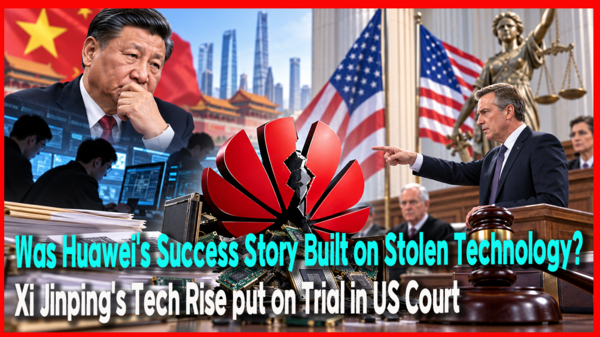
[The Question Posed by the FT: "Was Huawei's Rise Built on Crime?"]
The success story of Huawei, China's largest ICT company, has been put on trial in a U.S. court. The Financial Times (FT) raised the question on the 7th, "Was Huawei's rise built on crime?", highlighting a criminal case in which U.S. prosecutors claim Huawei systematically stole competitor technology, deceived financial institutions, and evaded sanctions related to Iran and North Korea over the past 20-plus years.
What matters more in this trial is not just the amount of the fine. If prosecutors' claims are accepted by the jury, a massive question mark could be placed on the growth process itself of Huawei, which China has touted as a success case of a global tech company. Ultimately, it can be viewed that what stands in court is not just one company, but Xi Jinping's 'tech rise model' itself, which aims to catch up with Western technology and rise as a tech hegemon.
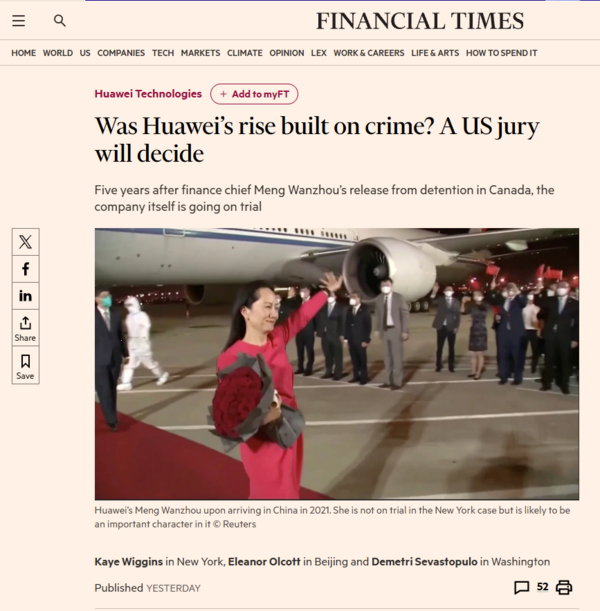
Reporting on Huawei's criminal trial on the 7th (local time), the FT ran a headline piercing the core of the case: "Was Huawei's rise built on crime? A US jury will decide."
In this article, the FT reported, "The picture painted by U.S. prosecutors differs from a simple corporate patent dispute or an individual employee's deviation," adding, "Prosecutors view Huawei's acts—such as stealing competitors' trade secrets over a long period, misleading financial institutions, and hiding business relationships with sanctioned countries—as a single continuous pattern of crime." Hence, the law mobilized is none other than the RICO Act, created in the U.S. to tackle the mafia and organized crime.
[Not Just One Technology: From Routers to Antennas and Robots]
The 56-page superseding indictment released by the U.S. Department of Justice in 2020 reveals how broad the prosecutors' claims are. According to the DOJ, "Prosecutors alleged that Huawei improperly obtained undisclosed intellectual property from competing companies, including internet router source code, cellular antenna technology, and robotics-related technology." The DOJ claims that "Through this, Huawei significantly reduced the cost and time required for research and development to secure a competitive advantage." Of course, these are prosecution charges that must be proven in the current trial.
The FT also pointed out, "A representative case is T-Mobile's phone-testing robot 'Tappy' incident," but noted that "In this trial, what prosecutors are trying to show is not whether a specific robot part was stolen, but that connecting individual incidents can prove the existence of a structure that secured competitors' technology and utilized it within the company."
[What Was Even More Chilling Were 'A2' and 'A9']
The U.S. Department of Justice indictment continued, stating that "The case does not end with technology theft," revealing that "Huawei managed sanctioned countries in internal documents using code names, where 'A2' was Iran and 'A9' was North Korea."
According to the DOJ, the allegations related to North Korea are particularly specific. The indictment specifies that Huawei was involved in various North Korean projects starting in 2008 at the latest, and that by 2013, there were even shipping instructions to the effect that Huawei logos should not be attached to items being sent to North Korea. Prosecutors claim Huawei personnel explained to financial institutions to the effect that they were not doing business in North Korea.
The Iran issue is also severe. Prosecutors claim that Huawei provided incorrect information to financial institutions while downplaying or concealing its relationship with Skycom, and conducted business in Iran through Skycom. The DOJ further stated that these operations included equipment that supported internal surveillance activities by the Iranian government.
[The 4-Page Document Left by Meng Wanzhou Returns]
Particularly burdensome for Huawei in this trial is the statement left by Meng Wanzhou, CFO and daughter of founder Ren Zhengfei. Although Meng Wanzhou herself is not a defendant in this current case, she signed a 4-page statement of facts when entering into a deferred prosecution agreement with U.S. prosecutors in 2021 to resolve her own case.
And last June, Judge Donnelly ruled that the contents of this statement could be used in the Huawei trial. That document includes admissions to the effect that some of the descriptions provided to financial institutions regarding Iran operations contained information that was untrue. A document that once freed Meng Wanzhou has turned into prosecution evidence targeting Huawei five years later.
[The Real Terror Is Not the Fine]
In the event of a guilty verdict, Huawei faces the possibility of massive financial penalties. However, what is far scarier for Huawei than the amount of the fine is the possibility of a ruling by a U.S. court designating it as a 'company that grew through crime.'
Huawei is already facing significant limitations in accessing cutting-edge semiconductors and manufacturing equipment due to U.S. export controls. Under these circumstances, if a guilty verdict in the RICO case is added, the legal and reputational risks that global financial firms, suppliers, telecom operators, and governments must bear when dealing with Huawei could increase significantly. How much this actually leads to business contraction is a separate issue, but the effect of adding one more powerful legal basis to the U.S. tech and security vigilance against Huawei is hard to ignore.
There is also a sober aspect to consider. Even if found guilty in this trial, it is difficult to conclude that Huawei will collapse immediately. Huawei has already significantly reduced its dependence on the U.S. market and is building its own semiconductor, AI, and telecommunications ecosystem backed by China's domestic market and government industrial policy. Indeed, even amidst ongoing strong U.S. export controls, Huawei continues its business in smartphones, telecom equipment, and AI computing fields. Therefore, rather than a simple formula of 'guilty = Huawei collapse,' one must observe how high the costs for finance, components, and overseas market access will rise in the future.
[Ultimately, Xi Jinping's Tech Rise Is Put on Trial]
Thus, this case carries a significance larger than the fate of Huawei as a single company. To Xi Jinping, Huawei is not merely a private firm. It is a symbolic company demonstrating that China can break through U.S. technology blockades and build an independent ecosystem in semiconductors, AI, and 5G. However, if a U.S. jury determines that part of Huawei's growth process was based on long-term technology theft and deceptive behavior, a political blow to the legitimacy of China's touted 'independent innovation (自主創新)' success story will be inevitable.
Moreover, the timing is sensitive. The FT also pointed out that "This case is taking place at a sensitive phase in U.S.-China relations." Therefore, "While the trial inside the courtroom deals with Huawei's past actions, outside the courtroom, it is highly likely to intersect with the much larger fight of the tech hegemony competition between the United States and China."
[Why Times Insight]
The core question of this trial is not "How large of a fine will Huawei pay?" It is "What was Huawei, the representative success model of China's tech rise, actually made of?" If the U.S. prosecutors' claims are accepted as fact, previously scattered allegations of trade secret theft, concealment of Iran and North Korea operations, and deception of financial institutions will be connected into one giant picture for the first time. If that happens, the U.S. will gain strong justification to press its claim in the tech war with China that "China's high-tech growth was not achieved through fair competition alone."
However, this does not mean the immediate collapse of Huawei. Rather, what warrants more attention is whether Huawei, backed by China's massive domestic market and state support, will shift further into an independent ecosystem separate from the U.S.-centered tech and financial systems, and whether the U.S. will once again press its allies to exclude Huawei.
In that sense, while this trial sits in judgment of Huawei's past, it is also likely to become another turning point determining how far Xi Jinping's tech rise can reach in the global market in the future
 .
-중국 푸단대학교 한국연구원 객좌교수
-전 EDUIN News 대표
-전 OUR NEWS 대표
-제17대 대통령직인수위원회 정책기획팀장
-전 대통령실 홍보기획비서관
-사단법인 한국가정상담연구소 이사장
-저서: 북한급변사태와 한반도통일, 2012 다시우파다, 선거마케팅, 한국의 정치광고, 국회의원 선거매뉴얼 등 50여권