
Update2026.10.24 (토)

[What Ukrainians Found Inside the "Mach 9" Zircon: Russia's Dismal Reality]
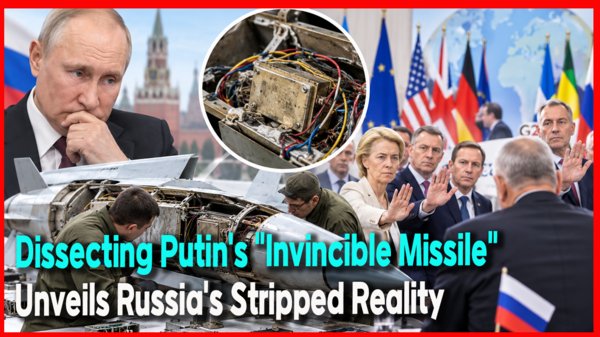
One of the representative "weapons of terror" that Russia has used to threaten the world was placed on the dissection table. Ukrainian intelligence released the internal structure and production network of the 3M22 Zircon—a strategic weapon boasted by President Vladimir Putin as capable of penetrating Western air defense systems—and some of the confirmed contents were at a considerable distance from the image created by the Kremlin. Coincidentally, on the same day at the G20 Finance Ministers' Meeting held in the United States, European nations staged a collective backlash against the Russian delegation. The two pillars that have supported Russia's prestige under Putin—namely, "military terror" and "superpower prestige"—came under test at the same time.
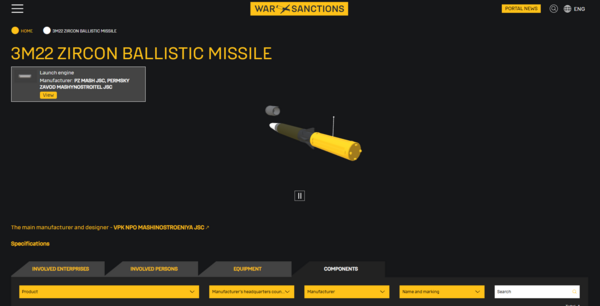
On August 31, the Main Directorate of Intelligence of the Ministry of Defense of Ukraine (GUR) disclosed an interactive 3D model, internal components, and information on manufacturing companies and personnel tied to the Zircon on its own intelligence portal, "War & Sanctions." In this report, the GUR stated, "The Russian 3M22 Zircon missile is approximately 8m long, 0.666m in diameter, and carries a warhead weight of about 120kg," adding, "What is particularly noticeable is the speed; while the Zircon's top speed is listed as Mach 8–9 on its spec sheet, its separate 'Maximum fixed speed'—the confirmed top speed—is Mach 6.8." A gap exists between the numbers Russia has long emphasized and the figures actually confirmed.
What is more interesting is the propulsion system. Business Insider pointed out, "The internal composition disclosed by GUR explicitly specifies a '3L2211 solid-fuel missile engine' and a separate launch engine," noting that "GUR even classifies the Zircon on its portal as a '3M22 Zircon ballistic missile.'" However, caution is required before concluding from this alone that a scramjet definitely does not exist in the Zircon. The important point is that as part of the Zircon's internal composition, previously shrouded in secrecy, has been revealed through physical items and production materials, it has become possible to compare Russia's official propaganda with its actual structure.
This does not mean that the Zircon is a meaningless weapon. The confirmed top speed of Mach 6.8 alone falls within the hypersonic range and remains a very threatening weapon to the defending side. Indeed, some analyze that Russia's recent increase in the proportion of high-speed ballistic-type weapons, including the Zircon, in its attacks on Ukraine is due to Ukraine's improved defense capabilities against existing cruise missiles and drones. Therefore, the core of this exposure is not 'Zircon is a fake,' but 'how much of a difference exists between the Zircon advertised by Russia and the Zircon verified on the actual battlefield.'
[Beyond the Missile: The Shocking Exposure of Russia's Defense Industry Supply Chain]
What deserves even more attention in this data is not the performance of a single Zircon missile, but the military-industrial ecosystem hidden behind it. GUR revealed 70 companies and 84 key company personnel involved in Zircon production. They tracked not only engines, radars, electronic equipment, and guidance systems, but also machine tools and testing equipment used by manufacturers. A significant portion of the veil surrounding how the Zircon—which Russia has put forward as one of its top strategic weapons—is made through which companies and technology networks has been lifted.
In particular, the Zircon-related materials feature foreign electronic components such as the TGA2704 amplifier from TriQuint Semiconductor (a U.S. RF semiconductor company that manufactured high-frequency amplifiers and semiconductor components used in communications, radar, aerospace, defense, etc.), currently under Qorvo (a U.S. semiconductor company). The list of equipment used in production facilities also identifies various foreign facilities, including South Korean acoustic microscopes and X-ray inspection equipment, Japanese machining centers, U.S. waterjet equipment, and Chinese machine tools. This serves as an important clue showing that Russia's military industry relies heavily on foreign electronic components and production equipment even under sanctions.
This exact point is painful for Putin. Long-term, what is far more dangerous than a single Zircon missile being intercepted is the disappearance of the 'technological mystery' surrounding Russian high-tech weapons. If an opponent grasps the missile's structure, manufacturers, personnel, foreign components, and manufacturing equipment, that weapon is no longer an unidentified fear. It transforms into an engineering object whose supply chain can be blocked, vulnerabilities analyzed, and new interception methods researched.
[Why Ukraine Fears Russia's "Doomsday Weapons" Less]
The war in Ukraine was also a process of stripping away these Russian myths one by one. In the early stages of the war alone, Russia's long-range precision strike weapons and hypersonic weapons imposed tremendous psychological pressure on Ukraine. However, as the war dragged on, Ukraine progressed beyond the level of collecting fallen missile debris to tracking internal components, production companies, supply chains, and production facilities. Just a few days ago on August 27, data on 140 Russian and foreign components confirmed in the Iskander-M, along with 35 related manufacturing companies and 108 personnel, were also released.
Fear is maximized when the opponent's true capabilities cannot be accurately known. Conversely, the moment a weapon's structure, limits, and production foundation are identified one by one, fear turns into a 'risk to be addressed.' The fact that Ukraine has recently attacked military facilities and energy infrastructure inside mainland Russia without treating Russia's retaliatory capability as absolute as in the past is also difficult to view as unrelated to this war experience. However, this is an analytical interpretation based on the war situation and intelligence disclosures, rather than a conclusion directly drawn by the GUR report.
[Embarrassment on the Diplomatic Stage: Putin Humiliated at the G20]
An even more coincidental scene took place on the same day, August 31, in Asheville, North Carolina, USA. Reuters reported, "Russian Finance Minister Anton Siluanov attended the G20 Finance Ministers' Meeting in person for the first time since the full-scale invasion of Ukraine in 2022, upon invitation by the United States," adding, "However, European finance ministers and central bank officials publicly voiced backlash against the return of the Russian representative."
What was symbolic was the group photo. Reuters pointed out, "The European side refused to take the traditional G20 'family photo' containing Siluanov, and eventually a photo was taken with the Russian representative omitted," noting that "German Finance Minister Lars Klingbeil emphasized the stance that a normalization of relations with Russia cannot occur while the war in Ukraine continues, meaning that although Russia returned to the meeting hall, it was not granted recognition of a 'return to a normal state.'"
Deserving further attention was the separate meeting between U.S. Treasury Secretary Scott Bessent and Siluanov. Reuters stated, "Although Siluanov discussed financial and economic cooperation between the two countries, Bessent delivered the position that it is difficult to advance economic cooperation unless the war in Ukraine ends," adding, "This did not mean the U.S. closed the door to dialogue with Russia itself, but it did not mean permitting the economic normalization that Russia might expect either."
[War Weariness Deepens Within Russia]
A part that concerns Putin even more is the internal changes within Russia. However, concluding from this that 'the Russian people have turned their backs on Putin' differs from the facts. In an August survey conducted by the Levada Center, an independent polling organization, responses supporting the Russian military's actions in Ukraine were still at 68%. Opposed was 21%. Of course, against the background of a social situation where expressing one's convictions is difficult due to severe societal surveillance, it means it is not yet at a stage to view the base of support for the war in Russian society as having collapsed.
However, looking at other numbers, the atmosphere is complex. 59% answered that a transition should be made toward peace negotiations rather than military actions. On the other hand, responses desiring the continuation of the war stood at 31%. What stands out even more is that 55% projected that the war will continue for more than another year. This is the highest figure recorded in this survey's history. It is a point that can be interpreted as a significant number of Russians starting to accept an 'endless war of attrition' as a reality rather than expecting victory.
The degree to which the war has penetrated into the daily lives of Russian citizens has also grown. In the Levada survey, about 6 out of 10 respondents answered that this war has affected them or their families in some way. Respondents who felt impacted cited economic hardship, the death of acquaintances, drone strikes, and severed family relationships as specific examples. A dual state of supporting military operations while simultaneously harboring the sentiment of 'wanting to end this war quickly' constitutes the characteristic feature of Russian public opinion today.
[Why the Zircon Debacle Troubles China]
Here, a question can also be posed regarding China. However, based on this Zircon analysis, one should not conclude that Chinese missile performance is similarly inflated. China has developed its own hypersonic weapon systems such as the DF-17, and viewing Chinese missiles in their entirety simply as replicas of Russian weapons is also inaccurate.
Nevertheless, an uncomfortable question remains for China. The Chinese military has for a long time imported Soviet and Russian weapons and military technologies, absorbing them while developing its own weapon systems. If so, to what extent should specifications such as top speed, range, and interception-evasion capabilities announced by a country with limited real-combat verification experience be accepted at face value? While the Zircon case neither proves nor disproves the performance of Chinese weapons, at least the lesson that 'published specs' differ from 'performance verified in actual combat' applies equally to China.
[Why Times Insight — What Putin Lost Is Not a Single Missile, But "Terror"]
The real reason why this Zircon disclosure is painful for Putin is not merely due to the single number that the confirmed top speed was Mach 6.8 instead of Mach 9. The power of a superpower comes not only from the actual destructive power of a weapon, but also from how much the opponent fears that weapon. Russia has long utilized that very 'terror' as a strategic asset by successively revealing new weapons that are difficult for the West to block.
However, as the war prolonged, Russia's tanks, air defense systems, cruise missiles, and ballistic missiles were deployed to actual combat one by one, and the opponent is now collecting the wreckage to dissect the interior. They track beyond the missile's engine and electronic components to its production enterprises, engineers, and production facilities. The Zircon, too, is no longer an 'unknown weapon' that overwhelms the opponent by name alone, but has come down to a weapon system whose structure and supply chain can be analyzed.
And on the same day at an international meeting hall, there were European countries that refused to even take a single group photo with the Russian Finance Minister. Domestically in Russia, support for military operations remains high, but at the same time, 59% desire peace negotiations, and a majority expects the war to continue for more than a year. Three scenes—the unraveling of a weapon's mystery on the battlefield, the challenge to a superpower's authority on the diplomatic stage, and the accumulation of fatigue over a long war domestically—are unfolding simultaneously.
What is most dangerous for Putin is not merely Russia losing the war right away. It is that the world no longer fears Russia as much as it used to. That may prove to be a far more fatal defeat than the failure of a single Zircon missile.

-중국 푸단대학교 한국연구원 객좌교수
-전 EDUIN News 대표
-전 OUR NEWS 대표
-제17대 대통령직인수위원회 정책기획팀장
-전 대통령실 홍보기획비서관
-사단법인 한국가정상담연구소 이사장
-저서: 북한급변사태와 한반도통일, 2012 다시우파다, 선거마케팅, 한국의 정치광고, 국회의원 선거매뉴얼 등 50여권