
Update2026.10.24 (토)

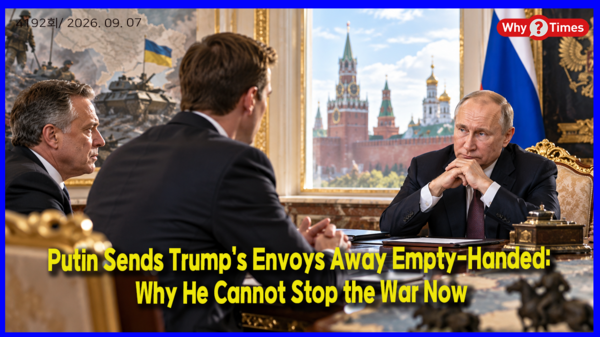
[3 Hours of Talks, Zero Movement: Putin Refuses to Budge]
Despite U.S. President Donald Trump dispatching special envoys Steve Witkoff and Jared Kushner to Moscow with specific proposals to end the war, Russian President Vladimir Putin showed no willingness to back down from his core objectives during three hours of negotiations. The dilemma now deepens: with immense casualties and staggering economic costs yielding virtually no frontline movement, why does Putin refuse to stop? Analysis suggests that the continuation of the Ukraine war has transcended state cost-benefit calculations, becoming inextricably linked to Putin’s personal political survival.
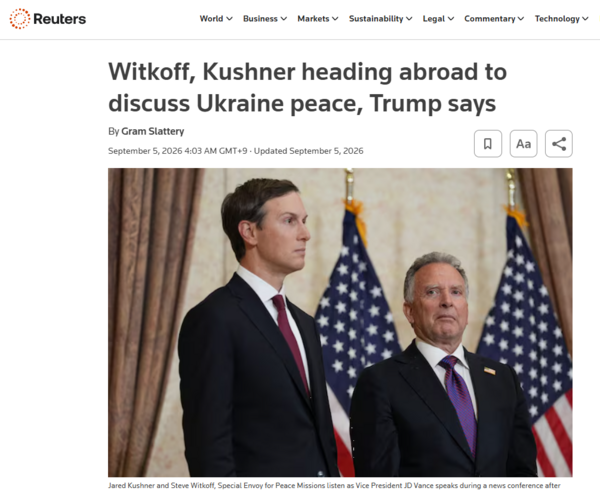
According to Reuters, Witkoff and Kushner met Putin at the Kremlin for over three hours. While Kremlin foreign policy aide Yuri Ushakov described the meeting as "highly useful," the talks yielded no breakthrough. Instead, Putin reiterated his existing stance that Russian forces are "advancing on the battlefield" and that any settlement must address the "root causes" of the war.
According to Reuters, Russia’s demands remain unchanged: Kyiv must concede territory in the four annexed regions and abandon its NATO ambitions, whereas Ukraine firmly rejects ceding land. Despite three hours at the Kremlin, the core gap remains unbridged.
[The "Frontline Freeze" Proposal: What Was Likely on the Table]
According to Reuters, it was not publicly disclosed whether the U.S. officially proposed freezing the war at current frontlines. Trump noted that Witkoff and Kushner carried a "concrete proposal," but omitted details.
However, negotiators cannot realistically discuss ending the war without addressing territory and current frontlines. The core of any compromise inevitably centers on freezing the conflict along current positions. Yet Putin demands a complete Ukrainian withdrawal from the Donbas before ending the war. The Carnegie Endowment for International Peace highlights that despite severe economic strains and tactical stalemates, Putin shows almost zero inclination to soften his maximalist position.
[Putin Claims He Is Winning, But the Battlefield Tells a Different Story]
According to Reuters, Putin’s primary logic to U.S. envoys rests on the claim that Russian troops continue to advance, particularly in Donetsk. Independent battlefield analyses present a starkly different reality.
Data from the Institute for the Study of War (ISW) shows Russian forces secured control over just ~90.35 km² in August—an average of merely 2.91 km² per day. This marks a sharp deceleration compared to the 505 km² seized in August of the previous year. Furthermore, ISW estimates Ukrainian forces recaptured at least 129.81 km² during the same month.
The human cost for these minimal gains has been astounding. Citing Ukrainian metrics, ISW reports over 42,020 Russian casualties in August alone—marking two consecutive months exceeding 40,000 casualties. This translates to roughly 465 casualties for every single square kilometer gained, pointing to a clear trend: Russia is expending massive manpower for highly restricted territory.
[Economic Strain: Russia's Mounting Financial Bill]
The financial toll of prolonged warfare is increasingly visible. According to draft government forecasts obtained by Reuters, Russian crude output is expected to drop to 9.88 million barrels per day—its lowest level in 17 years (since 2009)—driven by Western energy sanctions, targeted strikes on domestic refining infrastructure, and internal fuel shortages.
According to Reuters, Putin acknowledged at Vladivostok that Russia's budget deficit expanded to 2.8% of GDP between January and July, far surpassing the government's 1.6% target. Reuters pointed out that the prolonged war is slowing economic growth while escalating tax and borrowing burdens.
Internal warnings are now surfacing publicly within Russia. Boris Titov, Putin’s special envoy for sustainable development, issued an unprecedented warning that over-militarizing the economy could cause it to "go berserk," noting that the structural imbalance between military and civilian sectors can only be sustained for a limited period.
[Why Putin Refuses to Stop: Power over National Interest]
This is the pivotal point of the U.S.-Russia talks. Calculated strictly through state interests, Moscow would weigh mounting losses—personnel attrition, slowed momentum, and economic degradation—against potential gains.
However, Putin operates on a separate variable: personal political power. Analysis suggests that prolonged warfare has tied the political and financial fortunes of the Russian elite entirely to the survival of Putin's regime. The Carnegie Endowment for International Peace notes that elite dependence on Putin has deepened since the war began, reshaping Russia's internal power structure.
Over four and a half years have passed since the February 2022 full-scale invasion. Putin has framed this conflict not merely as a territorial dispute, but as a grand national effort for survival, halting NATO expansion, and reclaiming historical spheres of influence.
If the war ends without an undeniable "victory" for the Russian public, one devastating political question remains: "What were all these sacrifices for?"
[Fear of a "Victory-less End"]
For Putin, the most dangerous moment may not necessarily be military defeat; ending the war in a state that cannot be spun as a "victory" poses an even greater immediate threat to his political survival.
The Carnegie Endowment for International Peace analyzes that Russia's war objectives extend beyond territorial acquisitions to broader political and security goals aimed at blocking Ukraine's integration into Western security frameworks. Redrawing border lines across a few provinces is insufficient to deliver the "victory" Putin promised.
Carnegie's research on Russian elites emphasizes that prolonged warfare has bound the political and economic fates of the ruling class to Putin's regime, creating a self-reinforcing cycle where continuing the war maintains regime stability.
[Divergence Between State Interest and Political Survival]
The three-hour meeting should not be read simply as a failed negotiation. For Russia as a nation, continuing the war drains lives, funds, and economic viability. For Putin, ending the war without sufficient spoils incurs the political cost of explaining four and a half years of immense sacrifice.
The cost to the Russian nation to continue the war and the political cost to Putin to end it are moving in opposite directions. A mounting national loss does not automatically translate into a decision by Putin to stop.
Unless Washington presents terms that Putin can package domestically as a definitive victory, a deal remains elusive. The Kremlin's assessment of the meeting with Witkoff and Kushner as "highly useful"—despite yielding no breakthrough—reflects this core structural dilemma.
[Why Times Insight]
The crucial takeaway from the meeting is not merely what was discussed over three hours, but what Putin refused to surrender. Russia's baseline demands on territory and security remain unchanged.
While Russian forces suffered over 42,000 casualties in August to secure a net gain of roughly 90 km², oil output forecasts hit a 17-year low and budget deficits exceeded targets. Even Putin's economic envoy warned of an economy going "berserk."
Yet Putin repeatedly told U.S. envoys that Russian forces are advancing. The reason lies in the gap between the peace Russia needs and the peace Putin needs. Russia needs to curb human and economic drain, but Putin faces the political consequences of a "victory-less end."
The ultimate metric in peace efforts is no longer just "How long can Russia fight?" but rather "When can Putin end the war while guaranteeing his hold on power?" As national costs rise without increasing Putin's personal incentive to stop, the conflict highlights a tragic reality: whether the state exists for the war, or the war exists for the state.
-중국 푸단대학교 한국연구원 객좌교수
-전 EDUIN News 대표
-전 OUR NEWS 대표
-제17대 대통령직인수위원회 정책기획팀장
-전 대통령실 홍보기획비서관
-사단법인 한국가정상담연구소 이사장
-저서: 북한급변사태와 한반도통일, 2012 다시우파다, 선거마케팅, 한국의 정치광고, 국회의원 선거매뉴얼 등 50여권