
Update2026.10.24 (토)

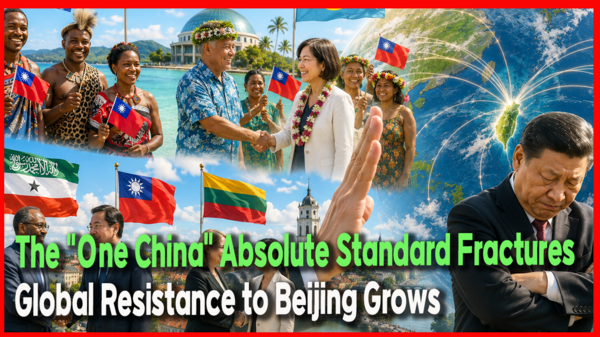
[Most Recently in Palau: Taiwan Enters Despite Beijing's Warnings]
China's "One China" principle, long enforced as an absolute diplomatic line, faces growing challenges worldwide. Eswatini, Africa’s sole remaining diplomatic ally of Taiwan, maintains ties despite sustained economic and diplomatic pressure from Beijing. Most recently, Palau hosted Taiwan's Foreign Minister Lin Chia-lung for international forum events, disregarding public warnings from China. Somaliland and Lithuania are similarly preserving their relationships with Taiwan while enduring Chinese backlash and economic coercion. The long-standing diplomatic playbook—where a Chinese "No" forced smaller nations to back down—is yielding increasing exceptions.
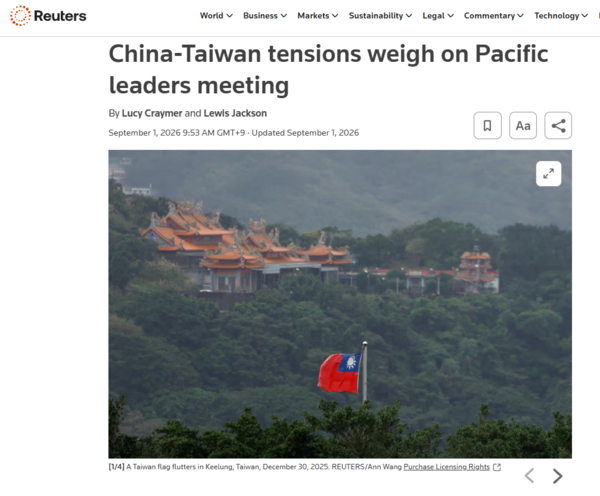
Reuters reported on September 2 that China strongly opposed Taiwanese Foreign Minister Lin Chia-lung’s attendance at the Pacific Islands Forum (PIF) in Palau, warning of potential "consequences." Host nation Palau stood firm, allowing Minister Lin to participate in related events. Australia and New Zealand reinforced that participation choices belong solely to Pacific nations. Ultimately, Beijing failed to block Taiwan’s attendance.
Reuters added that Palau, one of three Pacific nations maintaining formal diplomatic ties with Taiwan, held its position even as Beijing raised travel and tourism restrictions. This incident underscores that the legacy assumption—smaller countries yielding under Beijing's opposition—no longer consistently applies.
[Told to "Leave" Eswatini: Yet Chinese Enterprises Stayed]
A similar dynamic unfolded in Africa. Pan-African multilingual news network Africanews reported on August 27 that Beijing issued a travel warning advising its citizens to avoid visiting Eswatini—the continent's last Taiwanese ally—and urging those already present to evacuate or relocate to neighboring South Africa. Eswatini’s government pushed back, affirming that nations should not suffer penalties for sovereign foreign policy choices.
More symbolically, local Chinese corporate interests diverged from Beijing's guidance. A Chinese consortium engaged in the Mpakeni Dam construction publicly stated it had no plans to halt or downscale operations, confirming the project will proceed as scheduled.
Africanews highlighted that while Beijing urged an exit, Chinese firms remained grounded due to commercial interests, revealing a friction point between Beijing's geopolitical pressure and the economic priorities of Chinese enterprise. Beijing's directive failed to carry absolute authority.
Beyond travel advisories, Beijing excluded Eswatini from its expanded zero-tariff benefits offered across African nations—specifically citing Eswatini's formal diplomatic ties with Taipei over Beijing.
Reuters further noted that during Taiwanese President Lai Ching-te's visit to Eswatini, Chinese pressure led Seychelles, Mauritius, and Madagascar to refuse airspace transit rights. Though President Lai's initial schedule was delayed, he arrived in Eswatini in May via alternative routing. China blocked transit pathways, but could not disrupt the visit or the bilateral relationship itself.
[Somaliland and Lithuania: "We Move Forward Despite Beijing's 'No'"]
Somaliland made a comparable policy choice. Reuters noted that despite opposition from both Beijing and Somalia, Somaliland maintains and expands representative ties with Taiwan, declaring that international partnerships remain its sovereign choice. While Somaliland operates under the unique context of lacking widespread international recognition, its refusal to cut ties under Chinese pressure remains notable.
In Europe, Lithuania serves as a key reference point. In 2021, Lithuania permitted Taiwan to open a representative office under the name "Taiwanese" rather than "Taipei," prompting Beijing to downgrade diplomatic relations and implement trade retaliation. The office remains operational today. Furthermore, the European Union challenged China's trade measures at the WTO, elevating a bilateral pressure tactic into a broader European framework against economic coercion.
[The Largest Exception: China's "Principle" vs. America's "Policy"]
The primary exception remains the United States, anchored in the distinction between Beijing's "One China principle" and Washington's "One China policy." Since establishing official relations with China in 1979, the US has sustained unofficial ties with Taiwan under the Taiwan Relations Act, the Three Joint Communiqués, and the Six Assurances, alongside a framework for defensive arms supply. Despite Beijing's repeated calls for Washington to adhere to its "One China principle," the US does not isolate Taiwan in the manner Beijing demands.
Despite Beijing's warnings to the US regarding Taiwan-related actions, economic and security cooperation between Washington and Taipei continues. China has been unable to fully enforce its preferred scope of the "One China" principle against the world's leading power.
[Core Insight: Automatic Compliance Is Fading]
It remains premature to claim that China’s "One China" strategy is collapsing based on a subset of sovereign decisions. Over past decades, Beijing successfully reduced Taiwan’s formal diplomatic allies to 12 and retains massive economic and diplomatic leverage. The key shift lies not in the complete absence of Chinese leverage, but in the weakening link between that power and automatic compliance from other states.
Historically, Beijing's most potent diplomatic tool was the cost implied by saying "No" to China: lost market access, reduced investment and tourism, and strained diplomatic relations. However, as Eswatini holds its stance, Palau hosts Taiwan’s foreign minister, Somaliland asserts its diplomatic autonomy, and Lithuania retains Taiwan's representative office, strategic calculations across capitals are evolving. The international baseline question is shifting from "Can we afford to oppose China?" to "Can we navigate the pressure if we do?"
[Why Times Insight]
The core significance of these developments extends beyond individual policy decisions in Mbabane or Ngerulmud. The foundation of Beijing’s global influence has rested less on direct force and more on market access, trade, investment, and the perceived costs of losing them. The "One China" principle served as the primary arena for this dynamic.
The unfolding transition marks the emergence of structural exceptions to automatic compliance. The decision by a Chinese consortium to proceed with construction in Eswatini—despite official state exit advisories—highlights a key friction point: escalating political pressure can run counter to existing commercial investments.
While China's broader diplomatic framework remains formidable, systemic shifts often begin with incremental precedents. As nations demonstrate that opposition from Beijing can be managed, strategic calculations in other capitals recalibrate accordingly.
For Beijing, the critical strategic challenge extends beyond preventing individual diplomatic switches. The primary structural vulnerability is the growing global observation that declining Beijing's demands does not automatically trigger unmanageable consequences.

-중국 푸단대학교 한국연구원 객좌교수
-전 EDUIN News 대표
-전 OUR NEWS 대표
-제17대 대통령직인수위원회 정책기획팀장
-전 대통령실 홍보기획비서관
-사단법인 한국가정상담연구소 이사장
-저서: 북한급변사태와 한반도통일, 2012 다시우파다, 선거마케팅, 한국의 정치광고, 국회의원 선거매뉴얼 등 50여권