
Update2026.10.24 (토)

[Only 12 out of 32 Satellites in Stable Operational Altitude… Second Batch of 16 All Fail]
The Russian space industry—which once launched Sputnik, the world's first artificial satellite, and sent Yuri Gagarin into space—is in a precarious state. Russia’s low-Earth orbit satellite communication network 'Rassvet,' ambitiously pursued to counter Starlink, has run into severe bottlenecks right from its initial deployment phase. Out of 32 satellites launched across two missions this year, only 12 have reached a stable operational altitude, marking a dismal performance.
Even more alarming is the status of the second batch of 16 satellites launched in July. Not a single unit reached its expected altitude, and several are already descending back toward Earth. Vladimir Putin’s plan to replace Starlink to support Russian military communications and unmanned combat forces has hit a major snag right at the starting line.
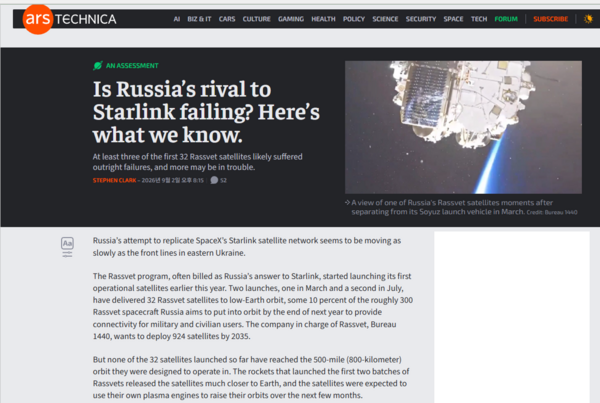
Ars Technica, a leading US global digital economy media outlet specializing in business, technology, finance, and innovation, closely analyzed these anomalies in an article titled “Is Russia’s Starlink Competitor Failing?” Ars Technica reported: “While Russia placed 32 production-grade satellites into space across two launches, at least three are presumed total failures, with a high likelihood that more are experiencing issues. Although Rassvet developer 'Bureau 1440' envisions deploying around 300 satellites by late next year and expanding to 924 by 2035, the 32 satellites currently in space represent barely 10% of their 300-satellite target.”
Business Insider, another prominent American global digital economy outlet, also reported: “None of the 16 Rassvet satellites launched on July 19 reached their intended operational altitude. Many are currently stuck in low orbits between 300 km and 400 km, raising serious doubts about whether they can operate normally over the long term.”
What makes this even more striking is that the mood was completely reversed just three weeks prior. Citing Ukrainian intelligence, Reuters reported that “Russia is constructing the Rassvet satellite network faster than anticipated” and that “Ukraine is scrambling to prepare countermeasures.” Russia’s ambitions were grand, but within weeks, warnings of a 'rapid Russian catch-up' shifted to grave concerns over 'satellites unable to ascend properly.'
[16 Satellites Launched at Once… Not a Single One Reached Target Altitude]
The concrete severity of the situation was highlighted in an analysis by the US-based Institute for the Study of War (ISW). Based on public satellite tracking data, the ISW stated: “As of late August, none of the 16 satellites from the second Rassvet batch launched on July 19 reached the expected altitude of 550 km. A significant number remain at 300–400 km, some are losing altitude, and at least two appear to be heading toward atmospheric re-entry.”
Here, a distinction must be made between 550 km and the final operational altitude. According to Ars Technica, Rassvet satellites are designed to use their own propulsion systems over several months after stage separation to raise their orbit, ultimately operating at around 800 km. Therefore, it is premature to conclude that all 16 satellites in the second batch are complete failures based on current data alone. However, the fact that several satellites are losing altitude rather than ascending indicates a clear departure from a normal deployment sequence.
Remaining in low orbits compounds the problem. Increased drag from the upper atmosphere requires satellites to burn more fuel to maintain orbit, drastically shortening their operational lifespans. While it cannot be said that all units are immediately out of communication, significant hurdles have emerged in establishing the long-term satellite network Russia originally planned.
[32 Satellites Launched, Only 12 Settled in Stable Altitude]
A broader issue is that the first launch was not flawless either. The ISW noted: “Out of the first batch of 16 satellites launched on March 24, only 12 reached an altitude of 550 km and maintained it through late August. These 12 satellites reportedly offer Russian forces over Ukraine limited connectivity windows of up to 1.5 hours, twice a day.”
According to the ISW, out of the 32 satellites launched so far, only 12—or 37.5%—have reached an altitude deemed viable for long-term operation. Conversely, 62.5% have failed to secure a stable operational orbit. Hence, describing the situation as a 'failure to secure a stable operational altitude for 62.5% of the satellites' is far more precise than calling it a '62.5% orbital insertion failure.'
The core requirement of a low-Earth orbit satellite communications network like Starlink is not the individual performance of one or two satellites. Hundreds to thousands of satellites must continuously pass over ground terminals, handing off communication signals seamlessly to maintain an active network. Serhii Beskrestnov, a defense technology advisor to the Office of the President of Ukraine, estimated that “Rassvet would require at least 200 to 300 satellites to provide stable 24/7 connectivity over Ukraine.”
Russia has launched a mere 32 satellites so far, with only 12 assessed to be at a stable altitude. This is not merely a matter of having a long way to go; if current launch rates and orbital degradation persist, building a Starlink-like, round-the-clock communications network in the near term will be practically impossible.
The Rassvet setbacks directly impact the war in Ukraine. Russian forces previously relied on unofficial channels to acquire official Starlink terminals for battlefield use, but access to unapproved Starlink connections was blocked on February 1. The ISW assesses that the loss of Starlink access drove Russia to accelerate its Rassvet deployment timeline.
[A Problem Far More Severe Than the Satellites: The 'Rockets']
An even larger bottleneck facing Russia is its launch capacity. Rassvet currently relies on the Soyuz-2.1b rocket. The ISW highlighted that “since its full-scale invasion of Ukraine in 2022, Russia has managed only 6 to 8 Soyuz-2.1b launches across all national and commercial missions combined.” At this rate, calculations suggest Russia can launch a maximum of 128 Rassvet satellites over the next four years.
Thus, the core issue with Rassvet is not the anomaly among the 16 satellites themselves. Rather, it is whether Russia retains the industrial capacity to mass-produce, repeatedly launch, insert into target orbits, and continuously replace hundreds of satellites. On this front, a massive gap remains between Russia and Starlink.
[Ukraine Now Targets Russia’s 'Space Factories']
To make matters worse, Ukraine has begun targeting the production and launch infrastructure of Russia’s space industry. According to the ISW, Ukrainian forces struck the Progress State Research and Production Rocket Space Center—which manufactures Soyuz rockets—in mid-August, and targeted the Plesetsk Cosmodrome, where Rassvet satellites were launched, on August 23.
Granted, these strikes did not directly cause the orbital anomalies of the Rassvet satellites launched in July. What matters is what comes next. To complete Rassvet, Russia must manufacture and launch satellites dozens more times, but Ukraine has now demonstrated its capability to strike those exact production facilities and launch sites. The war has entered a phase where it consumes not just the Russian military’s manpower and tanks, but the foundational infrastructure of its strategic industries.
[The Land of Sputnik and Gagarin: How Did It Come to This?]
At this juncture, the significance of the Rassvet situation becomes much broader. The Soviet Union, which launched Sputnik 1 in 1957 and sent Yuri Gagarin into space in 1961, once shared global space dominance with the United States. Russia inherited that vast technological and industrial legacy.
However, the dynamics of today's space race have completely transformed. According to Reuters, while massive rockets and manned spacecraft were once the symbols of space powers, the war in Ukraine has shown that linking thousands of LEO satellites and ground terminals into a massive network for seamless battlefield operation is the new strategic asset. This is precisely why Russia rushed to build Rassvet.
Yet, it is in this new arena that Russia's limits are coming to light. While the Rassvet ordeal alone does not signal the complete collapse of Russia's space technology, it clearly illustrates how grueling a catch-up game Russia is playing in 21st-century space competitiveness—where satellite mass production, reliable propulsion, high launch cadence, and large-scale constellation management are paramount.
[Why Times Insight]
It would be an exaggeration to conclude that Russia’s entire space capability has collapsed based solely on the second-batch Rassvet anomalies. Some satellites do provide limited communications capability, and Russia has not abandoned its effort to build an independent satellite network.
However, the symbolic message of this crisis is clear. What Russia needs is not a handful of satellites, but the capability to continuously manufacture, launch, and operate hundreds of units as one vast network. Yet out of the first 32 satellites, only 12 have reached a stable altitude, while its launch vehicle supply and production bases face severe wartime pressures.
Irony dictates that the war initiated by Putin made Russia acutely realize its need for a Starlink counterpart, only for the practical limits of its space industry to be exposed the moment it attempted to build one. The nation that launched Sputnik and sent Gagarin into space now finds itself in a desperate, uphill battle to build a basic satellite internet network for the battlefield.
The Rassvet situation is not decisive proof marking the end of the Russian space power myth. Nevertheless, it stands as an unmistakable symbol of how far Russia has fallen in the Putin era as it gradually depletes its Soviet inheritance.


-중국 푸단대학교 한국연구원 객좌교수
-전 EDUIN News 대표
-전 OUR NEWS 대표
-제17대 대통령직인수위원회 정책기획팀장
-전 대통령실 홍보기획비서관
-사단법인 한국가정상담연구소 이사장
-저서: 북한급변사태와 한반도통일, 2012 다시우파다, 선거마케팅, 한국의 정치광고, 국회의원 선거매뉴얼 등 50여권