
Update2026.10.24 (토)

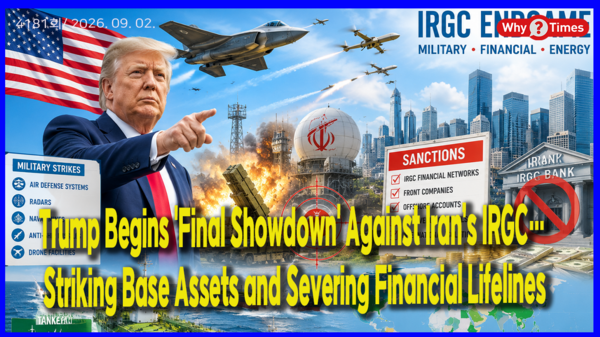
[Striking the IRGC, Not All of Iran… Approximately 100 Targets Attacked Simultaneously]
The US strategy toward Iran has shifted up another notch. The focus of military action is now narrowing directly onto disabling the Islamic Revolutionary Guard Corps (IRGC)—the military backbone of the regime—rather than targeting the nation of Iran as a whole. The US military conducted major strikes against IRGC air defense systems, radar facilities, mine warfare capabilities, anti-ship missiles, and attack drone infrastructure. Concurrently, the US Department of the Treasury initiated operations to sever the IRGC’s hidden overseas financial lifelines. Furthermore, the Trump administration executed its new "tanker for tanker" doctrine for the first time—promising to strike Iranian tankers if Iran attacks commercial tankers—initiating synchronized pressure across military, financial, and energy fronts.
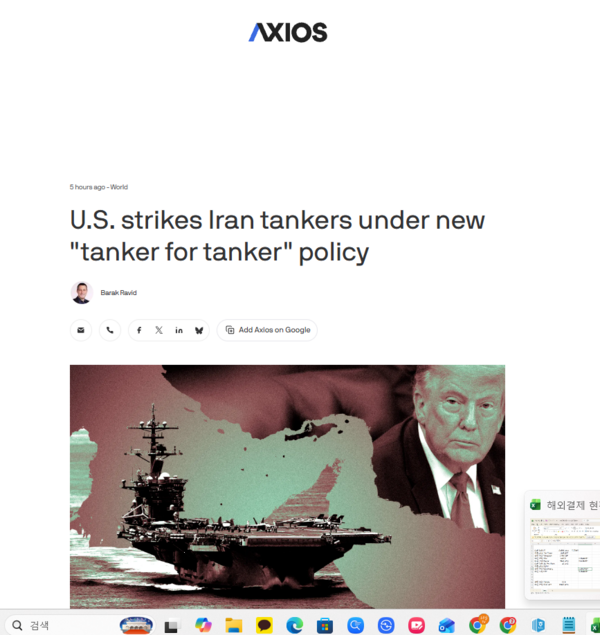
Axios reported that US Central Command (CENTCOM) launched a new wave of attacks against military targets inside Iran. According to US officials, what stood out in this operation was the specific nature of the targets: among approximately 100 targeted sites were IRGC air defense facilities, radar systems, mine-laying capabilities, communication centers, anti-ship cruise missile launchers, and attack drone facilities. This large-scale follow-up strike came just two days after the US military struck military installations on Larak Island in the Strait of Hormuz. Associated Press (AP) also reported that the US military hit Iran's air defense systems, radars, and naval assets, noting that the scope of operations has expanded from limited retaliation—such as destroying one or two launchers—to destabilizing the foundational infrastructure through which the IRGC projects military power around Hormuz.
Furthermore, CENTCOM stated that military operations conducted this year have destroyed significant portions of Iran's ballistic missile, drone, and naval defense industrial base, with extensive strikes specifically targeting command-and-control systems. Thus, this latest operation should be viewed not as a sudden, isolated event, but as follow-up pressure designed to prevent the rebuilding of Iran's already degraded military framework.
[Iran Retaliated… But the US Struck Back Even Harder]
Iran launched an immediate counterstrike. AP reported that Iran deployed missiles and drones targeting US-related facilities in regions such as Jordan, though US forces stated that a significant number were intercepted. AP evaluated this clash as a sudden end to a nearly month-long lull in direct military confrontation.
The key element lies in Washington's response method. AP noted that rather than focusing on defensive measures and containing escalations whenever Iran strikes, the US is attempting to establish a deterrence framework that imposes far higher military costs on Iran for any attack. President Trump also publicly warned that any additional retaliation would be met with significantly more powerful strikes.
[“Touch a Tanker, We Hit Your Tanker”… A New Tit-for-Tat Policy]
The most notable operational change in this campaign is the "tanker for tanker" policy. Axios cited US officials reporting that the US military struck two tankers owned by the Iranian government. The vessels were anchored off the Iranian coast north of the US naval blockade line when US drones fired missiles targeting their engine rooms. Axios highlighted that this marks the first time the US has directly struck Iranian tankers as direct retaliation for attacks on merchant shipping, rather than as a measure to enforce blockade violations.
Axios explained that this operation was conducted under a new "tanker for tanker" policy authorized by President Trump. The core logic is simple: if Iran attacks commercial tankers passing through Hormuz, the US will impose direct physical costs on Iran's own tanker fleet.
Immediately prior to this strike, the Saudi-flagged Sidr and the Liberian-flagged Senegal Prosperity came under attack from unidentified projectiles near Hormuz. Both vessels were carrying approximately 2 million barrels of Saudi crude oil each; no casualties were reported.
[Beyond Military Strikes… Cutting Off the IRGC’s Overseas Financial Networks]
The second front in the US campaign against the IRGC involves financial isolation. US Treasury Secretary Scott Bessent announced that the US is preparing sanctions against another bank, signaling a continued expansion of sanctions starting with financial institutions. He specifically warned that any entity conducting business with the IRGC could become a target for sanctions, including aircraft leasing companies and related corporate entities. He added that the US objective is to economically suffocate the Iranian regime.
Enforcement measures are already underway. The US Department of the Treasury revealed that the UAE operations network of Egypt's Banque Misr processed approximately $1.8 billion between January 2024 and June 2026 for 103 entities potentially linked to Iran's shadow banking network. This included front companies identified by the Treasury as being utilized by Iran's Ministry of Defense and the IRGC to evade international sanctions.
Washington's strategy is increasingly transparent: ensuring the IRGC loses weapons and military infrastructure inside Iran while simultaneously losing access to dollars and global banking networks abroad. Military kinetic strikes and financial isolation are functioning as a single integrated operation.
[Bessent’s Broader Strategic Objective… “Making Hormuz Obsolete”]
US strategy extends beyond the immediate neutralization of the IRGC, targeting the strategic leverage Iran has derived for decades from its ability to threaten the Strait of Hormuz.
Secretary Bessent pointed out in Asheville, North Carolina, that global risks must be reduced, highlighting how Iran utilizes Hormuz as a strategic choke point. He stated that as crude oil transportation increasingly shifts to overland pipelines, Hormuz will be bypassed within two years.
The strategic implication of this statement is significant, as it signals an intent to alter the geopolitical structure where Iranian threats to close Hormuz routinely drive up global oil prices. While realizing such a shift requires extensive infrastructure investment and coordination among oil-producing nations, public discussion of a "post-Hormuz" landscape by a US Treasury Secretary illustrates the broader trajectory of Washington's pressure campaign.
[Trump Warns of “Stronger Strikes If Iran Retaliates”… Cold Stance on Negotiations]
President Trump's messaging has turned noticeably firmer. Characterizing these strikes as a direct response to Iranian actions, he warned that if Tehran retaliates again, it will face far more devastating strikes. Foreign media outlets, including AP, reported that Trump forecasted stronger military responses to any further Iranian action.
Trump issued a stern warning stating that US military action could eliminate target capabilities entirely using conventional forces without relying on nuclear assets. While carrying high political rhetoric, these statements underscore a firm military stance.
[Pezeshkian Calls to "Return to the June Agreement"]
Amid these escalating actions, a contrasting diplomatic development occurred. Iranian President Masoud Pezeshkian stated at the Shanghai Cooperation Organisation (SCO) summit in Bishkek, Kyrgyzstan, that if the US returns to its obligations under the memorandum of understanding (MOU) signed last June, Iran would immediately reciprocate. According to Reuters, he indicated that Iran remains open to negotiations and linked the free navigation of Hormuz to US compliance with previous agreements.
Reuters noted that the agreement brokered by Pakistan and Qatar between the US and Iran last June was designed to extend a ceasefire and facilitate 60 days of negotiations toward ending hostilities. The terms included Iran clearing mines in Hormuz and permitting maritime traffic, in exchange for corresponding US measures regarding blockades and sanctions; however, the framework collapsed amid disputes over implementation.
At the exact moment the US was striking IRGC military assets, targeting Iranian tankers, and severing overseas financial pipelines, the Iranian president publicly stated a willingness to return to previous terms if the US does the same. This stark contrast highlights the complex position currently facing Iran's leadership.
[Why Times Insight]
Viewing this confrontation merely as a routine US retaliatory strike overlooks a fundamental shift in strategy. Washington is no longer aiming to neutralize a few Iranian missiles or naval mines; the entire operational system enabling the IRGC to sustain conflict is under target. Systemically, the US is striking air defenses, radars, mine warfare infrastructure, anti-ship missiles, and attack drone capabilities. At sea, it has established the "tanker for tanker" policy. Financially, the Treasury is identifying shadow banking networks and banks linked to the IRGC to sever their access to the US dollar system.
Furthermore, Secretary Bessent's comments regarding bypassing the Strait of Hormuz target Iran's primary geopolitical leverage point. If overland pipeline capacity among Middle Eastern oil producers expands significantly to reduce reliance on Hormuz, Tehran stands to lose one of its most potent strategic negotiation assets. Washington's overarching strategy combines military degradation by the armed forces, financial isolation by the Treasury, and the systematic reduction of Iran's geopolitical leverage around Hormuz.
This context highlights the weight of President Pezeshkian's remarks. As Washington maximizes its pressure campaign, Iran's president has publicly revisited the June agreement framework. While this does not indicate an immediate surrender by the regime, the mounting costs—military strikes against the IRGC, tightening financial networks, and challenges to its maritime strategy—inevitably increase internal debate regarding the sustainability of the conflict.
The key factor moving forward will be whether US pressure prompts the Iranian leadership to shift toward Pezeshkian's diplomatic track, or whether hardline factions within the IRGC initiate further retaliations that trigger the broader military responses promised by Washington. The upcoming choices of Iran's hardline leadership remain the central variable.

-중국 푸단대학교 한국연구원 객좌교수
-전 EDUIN News 대표
-전 OUR NEWS 대표
-제17대 대통령직인수위원회 정책기획팀장
-전 대통령실 홍보기획비서관
-사단법인 한국가정상담연구소 이사장
-저서: 북한급변사태와 한반도통일, 2012 다시우파다, 선거마케팅, 한국의 정치광고, 국회의원 선거매뉴얼 등 50여권