
Update2026.10.24 (토)

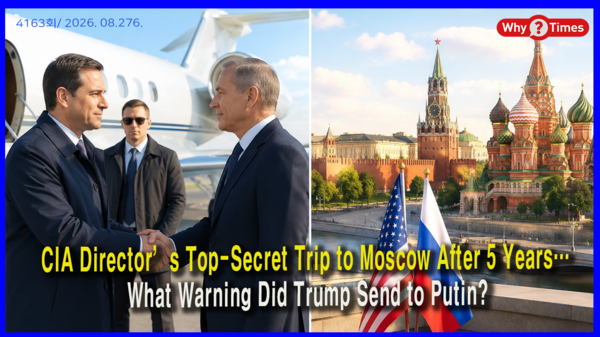
[Flight-Tracking Site Catches CIA Director’s ‘Secret Flight’]
The head of the U.S. intelligence agency suddenly flew to Moscow. John Ratcliffe, Director of the Central Intelligence Agency (CIA), made an unannounced visit to the Russian capital on the 25th (local time). This marks the first visit to Moscow by a CIA director since former Director William Burns visited in November 2021, just prior to Russia’s full-scale invasion of Ukraine. Given that the trip occurred at a sensitive moment—when the U.S. is closely monitoring Russia’s potential for additional military mobilization and moves to test NATO's resolve—observations suggest this holds significance beyond a routine contact between intelligence agencies.
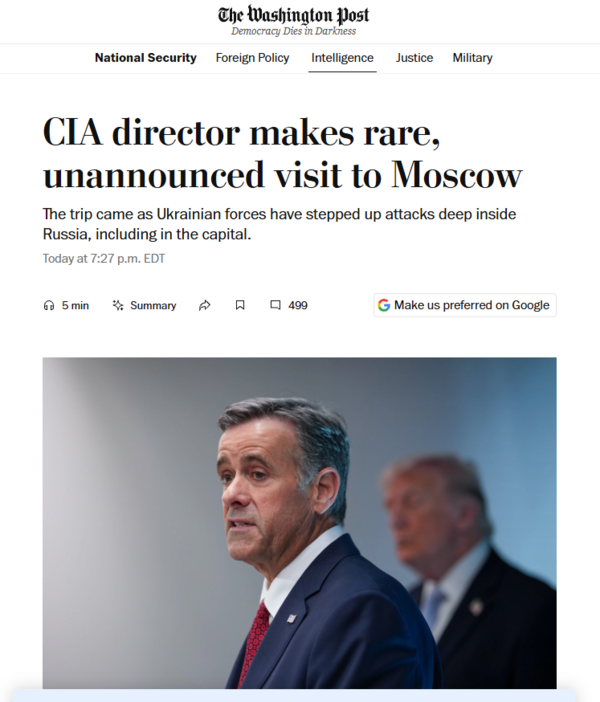
The Washington Post (WP) reported on the 26th that "Ratcliffe’s trip to Moscow became known to the world not through an official U.S. government announcement, but due to aircraft movements." According to public flight tracking records, a U.S. Air Force C-17A Globemaster III transport plane departed Joint Base Andrews near Washington, passed through Riga, Latvia, and landed at Moscow’s Vnukovo Airport on the morning of the 25th. Subsequently, a motorcade bearing U.S. diplomatic plates was spotted moving through central Moscow. WP added that "the C-17 can transport specialized vehicles, electronic equipment, and support personnel during sensitive high-level visits."
Regarding this, Reuters noted that "while exact estimates of Ratcliffe's duration in Moscow varied somewhat among foreign media, it was a short-term visit returning the same day." Reuters pointed out that "the CIA and the White House did not disclose the purpose of the visit, nor did Russia reveal details of the discussions. Above all, various interpretations are emerging regarding the nature of this trip because who he met and what was discussed remain shrouded in mystery."
[A More Significant Scene… U.S. Even Paused Ukrainian Attacks]
A particularly eye-catching detail of this visit is that the U.S. requested in advance that Ukraine refrain from launching attacks on key Russian regions, including Moscow. The Kyiv Independent reported, "The U.S. requested that Ukraine avoid strikes on areas like Moscow while notifying Kyiv of the high-level delegation's visit to Russia," adding that "Ukraine complied, though it was reported that Kyiv was not initially informed that Ratcliffe was part of the delegation."
Reuters also reported that "the U.S. asked Ukraine to restrain airstrikes on major Russian targets during a timeframe overlapping with the high-level official's visit." If Washington went so far as to coordinate Ukraine's long-range strike schedule to accommodate the CIA director’s Moscow trip, it underscores the extreme sensitivity with which the U.S. managed this mission.
[Five Years Ago, Another CIA Director Flew to Moscow]
This visit draws heightened attention due to the precedent set in 2021. According to Reuters, William Burns, then CIA Director, visited Moscow in November 2021 to convey U.S. concerns regarding an invasion of Ukraine to Russian leadership and to warn of the consequences should an invasion occur. Nevertheless, Russia launched its full-scale invasion of Ukraine just a few months later, in February 2022.
Five years later, a CIA director has reappeared in Moscow. Furthermore, this time it is not Burns, a career diplomat, but Ratcliffe—a key Trump confidant who previously served as Director of National Intelligence (DNI). This fuels analysis that U.S. intelligence may have intercepted concerning Russian maneuvers and delivered a direct message to deter them. However, whether this visit was indeed a 'warning mission' remains unconfirmed.
[What WSJ Highlighted as 'Russia's Next Move']
The most critical aspect is highlighted by The Wall Street Journal (WSJ). The WSJ reported that "at the time of Ratcliffe's visit, U.S. intelligence was closely monitoring the potential for a new Russian military mobilization and guarding against Russian moves to test NATO's willingness to respond." Russia has reportedly been auditing the readiness of its nationwide mobilization systems, with related exercises underway even in the strategically sensitive region of Kaliningrad.
Indeed, Ukrainian President Volodymyr Zelensky claimed that Russia intends to draft approximately 300,000 additional personnel following its parliamentary elections in September. While this represents Ukraine's assessment rather than an official announcement of a 300,000-person mobilization by Moscow, the entry of the CIA director into Moscow at a time when fresh mobilization prospects surface amid a prolonged war and heavy casualties cannot be viewed lightly.
Consequently, one can consider the possibility that the message Ratcliffe carried included a U.S. 'red line' warning Russia against further escalating the war in Ukraine or stepping directly into testing NATO. Beth Sanner, former U.S. Deputy Director of National Intelligence, similarly analyzed that "this visit could be intended to deliver a message to Russia essentially saying, 'We know what you are thinking. You had better not do it.'" This remains an analysis by a former intelligence official, and the actual message delivered has not been verified.
[Another Fuse: Iran… Did the U.S. Say 'Do Not Cross the Line'?]
A second key variable is Iran. Reuters observed that "Ratcliffe’s visit to Moscow occurred amid a significant tightening of U.S. economic pressure on Iran," noting that "Russia and Iran have drawn closer militarily and economically since the Ukraine war, and their intelligence and military cooperation regarding recent Middle East conflicts has emerged as a primary concern for the U.S."
Military intelligence sharing is an even more sensitive topic. According to an assessment by Ukrainian intelligence cited by Reuters, allegations surfaced that Russia provided Iran with satellite imagery that could be used to identify U.S. military targets in the Middle East. Russia denies these claims. If such intelligence support expands, it becomes a critical issue for Washington, transforming Russia from a mere diplomatic sponsor of Iran into an intelligence provider directly impacting the safety of U.S. forces.
Therefore, it is worth noting the possibility that Ratcliffe delivered a red line to Russian intelligence: "Even if you support Iran, do not cross into actions targeting the U.S. directly." Particularly as the Trump administration intensifies Iran's economic isolation, military or intelligence support from Russia could undermine America's broader Middle East strategy. However, this too remains an analysis based on available circumstances rather than an established meeting agenda.
[Why Didn't He Meet Putin?]
Another crucial fact warrants attention. The Kyiv Independent noted that "the Kremlin stated on the 26th that Ratcliffe did not meet President Putin." Kremlin spokesman Dmitry Peskov clarified that "there was no meeting between Putin and Ratcliffe, nor was a leader-level meeting scheduled." Therefore, framing this visit as 'Ratcliffe delivering a direct warning to Putin' is an interpretation that runs ahead of verified facts.
Rather, this detail offers a clue to understanding the trip's nature. The WSJ observed that "if the objective were a political deal between leaders, utilizing a special envoy or diplomatic channels would be more natural," adding that "yet the Trump administration dispatched the CIA director to Moscow." The WSJ further noted that "Ratcliffe has a track record of maintaining contact channels with Sergei Naryshkin, Director of Russia's Foreign Intelligence Service (SVR)," highlighting that "it is worth focusing on the operation of intelligence channels designed to coordinate military and intelligence issues—or mutual red lines—that are difficult to negotiate publicly."
[What About North Korea?]
While North Korea cannot be completely ruled out, current foreign media reports offer no direct evidence that Pyongyang was a primary agenda item during this visit. Issues directly tied to this trip so far remain the Ukraine war and Iran. Thus, rather than concluding North Korea was one of the 'top three agendas,' it is more reasonable to treat it as a secondary possibility.
Nevertheless, given that Russian-North Korean military cooperation expanded significantly following North Korean troop deployments to Russia, the direct contact between U.S. and Russian intelligence chiefs remains noteworthy. Should President Trump resume formal dialogue with Kim Jong Un in the future, Putin's influence over Pyongyang and Russia-North Korea military ties could become subjects of private U.S.-Russia consultations.
[Why Times Insight]
The central issue in this event is not merely "who Ratcliffe met," but "why the CIA director went directly to Moscow at this specific time." U.S. intelligence is monitoring potential new Russian military mobilizations and remains alert to Russian moves aimed at testing NATO's resolve. Simultaneously, Ukraine peace negotiations remain stalled, while Russian-Iranian military and intelligence cooperation presents another security burden for the U.S. At this exact junction, Trump dispatched an intelligence chief rather than a diplomat to Moscow.
Furthermore, aligned with Ratcliffe's trip, the U.S. requested that Ukraine hold back on strikes against key Russian territories. And as the Kremlin confirmed, Ratcliffe did not meet Putin. This suggests the visit functioned primarily as a 'backchannel' between intelligence agencies to coordinate matters unsuitable for public discussion, rather than a platform for political deal-making between leaders.
Based on publicly available circumstances, it is more persuasive to interpret this trip as an effort to deliver U.S. warnings and red lines regarding future Russian actions—and to manage confidential intelligence channels covering Ukraine and Iran simultaneously—rather than a mission to finalize a 'grand bargain.' However, because neither the CIA nor the Kremlin disclosed the meeting agenda, the notion of a 'warning' also remains within the realm of analysis.
Five years ago, Burns flew to Moscow to warn Russian leadership of the dangers of invading Ukraine. Yet Russia launched the war anyway. Five years later, a CIA director has again appeared in Moscow.
What 'next step' by Russia is the U.S. attempting to block this time? That is the real focal point surrounding Ratcliffe’s top-secret flight to Moscow.


-중국 푸단대학교 한국연구원 객좌교수
-전 EDUIN News 대표
-전 OUR NEWS 대표
-제17대 대통령직인수위원회 정책기획팀장
-전 대통령실 홍보기획비서관
-사단법인 한국가정상담연구소 이사장
-저서: 북한급변사태와 한반도통일, 2012 다시우파다, 선거마케팅, 한국의 정치광고, 국회의원 선거매뉴얼 등 50여권