
Update2026.10.24 (토)

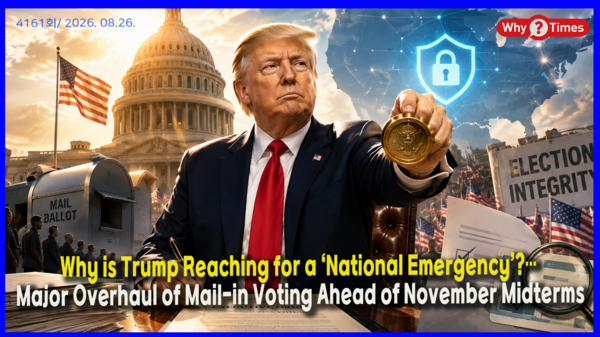
[6–3 Supreme Court Decision… Green Light Temporarily Lit for Trump’s Election Reform]
With the possibility raised that U.S. President Donald Trump might deploy the ultra-strong card of a ‘national emergency’ just two months ahead of the November midterm elections, the U.S. political scene is in turmoil. On the surface, this is a power dispute over how far a president can intervene in the electoral system; however, the question Trump has posed is far more fundamental: Is it acceptable to conduct the midterms under the current system of mail-in voting and voter eligibility verification?
In fact, Executive Order 14399, signed by Trump in March, centers on utilizing federal databases to verify citizenship and voting eligibility for federal elections, as well as tightening the delivery and management of mail-in ballots. The Supreme Court also cleared the path for Trump on the 24th by issuing a 6–3 decision that lifted lower court injunctions blocking certain executive actions. Nevertheless, talk of a ‘national emergency’ has not vanished from the Trump camp. Why on earth is Trump going this far?
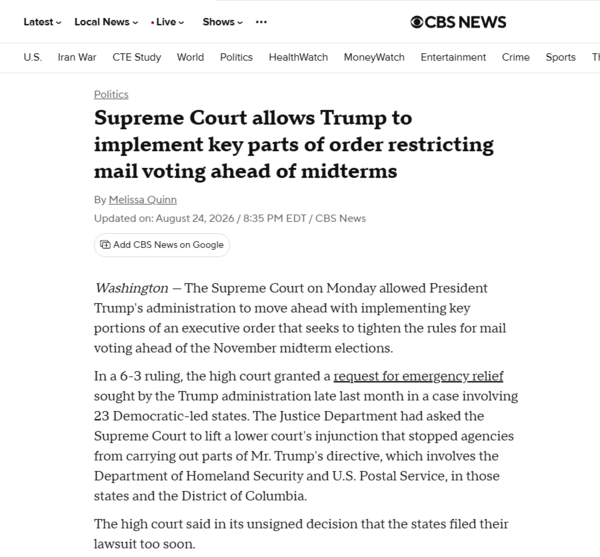
On the 24th, CBS News reported that “the Supreme Court granted the Trump administration's emergency application in a 6–3 ruling, lifting the injunction issued in June by U.S. District Judge Indira Talwani of the District of Massachusetts” and added that “this opens the way for the Department of Homeland Security (DHS) to pursue initiatives such as compiling state-by-state voter eligibility lists using federal databases”. The White House hailed this as a “major victory for the security of American elections,” emphasizing its stance that “it must be American citizens who elect Americans.”
[Trump’s Target Is ‘Before the Vote,’ Not ‘After the Vote’]
What, then, is Trump trying to change? CBS News pointed out that “the core issue is shifting from post-election detection to pre-election verification”. The network noted that “Trump’s March 31 executive order places the principle that only U.S. citizens have the right to vote in federal elections front and center, while mandating stronger verification of identity, citizenship, and voting eligibility by tapping into Social Security Administration (SSA) data and DHS’s SAVE system”. While non-citizen voting in federal elections is already illegal under federal law, Trump believes that state voter rolls and federal citizenship records must be linked far more aggressively.
CBS News further noted, “This also includes tighter management of mail-in voting via the United States Postal Service (USPS)”. “The final USPS rule contains measures requiring standardized envelope designs and barcode specifications for federal mail-in ballots, as well as mandating that state election authorities submit data on mail-in voters to an online system”. However, “USPS explicitly clarified that it would not act as an agency that determines voter eligibility, manages voter rolls, or counts ballots”. In short, “Trump’s blueprint can be understood as aiming to increase traceability and verification capabilities right from the movement of the ballot, rather than attempting to track down problematic votes after the election ends”.
[Is Mail-In Voting Actually Dangerous?]
Here, two distinct issues need to be separated. Although Trump has continually raised allegations of non-citizen voting and mail-in ballot fraud, it is difficult to conclude based strictly on publicly available data that widespread non-citizen voting or mail-in fraud sufficient to overturn U.S. election results has been confirmed. That said, it does not mean election fraud never occurred; rather, it is more accurate to say it has never been comprehensively audited or verified.
Nor does this mean mail-in voting systems are devoid of risk factors. A risk assessment by the Cybersecurity and Infrastructure Security Agency (CISA) also analyzes that “because voters are not physically present in a mail-in voting environment, resolving issues if voter registration data is altered or deleted can be more difficult than in in-person voting.” CISA specifically highlighted that “attacks targeting the integrity of registration data can create relatively higher risks in a mail-in voting setting.” Ultimately, the debate hinges on two different questions: “Has large-scale fraud already occurred?” versus “To what extent should structural vulnerabilities to fraud or errors be blocked in advance?” Trump’s focus aligns with the latter.
[Why a ‘National Emergency’ Despite Winning at the Supreme Court?]
Why, then, is Trump contemplating a declaration of a national emergency even after winning at the Supreme Court? This is the crux of the current standoff. In a recent interview, President Trump did not rule out the possibility of declaring a national emergency over election integrity. Steve Bannon, a longtime strategist, also publicly raised the possibility on his show on the 29th of last month that a national emergency might be declared in late August. Naturally, Bannon’s comments do not constitute an official government announcement, nor has Trump officially declared such an intention. At this stage, it is most accurate to say he is ‘leaving the door open’ rather than ‘imminently declaring it.’
Addressing this backdrop, CBS News observed, “Time is the driving factor: even with the November 3 midterm elections right around the corner, legal battles—from executive orders and lower-court injunctions to appeals, Supreme Court emergency petitions, USPS rulemaking, and subsequent lawsuits—continue to drag on”. “From the administration's perspective, if normal judicial proceedings continue, there is a growing likelihood that they will be unable to actually operationalize their proposed election security framework before the November election”. Consequently, the national emergency option can be interpreted as a final gambit considered in a situation where the legal and administrative clocks are ticking slower than the midterm election clock.
[Clash in Court Just One Day After Supreme Court Decision… Time Grows Even Mighter]
In reality, the Supreme Court decision did not eliminate all obstacles. On the 25th, Judge Talwani ruled that “the USPS finalizing its mail-in ballot rule violated her pre-existing nationwide injunction”. However, she stopped short of issuing a fresh ban on the rule itself. Legal skirmishes surrounding injunctions in separate lawsuits persist, leaving it uncertain to what extent USPS policies can be implemented for the November midterms.
This matters because American elections do not suddenly begin on November 3. The AP pointed out, “In several states, mail-in ballots for military and overseas voters will begin dispatching shortly”. “For election officials, modifying envelope designs, data systems, voter guidance, and staff training becomes increasingly difficult as time elapses”. Ultimately, for the Trump administration, ‘when’ a decision is reached has become just as critical as ‘who’ wins legally.
[Can a National Emergency Declaration Overhaul the Election System at Will?]
Would declaring a national emergency grant the president unilateral authority to alter the election system? No. The National Emergencies Act of 1976 is not a blank check that creates unprecedented powers simply because a president declares an emergency. The president must invoke specific statutory emergency powers already granted by Congress in existing laws. While the Brennan Center tallies 137 statutory emergency powers, the declaration itself does not allow a president to cancel elections, re-run them, or arbitrarily alter outcomes.
Crucially, Article I, Section 4 of the U.S. Constitution assigns the primary authority to prescribe the time, place, and manner of holding congressional elections to the states, while empowering Congress to alter such regulations by law. The presidency is not granted this power. Therefore, if Trump actually declares a national emergency to expand federal election security powers, it would immediately spark an unprecedented constitutional lawsuit over “how far presidential emergency powers can reach into election administration.”
[Escalating into a Debate That Shakes the Entire U.S. Electoral System]
Should a national emergency actually be declared, the fallout will extend far beyond these midterms. Historically, U.S. election administration has been a decentralized structure centered on state and local governments, with the federal government playing a defined legal baseline and support role. However, if the citizenship data integration and nationwide USPS mail-in voting standards pursued by Trump take root, federal involvement in voter eligibility verification and mail-in ballot oversight could expand significantly.
The Trump side frames this as a reform that rectifies inconsistent state-level security standards and enforces the principle that ‘only U.S. citizens elect U.S. leaders.’ Conversely, Democratic state governments and civil rights groups contend that the federal executive branch is encroaching on election administration domains not constitutionally granted to the president. The essence of this confrontation is not merely a ‘Trump vs. Democrats’ fight; it is expanding into a fundamental question about the U.S. electoral system itself: Who should verify election integrity, and through what mechanism?
[Why Times Insight]
To understand Trump’s national emergency card, one must refrain from choosing strictly between the narrative that he is ‘trying to seize control of the election’ and the narrative that he is ‘trying to prevent voter fraud.’ The core issue is that Trump is raising fundamental doubts about whether the U.S. voting system—particularly mail-in voting and voter qualification checks—is sufficiently secure, and is attempting to overhaul it at the federal level before the November midterms.
The direction pursued by Trump moves away from post-election fraud investigations toward a ‘pre-verification system’. This approach aims to cross-check voter rolls with federal citizenship data and enhance the end-to-end traceability of mail-in ballots to minimize vulnerabilities prior to voting.
The main bottleneck is that time has virtually run out. Although the Supreme Court opened a path for the executive branch on the 24th, key legal battles endure, underscored by another court clash over USPS rules on the 25th. If normal judicial proceedings continue, it will become increasingly difficult for Trump to fully deploy his intended election security apparatus prior to the midterms. This reality is the most practical driver behind the national emergency option.
Yet an emergency declaration is no silver bullet. If issued, the U.S. will immediately plunge into a massive constitutional clash: Is this a legitimate presidential emergency action to strengthen election integrity, or an unconstitutional infringement on powers assigned to the states and Congress?
What truly demands attention here is not merely whether Trump will ultimately declare a state of emergency. It is the fact that, triggered by the 2026 midterms, the United States has begun rewriting the fundamental rules of its electoral system around a defining question: Who verifies voter eligibility, and who ultimately guarantees the integrity of the election?

-중국 푸단대학교 한국연구원 객좌교수
-전 EDUIN News 대표
-전 OUR NEWS 대표
-제17대 대통령직인수위원회 정책기획팀장
-전 대통령실 홍보기획비서관
-사단법인 한국가정상담연구소 이사장
-저서: 북한급변사태와 한반도통일, 2012 다시우파다, 선거마케팅, 한국의 정치광고, 국회의원 선거매뉴얼 등 50여권