
Update2026.10.24 (토)

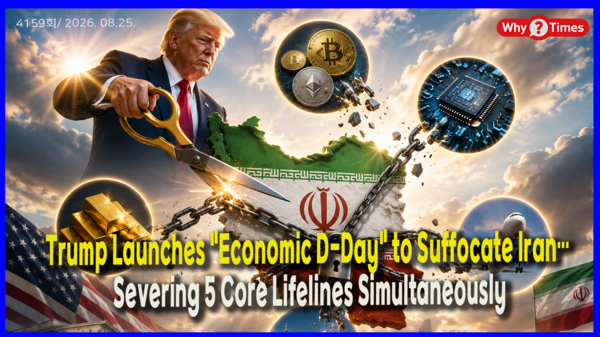
[Bessent Declares "Economic D-Day"… Cutting Off Iran's Sanctions Evasion Networks]
The United States has launched an "Economic D-Day" to effectively expel Iran from the global economic system. The U.S. Department of the Treasury designated digital assets, technology, gold, commercial aviation, and shipping as the five core lifelines sustaining the Iranian regime, declaring its intent to pressure third-country companies and financial institutions assisting Iran in these sectors through secondary sanctions. Addressing China—Iran's largest crude oil buyer—Treasury Secretary Scott Bessent issued a warning, stating that "no one is above the reach of U.S. sanctions." While Iran countered by claiming it is "prepared to endure for two years," its currency has already plummeted to a record low.
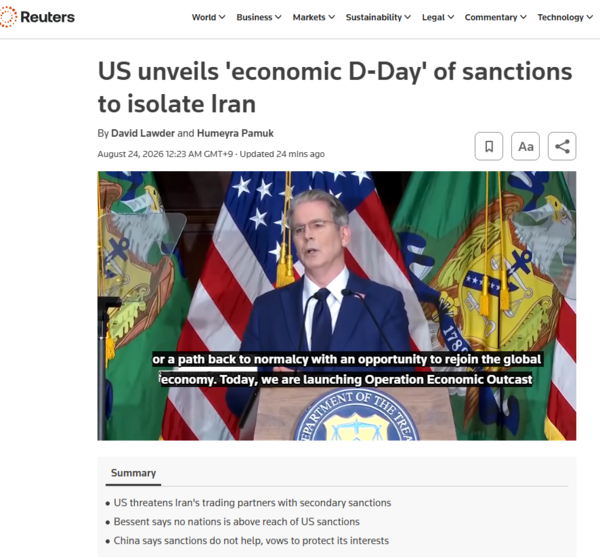
Reuters reported that Secretary Bessent officially announced a new economic campaign targeting Iran titled 'Operation Economic Outcast.' Reuters noted that the U.S. newly sanctioned approximately 60 individuals, companies, and vessels that supported Iran's nuclear and missile procurement, cyber activities, and crude oil exports. However, the true significance of this measure does not lie merely in expanding the sanctions list; rather, Washington is implementing a strategy to dismantle the bypass channels through which Iran connects with the outside world to generate revenue and import goods.
Reuters continued that this is precisely why Bessent referred to it as 'Economic D-Day.' The launch does not mark the conclusion of sanctions, but rather the starting line of a new economic campaign. The U.S. plan is to grant third-country firms and financial institutions trading with Iran a wind-down period to conclude their transactions, after which secondary sanctions will be expanded against those that fail to comply. Consequently, this date represents the activation of an economic time bomb rather than the immediate collapse of the Iranian economy.
[Simultaneous Strike on "5 Core Lifelines": Digital Assets, Technology, Gold, Aviation, and Shipping]
Regarding these developments, the Financial Times (FT) pointed out that the sectors newly targeted by the U.S. are digital assets, technology, gold, commercial aviation, and shipping, describing them as the primary bypass channels that allowed Iran to withstand prolonged sanctions. According to the FT, cryptocurrencies serve as a means of moving funds outside the U.S. dollar network, while gold functions as an alternative settlement method and store of value. Technology is essential for maintaining Iran's nuclear, missile, and industrial capabilities, while aviation and shipping form the crucial transport network for moving personnel, goods, and crude oil.
Ultimately, the U.S. is targeting the means by which Iran earns, stores, acquires, and transports resources all at once. The impact is particularly potent because non-Iranian foreign companies and financial institutions facilitating these transactions also face exclusion from the U.S. financial system.
["Choose Between Iran and the U.S."… Secondary Sanctions as the Primary Weapon]
The most potent mechanism in this campaign is secondary sanctions. Reuters noted that foreign entities that do not trade directly with the U.S. may still face restricted access to the U.S. financial system if they engage with sanctioned Iranian sectors. For businesses dependent on the U.S. dollar and American financial architecture in international trade, this effectively demands a choice between Iran and the United States.
Of course, the U.S. did not immediately apply sanctions to every global trading partner of Iran. Instead, the strategy provides a grace period to wind down transactions, followed by phased enforcement against non-compliant entities. Bessent did not publicly disclose specific targeted nations or exact deadlines. However, for businesses unable to forgo the U.S. market and dollar-denominated clearing services, the warning alone forces an immediate reassessment of their commercial ties with Iran.
[The Primary Battleground is China… Bessent: "No One is Exempt"]
China represents the critical variable in this operation. As Iran's largest buyer of crude oil, Beijing has served as the regime's primary economic lifeline, supplying foreign currency despite U.S. sanctions. Even if Washington successfully severs other nations and firms from Iran, achieving complete economic isolation remains difficult as long as China continues purchasing Iranian crude oil. The success or failure of this economic warfare ultimately hinges on how effectively Washington can pressure Beijing.
When asked about potential sanctions on Chinese financial institutions, Bessent signaled that "no one is above the reach of U.S. sanctions." Nevertheless, Washington has refrained from directly sanctioning major Chinese state-owned banks. Severing mega-banks in China from the dollar clearing system could trigger severe instability in global financial markets, and a visit to the U.S. by Chinese President Xi Jinping remains on the schedule. Consequently, Washington appears to be presenting Beijing with a choice rather than immediately deploying its most extreme measures.
[Iran Claims "We Can Endure 2 Years"… But Strategy and Stamina are Different Matters]
Following the U.S. announcement, Iran adopted a defiant stance. Economy Minister Ali Madanizadeh claimed that "the U.S. sanctions were anticipated" and asserted that "the government possesses a two-year contingency plan and is fully prepared."
However, possessing a two-year plan is entirely different from having the economic stamina to survive it. The Iranian rial has already plunged to an all-time low, while crude oil exports and foreign currency inflows face immense pressure. Above all, Iran's historical resilience against sanctions relied heavily on remaining bypass avenues, such as Chinese buyers, third-country banking links, shadow fleets, and front companies. Washington's latest measures directly target those precise networks.
Therefore, the assumption that "Iran survived past sanctions and will survive again" is no longer guaranteed. Whether Iran's "two-year endurance" materializes in practice depends on whether Chinese buyers and third-country financial institutions can maintain commercial dealings with Tehran under mounting U.S. pressure.
[Military Options Behind Economic Warfare… U.S. Pressure Persists]
In announcing Operation Economic Outcast, the U.S. has not removed military options from the table. U.S. Secretary of Defense Pete Hegseth stated that "the U.S. does not rule out the further use of military force against Iran." This indicates that economic sanctions are not a substitute for military action, but rather a parallel front intended to alter Tehran's strategic calculations prior to any potential kinetic operations.
Reuters noted that the Trump administration's strategy is straightforward: first, restrict Iran's economic capabilities; second, compel third countries to choose between Iran and the U.S.; and finally, maintain the military option if Tehran refuses to back down. Simultaneously, diplomatic channels for mediation through countries like Oman and Pakistan remain open. In short, Washington is pressing Iran by synchronously applying economic force, military posture, and diplomatic options.
[Why Times Insight]
The core significance of Operation Economic Outcast lies not in the mere addition of another sanctions designation against Iran, but in Washington's systemic effort to dismantle the very bypass channels that allowed Tehran to withstand sanctions for decades.
China remains the primary battleground. Regardless of Tehran's assertions regarding a "two-year endurance plan," the situation alters dramatically if China—its primary avenue for oil sales and revenue collection—begins to retreat. Thus, Bessent's statement that "no one is exempt" serves as a direct message to Beijing.
While Washington has not yet directly targeted major Chinese state-owned banks, the commencement of the countdown for "Economic D-Day" is clear.
Ultimately, the decisive factor is not the scale of Tehran's rhetoric regarding a "two-year endurance plan," but how long Iran's remaining economic partners—most notably China—can withstand U.S. sanctions pressure while maintaining commercial ties with Tehran. That dynamic will determine both the ultimate outcome of Operation Economic Outcast and the strategic trajectory of Iran.

-중국 푸단대학교 한국연구원 객좌교수
-전 EDUIN News 대표
-전 OUR NEWS 대표
-제17대 대통령직인수위원회 정책기획팀장
-전 대통령실 홍보기획비서관
-사단법인 한국가정상담연구소 이사장
-저서: 북한급변사태와 한반도통일, 2012 다시우파다, 선거마케팅, 한국의 정치광고, 국회의원 선거매뉴얼 등 50여권