
Update2026.10.24 (토)

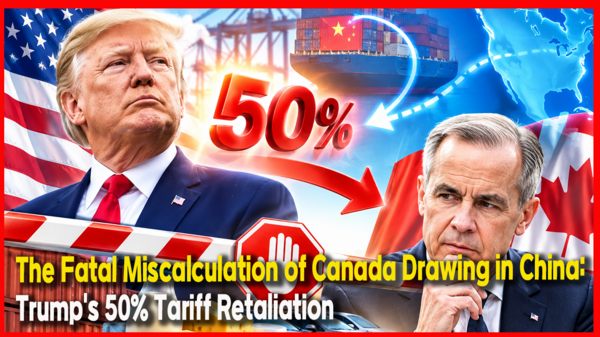
[50% Tariff Bomb Dropped on Canada: Looking at This Alone Misses the Essence]
The United States dropped a massive 50% tariff bomb on Canada. On the surface, the driver is a long-standing trade dispute involving dairy, alcohol, and automobiles. However, connecting recent actions out of Washington reveals that this clash is far more complex than a standard tariff feud. The Trump administration is strengthening direct tariff barriers against China while simultaneously shutting down third-country transshipment routes through nations like Canada and Mexico.
The negotiations broke down right after the White House classified Canada as a Tier 1 high-risk country for illegal transshipments of Chinese-linked goods. During the talks, the U.S. went so far as to demand limits on Canada’s third-country trade policies. The core issue extends far beyond dairy. It marks a direct clash between America's ambition to build a "China-Free North American Economic Zone" and Canada’s strategy to diversify its economic ties, including with Beijing.
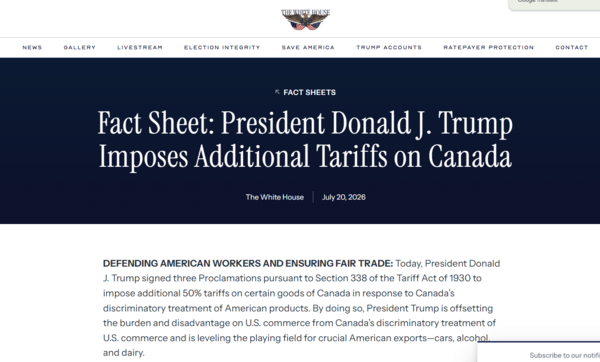
The White House announced that 50% tariffs were triggered on roughly $20 billion worth of Canadian goods, representing roughly 5% of Canada’s annual exports to the U.S. Key affected items include alcohol, select dairy products, cement, apparel, and hockey equipment. The official justification cites Canadian discrimination against U.S. alcohol, auto export tariff-rate quotas, and unfair treatment of American dairy farmers. Yet, the expanding U.S. demands indicate that Washington is far more focused on Canada’s future economic posture toward third countries like China.
[“Chinese Goods via Canada” Emerges in White House Report]
A critical document illustrating this mindset is "The Great Transshipment Scam" report released by the White House Office of Trade and Manufacturing Policy.
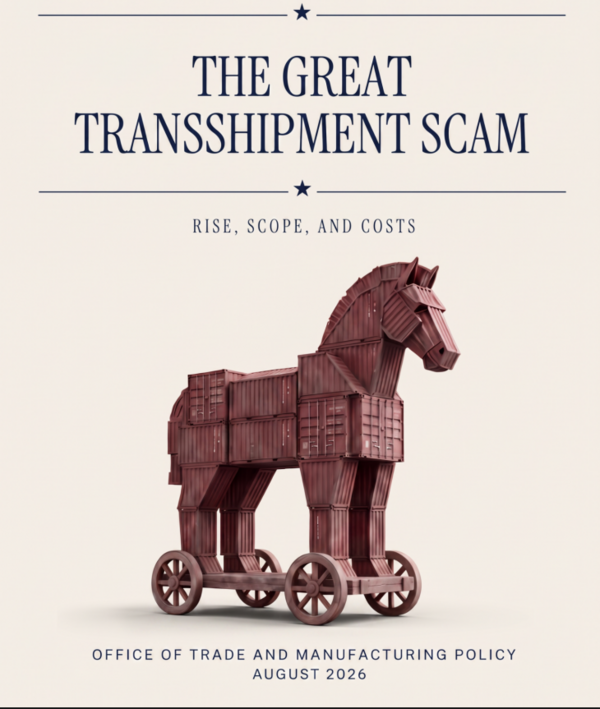
The report states that as high U.S. tariffs hit China, Chinese exporters increasingly route products through third countries to perform simple assembly, repackaging, relabeling, or re-invoicing to falsify origin labels.
The report offers a concrete scenario: shipping $1 billion of Chinese goods directly to the U.S. incurs steep Chinese tariffs, but routing them through Canada or Mexico while illicitly claiming rules-of-origin benefits under the USMCA can drive the tariff rate down toward zero. This scenario highlights what Washington views as a critical vulnerability in the North American "backdoor."
[Canada Classified as Tier 1: "China's Biggest Enablers"]
The White House report categorized over 40 countries and economies into three risk tiers for illegal transshipment. Canada was placed in Tier 1 ("Diversified Scale Leaders")—a priority monitoring group—alongside the EU, India, Israel, Japan, Mexico, South Korea, and Taiwan.
While this label does not imply all Canadian exports are laundered Chinese products, it reflects Washington’s high state of alert regarding legitimate trade flows masking illicit transshipments. Placing its closest ally and USMCA partner on a high-risk list carries significant political weight.
[Carney Reveals Final U.S. Demand: "Restricting Agreements with Third Countries"]
The breakdown of the U.S.-Canada talks hinges on additional last-minute demands. Canadian Prime Minister Mark Carney noted that the U.S. introduced new conditions toward the end of negotiations, including measures that would limit Canada’s ability to independently enter into trade agreements with other nations.
Washington shifted the agenda from Canadian dairy imports to Canada's broader authority to build trade relationships with third countries. Viewed alongside U.S. supply chain decoupling efforts and the White House transshipment report, addressing China remains a central backdrop to these demands.
[Greer’s Unprecedented Remarks: "The Countries That Retaliated Are China and Canada"]
U.S. Trade Representative Jamieson Greer signaled Washington's frustration during testimony before the Senate Finance Committee, criticizing Canada as one of the only nations alongside China to retaliate against Trump's trade policies. Greer argued that despite receiving favorable tariff treatment under "America First Trade Policy," Canada showed little willingness to resolve U.S. market access concerns.
While equating Canada and China outright may go too far, a top U.S. trade official publicly pairing an ally with Beijing underlines the intensity of the friction.
[Canada Opens Door to Chinese EVs: Creating a Structural Concern for Washington]
Compounding the tension is the EV arrangement Canada signed with China. Under Prime Minister Carney, Ottawa agreed to import up to 49,000 Chinese electric vehicles annually at a reduced 6.1% tariff—a major retreat from the 100% surtax previously imposed under Prime Minister Trudeau. In exchange, China lowered tariffs on Canadian canola seed from 84% down to approximately 15%.
The structural shift matters more than the volume of 49,000 vehicles. As the U.S. seeks to decouple North American auto and battery supply chains from China, Canada moved in the opposite direction. For Chinese firms facing U.S. market barriers, connecting with Canadian automotive and battery industries offers a clear incentive. Consequently, Washington views Canada not just as a neighbor, but as a potential gateway for Chinese capital and supply chains into North America.
[Is America’s Goal a 'China-Free North American Economic Zone'?]
The Trump administration’s strategy goes beyond getting Canada to buy more American dairy and alcohol. It aims to revitalize domestic manufacturing while preventing redirected Chinese production from entering the U.S. market through Mexico or Canada.
USTR Greer noted that U.S. trade policy for decades incentivized shifting production to China, Mexico, Vietnam, and "in some cases, Canada," asserting that this dynamic will no longer be permitted. This stance points to an effort to align the entire North American economic zone with U.S. economic security goals regarding China.
[The Core Friction: Canada Moving in the Opposite Direction]
The main point of contention is that Canada’s strategy runs counter to Washington’s. The Carney government aims to reduce reliance on the U.S. and expand economic ties with other nations—including China—to preserve strategic autonomy. Prime Minister Carney reiterated in his statement following the collapsed talks that Canada intends to diversify its international partnerships while protecting its sovereignty.
These divergent priorities create an inescapable structural clash. The U.S. seeks to isolate North American supply chains from China, whereas Canada seeks to broaden third-country ties to lessen its U.S. dependency. From Washington's vantage point, Canadian economic autonomy creates access points for China into the North American market; from Ottawa's perspective, U.S. demands represent an infringement on trade sovereignty.
[Why Times Insight]
Treating the U.S.-Canada tariff fight as a simple trade dispute over dairy and alcohol presents an incomplete picture. The White House has framed third-country transshipments as a national economic security priority, explicitly placing Canada in its Tier 1 risk category.
By demanding conditions on Canada’s third-country trade policies and publicly grouping Canada with China regarding retaliatory measures, Washington is signaling a strategic shift. The broader trade conflict is moving from direct bilateral tariffs with China into a second phase: monitoring and controlling the transit routes of Chinese goods and capital into the American market.
The U.S. is pushing toward a North American economic sphere isolated from Chinese supply chains. If Canada pursues deeper integration with Chinese capital and manufacturing, Washington will view Ottawa as a major weakness in its containment strategy.
This 50% tariff penalty represents both an immediate trade dispute and the opening stage of an economic security conflict over North American trade access. As Canada’s retaliatory tariffs take effect on September 8, subsequent developments will likely center on how closely Ottawa can align economically with Beijing without triggering further U.S. actions.
-중국 푸단대학교 한국연구원 객좌교수
-전 EDUIN News 대표
-전 OUR NEWS 대표
-제17대 대통령직인수위원회 정책기획팀장
-전 대통령실 홍보기획비서관
-사단법인 한국가정상담연구소 이사장
-저서: 북한급변사태와 한반도통일, 2012 다시우파다, 선거마케팅, 한국의 정치광고, 국회의원 선거매뉴얼 등 50여권