
Update2026.10.24 (토)

[Russian Citizens Begin Withdrawing Money from Banks]
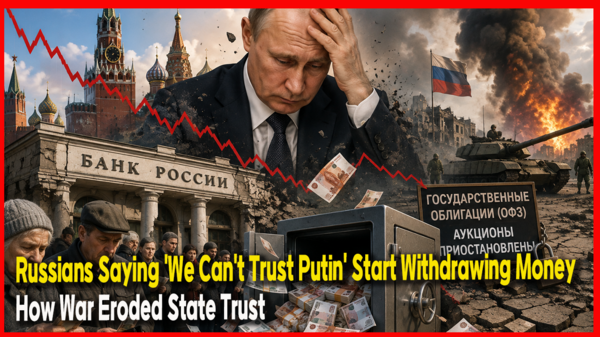
An unusual movement of capital has begun in Russia. In August alone, approximately $3.4 billion was withdrawn from Russian banks in just two weeks, following roughly $11.8 billion withdrawn across June and July. Furthermore, auctions for OFZ sovereign bonds—the primary instrument used by the Russian government to cover its fiscal deficit—have been suspended indefinitely since last month. Warning sirens are growing louder that the Putin regime, having drained state funds for the war, is now eroding Russian citizens' fundamental trust in the state.
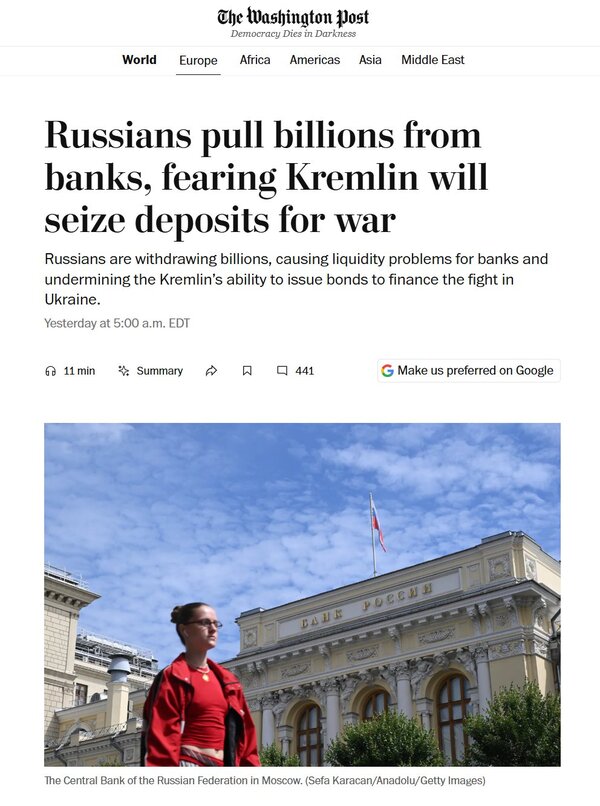
The Washington Post reported on the 19th that "around $3.4 billion flowed out of Russian banks during the first two weeks of August," adding that "with an estimated $11.8 billion withdrawn across June and July, more than $15 billion moved out of the banking system in less than three months." The outlet noted that "given that the Russian banking sector is already bearing significant burdens from government-directed loans to the defense industry and rising corporate defaults since the war, this is not a movement that can be taken lightly."
Even more noteworthy is that Russians are not simply transferring funds from Bank A to Bank B; there is a growing trend of people choosing to hold physical cash. Based on an analysis of Russian Central Bank data, the BBC reported that "Russia's currency in circulation increased by 1.56 trillion rubles (approximately $20 billion) this year," marking "the largest increase for the same period outside of the exceptional COVID-19 pandemic era."
The BBC added, "Of course, this cannot be attributed entirely to 'distrust in Putin.' One direct driver appears to be Ukrainian drone attacks; Russian authorities repeatedly disable mobile internet across broad regions to block drone communications, which seems to be a major factor."
The issue is that when internet access is cut, card and QR code payments frequently fail. The Putin government's defensive measures against war are paradoxically pushing Russian citizens back into a cash economy.
However, this alone does not fully account for the recent preference for cash. A Moscow resident interviewed by the BBC noted feeling a sense of control and safety when holding cash. The BBC observed that "with tax burdens rising, companies increasingly prefer cash transactions, leading to an expansion of the informal economy. Ultimately, the prolonged war is reshaping the everyday financial behavior of Russian citizens."
[The Fear That "The State Could Touch My Money"]
Compounding this cash preference is a far more dangerous anxiety: the potential mobilization of private assets by the state. Debates have been intensifying in Russia over how to finance the war. Russian economic expert Alexandra Prokopenko pointed out that "as the Russian government failed to find clear methods to finance the war last month, it began attempting to raise funds beyond existing budgetary frameworks, a burden that may ultimately fall on private companies and citizens."
Reports covering the surge in bank withdrawals also highlighted widespread social concern in Russia that the government might tap personal assets to fund the war effort. If fears spread that prolonged conflict will lead the government to mobilize civilian assets in one way or another, citizens are increasingly likely to view holding physical cash as safer than numbers in a bank account.
This is precisely where the political significance of the phenomenon lies. The BBC noted, "While Russian citizens are not taking to the streets shouting for Putin's resignation, the anxiety among a segment of the population is manifesting as economic action—withdrawing money from banks to hold it themselves."
[Citizens Withdraw Deposits While Investors Turn Away from Russian Sovereign Debt]
What makes the situation more critical is that just as citizens are withdrawing cash, the government's other primary funding channel—the sovereign bond market—is unraveling simultaneously.
Russian news agency Interfax reported, "Following the cancellation of OFZ auctions on June 24 and July 8, the Russian Ministry of Finance announced on July 20 that it was suspending bond auctions altogether." The stated rationale was "stabilizing market conditions," though no resumption date was provided. A prolonged halt to government bond issuances is highly unusual, not seen since the immediate financial shocks following the full-scale invasion of Ukraine in 2022.
The severity is underscored by issuance performance. Interfax noted, "The Ministry of Finance planned to raise approximately 1.5 trillion rubles through OFZs in the third quarter. However, out of three scheduled issuance dates in July, bonds were sold only once on July 1, totaling a mere 9.1 billion rubles. Even with floating-rate bonds offered, the government failed to secure bids at acceptable prices."
This poses a grave problem for the Putin administration. Interfax explained, "Severely restricted from overseas capital markets due to Western financial sanctions, Russia has relied on domestic banks and institutional investors to absorb sovereign debt and cover fiscal deficits. Now, capital is moving outside the banking sector on the citizen side, while investors in the bond market refuse to accept government debt on the regime's preferred terms." The two domestic financial pillars sustaining Putin’s war economy are coming under pressure at the same time.
[Money Poured into War... Ballooning Fiscal Deficits]
The core dilemma is that the Russian government needs capital now more than ever. Interfax reported that "Russia's fiscal deficit in the first half of the year reached 5.7 trillion rubles, accounting for roughly 2.5% of GDP," noting that "as the government injects massive funds to sustain the Ukrainian war effort and the defense industry, fiscal burdens are expanding faster than initially projected." The suspension of OFZ auctions occurred directly against the backdrop of this widening deficit.
Adding to the Putin administration's predicament is the inability to simply print money at will. War-related state spending, labor shortages, and rising production costs are driving inflation. Lowering interest rates risks destabilizing inflation and the ruble further; conversely, maintaining high interest rates over extended periods increases corporate financing costs and default risks.
Ultimately, the Russian economy is caught in a structural trap: continuing the war requires spending more money, but additional spending destabilizes prices and public finances. Yet tightening money supplies to mitigate these risks severely strains businesses and banks.
Warning signs are emerging even from within Russia's economic establishment. Andrei Klepach, former chief economist at state development bank VEB, recently stepped down after warning of a broader socio-economic crisis and stating that "it will be difficult for Russia to succeed in a long-term economic war." Critical diagnoses of the war economy are proving to be a substantial burden for the Kremlin.
[Why Times Insight: Has a 'Quiet No-Confidence Motion' Begun Among Russian Citizens?]
This development should not be viewed merely as "Russia running out of money," nor does it imply an imminent sovereign default. Energy revenues persist, and the government retains assets and financial levers to deploy. Furthermore, tangible drivers behind the cash demand surge—such as mobile internet blackouts and tax-evading cash transactions—clearly exist. Categorizing the situation as a full-scale 'bank run' remains premature.
Nevertheless, the shift carries profound significance because war costs have begun altering the everyday financial behavior of the Russian public. The market turmoil immediately following the 2022 invasion was primarily driven by external fear—the shock of unprecedented Western sanctions. Today, as the war drags on, internally generated structural pressures are seeping directly into daily life.
When Ukrainian drones approach, the government cuts the internet. With internet disabled, card payments fail. Citizens respond by withdrawing cash. As war costs escalate, the fiscal deficit widens. The government attempts to issue sovereign debt, but the market demands higher premiums.
Seemingly disparate developments converge on a single point of origin: the war. This presents the most dangerous challenge for Putin. Russian citizens may not be openly defying Putin in the streets, but while political support is measured by polls, trust in the state is revealed most dispassionately by the movement of money.
When a growing number of people conclude that holding cash is safer than trusting a bank, and investors refuse government debt on the regime's terms, what is draining from society is more than just liquidity—it is trust in the state itself.
Putin has pursued a war intended to subjugate Ukraine for over four years. However, the costs are no longer paid exclusively on the battlefield. Through fiscal deficits, elevated interest rates, inflationary pressures, and corporate financial burdens, the bill has arrived directly in the wallets of Russian citizens.
In this context, the emerging preference for cash and deposit flight serve as a significant warning to Putin. Rather than casting a public vote against him, Russian citizens may be initiating a 'quiet no-confidence motion' by moving their wealth outside the state financial system.
History will judge how much territory Putin secures in Ukraine. Yet the price Russia is paying today is increasingly clear: Putin spent state reserves to sustain a war, and now that war has begun consuming his people's trust in the state.
The moment Putin fears most may arrive long before citizens take to the streets. It is the moment citizens decide, "The cash in my hand is safer than the bank."


-중국 푸단대학교 한국연구원 객좌교수
-전 EDUIN News 대표
-전 OUR NEWS 대표
-제17대 대통령직인수위원회 정책기획팀장
-전 대통령실 홍보기획비서관
-사단법인 한국가정상담연구소 이사장
-저서: 북한급변사태와 한반도통일, 2012 다시우파다, 선거마케팅, 한국의 정치광고, 국회의원 선거매뉴얼 등 50여권