
Update2026.10.24 (토)

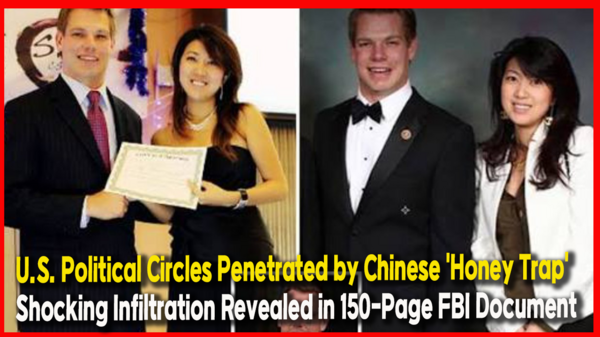
[How a Suspected Chinese-Linked Agent Gained Access to the Heart of U.S. Politics]
A shocking set of FBI documents has been declassified, exposing just how vulnerable American politics can be to Chinese influence operations. The records—released by the Trump White House on August 17—detail an FBI investigation into Christine Fang (Fang Fang), a Chinese national suspected of ties to Chinese intelligence services. The documents outline her extensive access to California political circles through political fundraising and network building. The fallout has intensified following disclosures that former Democratic Representative Eric Swalwell admitted to FBI agents during interviews that he had physical relations with Fang on multiple occasions.
However, the core issue is not the private lives of these two individuals. If an individual suspected of links to a foreign intelligence service approached a promising American politician to build personal relationships and secure political influence, this must be viewed as a major counterintelligence incident—a direct attack on the American democratic system itself.
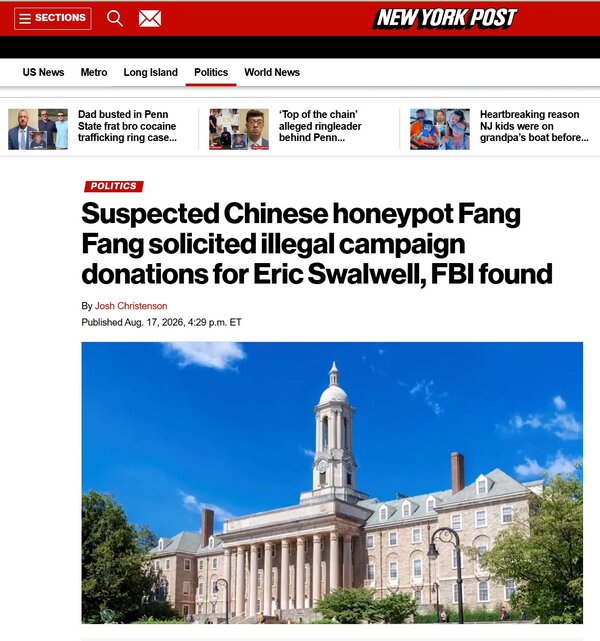
The New York Post reported on August 18, upon the release of these details, that "the most noteworthy aspect of this disclosure is that the FBI did not treat the relationship between Fang and Swalwell as a simple romantic affair." According to the declassified FBI documents, the bureau codenamed the case "Freshman Fifteen" and initiated a full-scale investigation in 2014. A central focus was determining whether Fang, as a non-U.S. citizen, bypassed contribution limits or foreign donor restrictions by using third parties as "conduits"—a scheme where straw donors act as "pipes" to route illicit political funds.
The New York Post further noted that "the FBI concluded Fang was involved in illegal political fundraising on at least four occasions and examined potential violations involving destruction of records, false statements, and unregistered foreign agent activities". "However, no criminal charges were ultimately brought".
A crucial distinction must be made here. As the online outlet Axios pointed out, "Based on the currently available records alone, there is no evidence to conclude that Swalwell acted on behalf of China or passed classified information to the Chinese side". Swalwell has maintained that he was unaware of Fang's illegal activities, severed all contact with her in 2015 upon being warned by the FBI, and cooperated fully with the investigation. Furthermore, the House Ethics Committee closed its own two-year probe in 2023 without taking any disciplinary action.
[The Most Shocking 'Honeypot' Allegations… Was Sexual Intimacy Used as a Tool for Political Access?]
The most explosive revelation in the released files stems from Swalwell’s own statements to the FBI. According to reporting by outlets such as the San Francisco Chronicle that reviewed the declassified files, Swalwell admitted during FBI interviews to having physical relations with Fang on several occasions. The records also include statements describing an incident where Fang came to his apartment late at night, a situation Swalwell said he could not fully recall because he had taken Ambien, a sleep aid.
Even more notable is that the FBI did not initially approach Fang solely as a target of investigation. Reports based on the documents reveal that the FBI attempted to recruit Fang as an informant in 2013 under the operation codename "Rusty Thumbs." After concluding that Fang could not be relied upon as a trustworthy source, the bureau shortly thereafter began scrutinizing her political activities in earnest.
Thus, framing this case as an issue centered on a "woman" misses the point entirely. The real question is whether physical appearance, personal intimacy, and romantic or sexual relationships were deliberately weaponized as tools to gain political access and expand influence. In Axios’s original 2020 investigative report, intelligence officials noted that Fang had established broad networks with politicians and engaged in romantic or sexual relationships with at least two mayors in the Midwest.
[It Didn't End with Sexual Relations… A Network Extending to Interns, Funds, and Political Events]
The true severity of the Fang case lies in the fact that her activities extended far beyond personal relationships with specific politicians. According to Axios’s 2020 investigative report, between 2011 and 2015, Fang embedded herself deep within San Francisco Bay Area political circles, building relationships with politicians, participating in campaign fundraising, and even playing a role in placing an intern in Swalwell’s congressional office. U.S. intelligence officials viewed her actions as a classic example of a long-term political intelligence-gathering operation orchestrated by China to gain access to American politics.
This changes the entire significance of the case. Foreign influence operations do not necessarily begin with an explicit demand to "hand over classified information." They often start subtly—helping with campaigns, connecting donors, arranging events, and making introductions to enter a politician's inner circle. U.S. counterintelligence agencies must remain vigilant because the resulting "access" and long-term personal relationships can themselves be leveraged as intelligence assets. Axios similarly analyzed the case as an example of Chinese intelligence identifying local political figures early in their careers to build relationships before they advance to national prominence.
[Swalwell Later Joined the Intelligence Committee… Was the U.S. Counterintelligence Network Secure?]
A particularly sensitive aspect of this case is that Swalwell subsequently served on the House Permanent Select Committee on Intelligence. His relationship with Fang ended before his tenure on the committee, and to date, no evidence has surfaced showing that Swalwell provided classified information to China. At the time, both Democratic and Republican congressional leadership received defensive briefings from the FBI regarding China's political targeting operations, after which Swalwell severed all contact with Fang.
Yet, this does not mean the counterintelligence concern disappears. As Axios noted, "From the U.S. perspective, the serious concern is that an individual suspected of links to Chinese intelligence managed to get close to a rising politician who could eventually gain access to the nation's highest-level intelligence." Axios added that "the real lesson of the Fang case is not merely checking whether secrets were leaked, but recognizing how early hostile intelligence agencies can identify and approach future power brokers".
[What's More Shocking Is the Absence of Charges]
Regarding this point, the New York Post highlighted that "despite tracking Fang's activities for years, the FBI ultimately did not indict either Fang or Swalwell in connection with this case". "The newly released documents show that while investigators examined illegal political fundraising, destruction of records, false statements, and unregistered foreign agent activities, the case was closed without criminal charges under a determination that included 'national security considerations'".
Axios similarly observed that "the absence of charges is entirely distinct from the absence of national security concerns." The fact that the FBI conducted defensive briefings and notified congressional leadership demonstrates that U.S. intelligence agencies clearly viewed the matter as a counterintelligence concern. At the same time, Axios noted it must be placed on the record that no personal criminal wrongdoing by Swalwell was established, and the House Ethics Committee took no further action.
[Why Disclose It Now? Patel’s Document Push Triggers Controversy]
The timing of the document release has ignited another layer of political debate. The Washington Post reported in March that FBI Director Kash Patel was pushing to declassify and release the years-old investigative files on Swalwell and Fang, assigning FBI agents in the San Francisco field office to review and redact the materials. In response, Swalwell’s legal team sent a cease-and-desist letter warning of potential legal action, arguing that releasing investigative files from a case where no criminal wrongdoing was found amounted to political retaliation.
However, whether the release was politically motivated must be evaluated separately from the gravity of the foreign counterintelligence details contained within the documents. The Washington Post noted, "If there is no evidence that Swalwell committed illegal acts for China, that fact must be acknowledged as such." At the same time, "the fact that an individual suspected of ties to Chinese intelligence established long-term relationships with American politicians and gained access to fundraising, internships, and political events should not be swept under the rug due to partisan bias."
In a related development, Reuters reported that "Swalwell resigned from Congress in April and withdrew from the California gubernatorial race following separate, unrelated allegations of sexual misconduct and assault, which he denied". Following his resignation, the California state government officially announced a special election for the 14th Congressional District scheduled for August 18.
[Why Times Insight]
Treating these FBI documents merely as a "scandal revealing Swalwell’s sexual relationship with a Chinese woman" means missing the core of the issue. The essence of the case is that an individual suspected by U.S. authorities of links to Chinese intelligence gained entry into the American political establishment through diverse channels—student and diaspora organizations, political events, campaign fundraising, intern referrals, personal friendships, and sexual relationships. This long-term approach by Chinese intelligence was precisely what Axios emphasized when it first broke the story in 2020.
What makes this tactic dangerous is that it does not require an immediate operation to steal classified secrets. By approaching politicians during their local careers, assisting in campaigns, introducing contacts, and building trust through political events, the resulting long-term personal relationships become invaluable intelligence assets if those politicians eventually rise to the power centers of Washington. Today's city council member or local politician can become tomorrow's member of the House, Senator, Governor, or Cabinet Secretary.
Therefore, the takeaway for the United States should not stop at attacking a specific politician. The nation must rigorously track illegal foreign political contributions and unregistered foreign agent activities, educate lawmakers and high-ranking officials on foreign intelligence tactics, and tighten counterintelligence safeguards regarding access for interns and external figures in Congress and election campaigns. In particular, when sexual intimacy, financial backing, or political fundraising are intentionally exploited to penetrate political circles under the direction or control of a foreign government, the matter must be treated not as a personal privacy scandal, but as a severe act of foreign political warfare.
Ultimately, the most critical question posed by these ~150 pages of FBI files is not simply "Did Swalwell pass classified information to China?" To date, no evidence supports that claim. Rather, the more vital question is this:
"How was an individual suspected of ties to Chinese intelligence able to penetrate so deeply into the inner circle of a promising American politician?"
And there is a second, even more critical question that the United States must confront:
"Who is the next 'Fang Fang' approaching right now?"
If America fails to find that answer, this case will not remain an isolated scandal from a decade ago. If Chinese political operations against the United States continue to target interpersonal relationships, what America needs to bolster is not partisan mudslinging, but its core counterintelligence network. When evidence reveals individuals approaching politicians on behalf of foreign governments to exert unlawful influence, they must be investigated and held accountable regardless of nationality or political party.
That is why the "Fang Fang files" must be read not as a sordid tabloid scandal, but as a major national security incident for the United States.
-중국 푸단대학교 한국연구원 객좌교수
-전 EDUIN News 대표
-전 OUR NEWS 대표
-제17대 대통령직인수위원회 정책기획팀장
-전 대통령실 홍보기획비서관
-사단법인 한국가정상담연구소 이사장
-저서: 북한급변사태와 한반도통일, 2012 다시우파다, 선거마케팅, 한국의 정치광고, 국회의원 선거매뉴얼 등 50여권