
Update2026.10.24 (토)

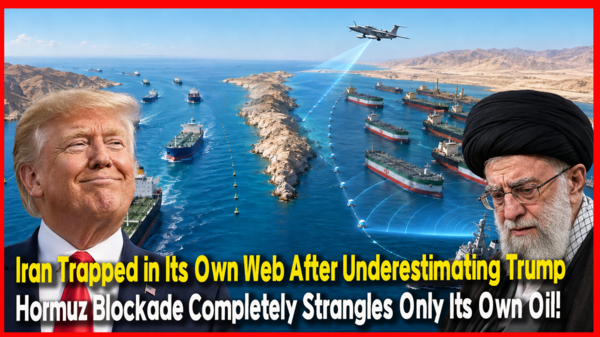
[Iran Fails to Stop Foreign Tankers While US Blockades Iranian Ports… The Paradox of 'One-Way Blockade']
Iran’s high-stakes gamble to hold global energy markets hostage by blockading the Strait of Hormuz is triggering a massive backlash. Tehran believed that closing the strait would plunge the world into panic and force Donald Trump to capitulate first. Parts of the South Korean media also highlighted Iran’s threats and negotiation terms heavily, while largely overlooking the actual real-world impact of the US maritime blockade. However, reality unfolded in the exact opposite direction. While tankers from other oil-producing nations turned off their tracking signals to navigate the strait, Iranian crude targeted by US surveillance remained trapped around Kharg Island. Iran, which sought to blockade the world, got caught in Trump’s counter-blockade—effectively severing its own financial lifeline in a classic case of being hoist by its own petard.
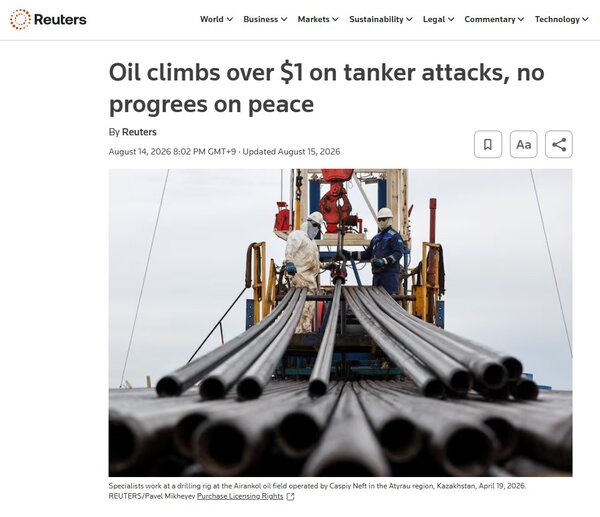
Reuters reported that following the outbreak of war between the US, Israel, and Iran on February 28, traffic through the Strait of Hormuz dropped sharply. As this critical choke point—handling roughly 20% of global oil and LNG shipments—was disrupted, Brent crude surged past $126 per barrel by late April. However, by early July, prices fell to $71.99, and closed at $88.52 on August 14. Although prices remain higher than pre-war levels, considering the prolonged strait blockade and ongoing tanker attacks, the market has largely priced out the worst-case supply disruption scenario. This starkly contrasts with the continuous narrative reported by South Korean media outlets.
This does not mean conditions in the Strait of Hormuz have normalized. Reuters reported that tanker transit effectively ground to a halt in early July, and overall vessel traffic remains severely constrained. However, ships making limited crossings have increasingly adopted "dark voyages," turning off their Automatic Identification Systems (AIS) to hide their tracks. Bloomberg, citing Signal Ocean data, noted that between July 14, when the US resumed its sanctions enforcement against Iran, and early August, 62% of crude and refined product tankers passing through the strait refrained from transmitting position signals for a period. While this does not mean 62% of normal trade volume was transported, it demonstrates that Iran lacks the capability to fully detect or block even the vessels currently making the transit.
Reuters further stated that in May, three Very Large Crude Carriers (VLCCs) carrying a combined 6 million barrels of Middle Eastern crude successfully passed through the Strait of Hormuz. Some vessels disabled tracking signals to evade Iranian surveillance and attacks, relying on complex ownership structures and Chinese or non-Western flags. While the Islamic Revolutionary Guard Corps (IRGC) can pose a substantial threat to Western-flagged or Western-insured vessels, its lack of surveillance and identification capabilities has exposed a glaring weakness: an inability to control the 'dark fleet' utilizing flag-swapping, ownership shifts, and ship-to-ship transfers on the high seas.
[Foreign Ships Slip Through While Iranian Crude Oil Remains Stranded]
In contrast to Iran’s incomplete blockade of the strait, the US counter-blockade is precision-targeted at Iran’s export infrastructure. The Financial Times (FT) reported that since the US reactivated its naval blockade of Iranian ports in mid-July, no new loading activity has been observed at Kharg Island—which traditionally handles roughly 90% of Iran’s crude exports—for a prolonged period following July 31. Satellite imagery from August 4 showed 13 crude tankers anchored off the eastern coast of Kharg Island awaiting orders, but not a single vessel was actively loading at the berths.
United Against Nuclear Iran (UANI) stated that as of July 28, they have not identified any tankers carrying Iranian crude that successfully slipped past the US blockade line in the Gulf of Oman. While it is premature to conclude that Iranian exports are statistically at zero, routine overseas shipments of newly loaded crude have effectively halted. UANI added that the AIS-disabling and ship-to-ship transfer tactics Iran previously used to evade sanctions are proving ineffective against the US military's network of satellites, maritime patrol aircraft, and electronic intelligence. As a result, a bizarre situation has emerged: foreign tankers manage to sneak through in small numbers by taking risks, while Iran’s own tankers lie stranded along its coastline.
UANI explained that in 2025, Iran exported an average of 1.5 to 1.8 million barrels per day (bpd), using oil revenues as a core driver of state finances and foreign exchange. However, during the initial US blockade in May, Iranian oil exports collapsed by 93% month-on-month to an average of just 64,921 bpd. At the time, an estimated 80 million barrels of crude and refined products were trapped behind the blockade line.
Iran has not lost all oil revenue overnight. The FT noted that revenues from cargoes dispatched prior to the blockade currently en route to Asia, alongside remaining crude reserves, provide a temporary buffer. However, if new loadings and monetization remain blocked long-term, crude storage facilities will reach capacity, forcing production cuts. The resulting shortage of foreign currency will pressure the rial and import prices, while weakening the government's ability to fund food and medicine subsidies or pay public sector and military salaries. This is precisely why the US opted for a naval blockade over a large-scale ground war: to steadily drain the regime's capacity to sustain conflict day by day.
[OPEC+ and Bypass Pipelines… The World Prepares for a 'Market Without Iran']
Another reason Iran’s blockade leverage has diminished is that rival producers are stepping in to fill the vacuum. Reuters reported that seven OPEC+ members—including Saudi Arabia, Russia, Iraq, Kuwait, Kazakhstan, Algeria, and Oman—agreed to increase output by an additional 188,000 bpd starting in September. This marks six consecutive months of supply expansion since April. While the volume alone cannot replace the entire flow through Hormuz, it combines with slowing demand growth and rising US crude inventories to ease panic in international markets.
The US Energy Information Administration (EIA) noted that Saudi Arabia’s East-West Pipeline and the UAE’s Abu Dhabi–Fujairah Pipeline can bypass the Strait of Hormuz to transport up to 4.7 million bpd. Though this represents less than a quarter of the roughly 21 million bpd that normally flows through the strait, it acts as a critical shock absorber to maintain Gulf exports.
The EIA added that as Iranian crude disappears from the market, rival producers like Saudi Arabia and the UAE are cementing their market share. The more Iran tries to destabilize the strait, the greater the strategic value and revenue gains for its competitors.
[Hormuz Extortion Backfires as Regime's Financial Crisis]
To be sure, the threat posed by Iran has not vanished entirely. Reuters observed that in August, vessels operated by the UAE's state oil company ADNOC came under attack in succession, and transit volumes remain well below normal levels. The rebound of Brent crude into the upper $80s signals that war and supply disruption risks remain alive. Thus, dismissing the Hormuz blockade as a mere bluff is dangerous. However, while fears that Iran could entirely sever global oil supplies have receded, the reality that the US can selectively suffocate Iranian oil exports has become increasingly clear.
Regarding this, the FT analyzed that Iran is demanding a halt to US strikes, troop withdrawals, and the lifting of sanctions and the naval blockade as conditions to normalize the strait. However, the US has gained far stronger leverage from blockading Iranian crude exports than Iran has from disrupting Hormuz traffic. If Iran retaliates with uranium enrichment or proxy attacks, it provides justification for further military strikes; if the blockade continues, its domestic finances and public livelihood will collapse first. Caught in this dilemma, no option favors Tehran.
[Why Times Insight]
The essence of the Hormuz crisis does not lie in the global oil market completely ignoring Iran's threats. Rather, it lies in the fact that while global markets and the West rapidly find ways to circumvent Iranian threats, Iran has failed to find ways to evade precision US enforcement.
Tehran believed that closing Hormuz would force the world to surrender first. Instead, the world mitigated the shock through bypass routes, production hikes, and dark voyages. Consequently, the blockade aimed at the world transformed into a self-inflicted blockade that strangles Iran's own oil exports and public finances. The Strait of Hormuz is no longer Iran's ultimate trump card, but a giant trap enabling the US to tighten the noose around the regime's lifeline.

-중국 푸단대학교 한국연구원 객좌교수
-전 EDUIN News 대표
-전 OUR NEWS 대표
-제17대 대통령직인수위원회 정책기획팀장
-전 대통령실 홍보기획비서관
-사단법인 한국가정상담연구소 이사장
-저서: 북한급변사태와 한반도통일, 2012 다시우파다, 선거마케팅, 한국의 정치광고, 국회의원 선거매뉴얼 등 50여권