
Update2026.10.24 (토)

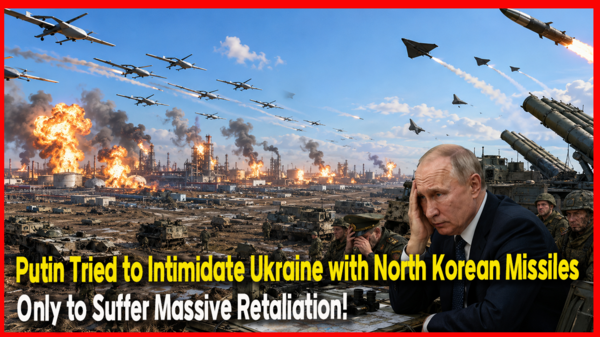
[Russian Rear Ravaged with Every North Korean Missile Strike... Putin’s War of Attrition Reaches Its Limit]
While Russia continues to strike Ukrainian cities using North Korean ballistic missiles and Iranian-designed attack drones, these actions have failed to alter the strategic momentum on the battlefield. Instead, each attempt to target civilian infrastructure is triggering deep, highly precise Ukrainian retaliatory strikes against key military and industrial targets inside Russia. With Russian military casualties hitting a record 42,860 personnel in July alone, Moscow is locked in a classic war of attrition—trading unsustainable manpower and economic capacity for minimal tactical gain.
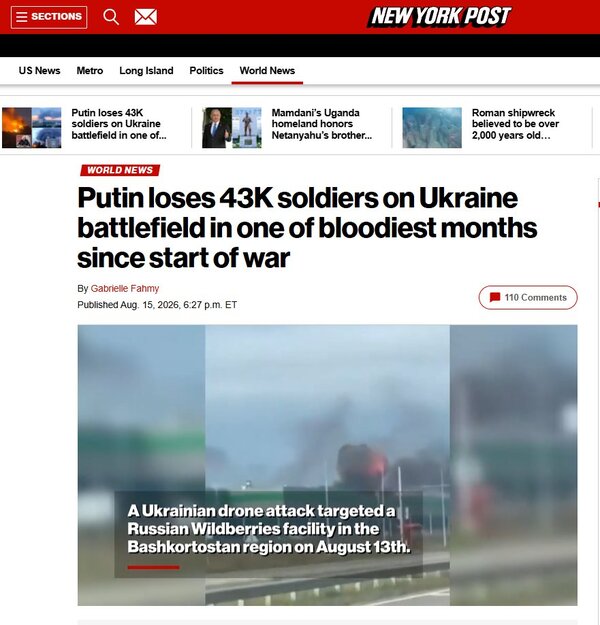
The New York Post reported on the 16th, citing the General Staff of the Armed Forces of Ukraine, that "the Russian military suffered a total of 42,860 casualties, including killed and wounded, on the front lines in July—an average of approximately 1,383 per day." The report noted that "this marks the highest monthly loss since January 2025 and the fourth most devastating month since the full-scale invasion in 2022." The New York Post added that "based on Ukrainian figures, cumulative Russian personnel losses surpassed 1.46 million by mid-August."
The defining characteristic of July’s combat was the overwhelming lethality of drones. President Zelenskyy claimed that "more than 30,000 of the Russian casualties were killed or severely injured by Ukrainian drone strikes." During the same month, the Ukrainian military announced that it had "destroyed or damaged 13,998 Russian vehicles, 2,016 artillery systems, 204 armored vehicles, and 68 air defense systems." The reason Russia continues to deploy small infantry squads rather than large-scale mechanized assaults led by tanks and armored vehicles is that both equipment and manpower are being simultaneously consumed in the face of drone warfare.
The New York Post pointed out that "while casualty figures should not be mistaken solely for total deaths, a monthly attrition rate of 42,860 personnel is staggering in itself." It added, "Even if Russia replenishes its ranks by recruiting new contract soldiers, it cannot fill the gap of experienced officers, non-commissioned officers, and specialized personnel in the short term. In this light, Putin's reliance on high signing bonuses, foreign mercenaries, and North Korean troops—rather than declaring a massive additional mobilization—can be viewed as a political choice to avoid exposing the true cost of the war to Russian society."
[Russia’s Terror Bombing Fails to Break Ukrainian Resolve]
Even while expending vast numbers of troops on the front lines, Russia is intensifying its missile and drone strikes against cities in Ukraine's rear. Despite mobilizing North Korean ballistic missiles and upgraded Iranian Shahed-series drones, the targets include residential areas and civilian infrastructure alongside military facilities. Rather than creating a military breakthrough, this approach aims to instill terror in the Ukrainian public—signaling that "even the rear is not safe"—and exhaust Ukraine's air defense capabilities.
In connection with this, AP reported that "on the 15th, Russia launched 152 attack drones toward Ukraine. While the Ukrainian Air Force announced it neutralized approximately 120 of them, an apartment building in Marhanets, Dnipropetrovsk Oblast, was hit, killing a 3-month-old infant and injuring 11 residents." It highlighted that "the injured included children aged 5 and 12, demonstrating how Russia's long-range strikes—having failed to alter the front lines—are ultimately taking the lives of infants and children."
However, this strategy of terror bombing has invited stronger retaliation against the Russian mainland rather than dampening Ukraine’s will to fight. While Russia attacks Ukrainian residential areas, Ukraine is selectively striking Russian airbases, munitions factories, oil refineries, ports, and naval bases. The selection of targets starkly contrasts Russia's attempt to terrorize civilians with Ukraine's focus on degrading Russia's operational war-making capacity.
[26 Settlements Recaptured... Russia’s Human-Wave Tactics Pierced]
Reuters reported that "the Ukrainian military announced it recaptured 26 settlements and 745 square kilometers across Dnipropetrovsk, Donetsk, and Zaporizhzhia Oblasts through operations conducted since late January in the direction of Oleksandrivka in the southeast." It noted, "This is significant as Ukraine regained the offensive initiative along a 60-kilometer front despite Russia committing massive forces." DeepState, an independent battlefield analysis group, confirmed the liberation of 19 settlements and the repulse of Russian forces in 6 areas.
The Institute for the Study of War (ISW) estimated the liberated area at approximately 627 square kilometers based on open-source footage and geolocational data. Although lower than the Ukrainian government's announcement, the ISW explained that its conservative methodology relying primarily on open-source material could underestimate the actual extent of the advance. Regardless of which figures are applied, the reality remains unchanged that Ukraine has reclaimed territory on a scale rarely seen since 2023, even as Russia continuously pours in fresh troops.
Regarding this, Reuters noted that "of course, because Russian forces also claim advances and control in parts of the southeast, it cannot be concluded that the overall front line has shifted decisively." However, it emphasized that "with the pace of Russia's advance slowing down, Ukraine's successful large-scale territorial recovery has fractured the conventional wisdom that 'time is unconditionally on Russia's side.'" Reuters further stated, "Russia lost tens of thousands of troops without achieving decisive strategic objectives, whereas Ukraine regained localized initiative by combining drones with limited maneuver forces."
[Black Sea Fleet Flees Sevastopol, Only to be Hit in Novorossiysk]
On the 12th, Ukraine attacked the Novorossiysk Naval Base, a key stronghold of the Russian Black Sea Fleet. Naval News, a specialized defense publication, cited Ukrainian announcements stating that "four naval vessels—the frigates Admiral Makarov and Admiral Essen, a Buyan-M class corvette, and the patrol ship Vasily Bykov—sustained varying degrees of damage." It noted, "While full verification requires further assessment as Russia has not disclosed the extent of the damage, satellite imagery analysis suggests significant damage likely occurred to at least two key frigates."
Commenting on this, Ukrainska Pravda explained, "Novorossiysk served as a de facto rear haven after forces were relocated from Sevastopol; striking it there signifies that the Russian Navy can no longer guarantee absolute safety anywhere in the Black Sea." It added, "In particular, the two frigates reported damaged are core surface combatants capable of launching Kalibr cruise missiles, meaning the very missile platforms used to strike Ukrainian cities were targeted directly inside their port."
[Munitions Facilities Struck 900 km Away... Russia’s Rear Disappears]
The scope of Ukraine's retaliation has expanded beyond the Black Sea deep into the Russian interior. AP reported on the 15th that "Ukraine attacked the Progress Rocket Space Center in Samara Oblast and the Savasleyka Air Base in Nizhny Novgorod Oblast, approximately 900 kilometers from the border." It added that "President Zelenskyy confirmed the use of the domestically produced long-range cruise missile 'Flamingo.'" The Progress Center produces Soyuz rockets and satellites, while Savasleyka is known as a main base for MiG-31K aircraft capable of launching Kinzhal missiles.
The core significance of this attack lies in demonstrating that Ukraine is not solely bound by range restrictions on Western-supplied weaponry. If Ukrainian-made long-range weapons are deployed reliably, Russia must stretch its air defense coverage to protect military factories, airbases, and oil refineries hundreds of kilometers behind the front line. A framework has emerged where every missile Russia fires at Ukrainian cities invites retaliatory strikes against the rear facilities in Russia that manufacture, launch, and fuel those weapons.
[50,000 North Korean Troops Rumor... Putin’s Outsourcing of Manpower Shortages]
The New York Post stated, "Russia’s manpower shortage is also evident in its increasing reliance on North Korean troops, with President Zelenskyy claiming that Russia is seeking to deploy an additional 30,000 to 50,000 North Korean personnel." The strategy behind deploying North Korean troops to Russian border regions is to allow regular Russian forces stationed there to be redeployed to the active front lines in Ukraine.
Nevertheless, the political implication of reports regarding additional North Korean deployments is clear. Putin seeks to avoid a massive mobilization that could destabilize Russian society while refusing to abandon the war effort. Ultimately, he is scattering the perceived costs of the war by luring Russian youth from rural regions with high cash bonuses, recruiting foreigners, and delegating personnel shortages to North Korea. This reflects a regime fearful of domestic political backlash that outsources the human cost of war, rather than a confident superpower poised for victory.
[Why Times Insight]
Russia's airstrikes cannot be understated. Ukraine also faces severe burdens, including personnel shortages, dwindling air defense interceptors, and destroyed energy infrastructure, while Russia retains the capacity to recruit new troops and manufacture arms. Therefore, concluding that the Russian military will soon collapse or lose its ability to sustain the conflict based solely on one month of heavy losses would be premature.
However, what is far more critical for Putin is the stark asymmetry between the costs incurred and the results achieved. Despite losing over 40,000 troops in a single month, Russia has failed to break Ukraine's resolve to resist. While terrorizing civilians with North Korean missiles and Shahed-series drones, Russia's return has been the loss of 26 settlements, strikes on its Black Sea Fleet, and deep long-range penetrations up to 900 kilometers into the Russian heartland.
Ultimately, what Putin is maintaining is not the prospect of victory, but the war itself. The moment the conflict ends, he must answer for the failure of the invasion and the immense sacrifices made; thus, he continues to push young Russians and North Korean soldiers onto the front lines. Yet, if this costly exchange continues, manpower will not be the only thing Russia loses first. Its defense industry, energy export networks, Black Sea Fleet, and the political authority Putin has guarded so far could all collapse together.


-중국 푸단대학교 한국연구원 객좌교수
-전 EDUIN News 대표
-전 OUR NEWS 대표
-제17대 대통령직인수위원회 정책기획팀장
-전 대통령실 홍보기획비서관
-사단법인 한국가정상담연구소 이사장
-저서: 북한급변사태와 한반도통일, 2012 다시우파다, 선거마케팅, 한국의 정치광고, 국회의원 선거매뉴얼 등 50여권